Kung Fu and Wushu — The Martial Arts of China
Kung Fu is the umbrella term for over 400 Chinese martial arts — from Shaolin to Wing Chun to Tai Chi, unified by Qi cultivation, Daoist philosophy and relentless practice.
Lineage
Contents
Kung Fu (功夫) — literally “skill acquired through hard work and time” — is not a single fighting style but an umbrella term for the vast spectrum of Chinese martial arts that have accumulated over millennia. More than 400 distinct styles have been catalogued, many of which contain dozens of sub-styles. Wushu (武術, “martial art”) is the modern Chinese term encompassing both traditional systems and the standardised competitive form developed in the People’s Republic of China after 1949.
What unifies all styles is the conviction that physical combat skill and inner cultivation — the development of Qi (气), life energy — are inseparable. Daoism, Chan Buddhism and Confucianism have shaped Kung Fu at a philosophical depth that distinguishes it fundamentally from purely athletic combat systems.
China produced the world’s oldest, most diverse and most philosophically elaborated martial arts ecosystem.
History and Origins
Mythological beginnings: Chinese tradition attributes the origins of martial arts to the Yellow Emperor Huangdi (mythically c. 2697 BCE), who is said to have introduced Jiao Di (horn-butting wrestling). Historically documented combat systems emerge from the Zhou Dynasty military (1046–256 BCE).
Shaolin Temple (495 CE): Emperor Xiaowen built the temple in the Songshan Mountains (Henan Province) for the Indian monk Batuo. The legendary founder of Chan Buddhism, Bodhidharma (Damo, 達磨), is said to have arrived at Shaolin in the early 6th century, meditating for nine years and then teaching the monks movement sequences — the legendary 18 Hands of Lohan, forerunner of Shaolin combat arts. Bodhidharma’s role is historically contested but culturally foundational.
Tang and Song Dynasties (618–1279): Kung Fu refined itself across thousands of regional schools. Weapons practice and unarmed systems developed separately.
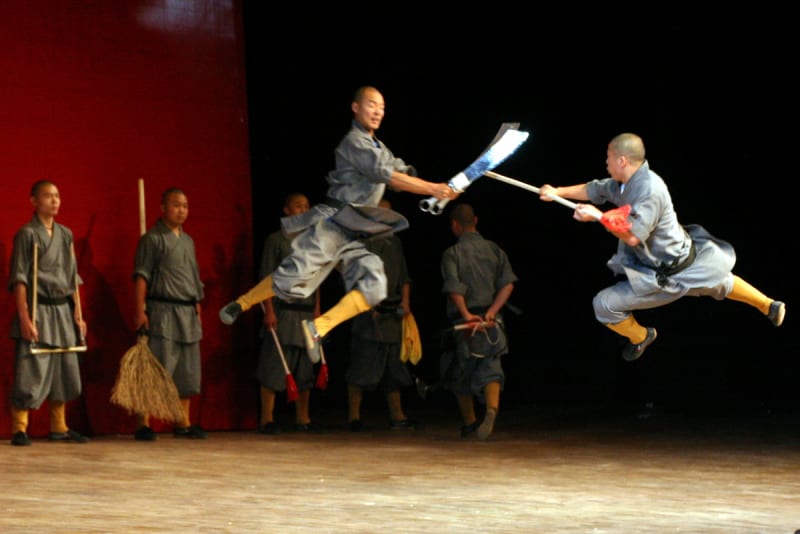
Ming Dynasty (1368–1644): The golden age of Shaolin martial arts. The temple became a national institution. Shaolin monks fought on behalf of the emperor against Japanese pirates (Wokou).
Qing suppression (1644–1912): The Manchu Qing Dynasty frequently banned martial arts practice among Han Chinese. Secret societies such as the Triads preserved Kung Fu underground. The Taiping Rebellion (1850–1864) and the Boxer Rebellion (1899–1901) brought Chinese martial arts back to the surface — with catastrophic results when they failed against modern weapons.
Republican era and reform: After 1912, the Nationalist government attempted to systematise Kung Fu under the banner of Guoshu (国術, “National Art”). After the founding of the PRC in 1949, Wushu was developed as a standardised state sport.
Technical Foundations
| System | Type | Examples |
|---|---|---|
| Shaolin | External, northern | Changquan, Eagle Claw |
| Southern styles | External, southern | Wing Chun, Hung Gar, Choy Li Fut |
| Internal styles | Internal (Qi-based) | Taijiquan (Tai Chi), Baguazhang, Xingyiquan |
| Wushu (sport) | Athletic, performative | Changquan, Nanquan, Taijijian |
| Weapons systems | Armed | 18 traditional weapons |
Northern styles (north of the Yangtze): wide stances, many kicking techniques, expansive movements. The saying goes: “In the north, the legs are like the wind.”
Southern styles (south of the Yangtze): narrow stances, hand and arm techniques dominate, stable low centre of gravity. “In the south, the fists fall like rain.”
Internal vs. external styles: External styles emphasise physical strength, conditioning and speed. Internal styles (Neijiaquan, 内家拳) cultivate Qi, refined force (Jing) and psychophysical alignment.
Core Concepts and Techniques
The Five Animals (Shaolin):
- Dragon — Spiritual force, spiralling movement
- Tiger — External strength, bone conditioning
- Leopard — Speed, endurance
- Snake — Qi flow, flexibility
- Crane — Balance, precision
Wushu competition:
- Taolu (套路) — Forms competition; judged on difficulty, expression and technical precision
- Sanda / Sanshou (散打) — Free fighting; punches, kicks and throws permitted
18 Traditional Weapons: Spear (Qiang), straight sword (Jian), broadsword (Dao), staff (Gun), halberd (Ji), trident (Cha) and more.
Qigong (气功) — Breathing exercises and meditative forms for Qi cultivation; integrated into virtually every Kung Fu system.
Philosophy
Kung Fu is profoundly philosophical — one learns not only how to fight but how the world works.
Daoism: Wu Wei (无为, non-forcing action) — optimal movement arises from releasing effort, not adding more. The flow of water as the paradigm: soft yet penetrating everything.
Chan Buddhism: Mindfulness (Zhengzhi), inner stillness and the unity of practice and enlightenment. The training hall is a meditation space.
Confucianism: Respect for the teacher (Shifu), loyalty, punctuality. The student–master relationship is a moral institution.
“Kung Fu begins and ends with respect.” — Traditional teaching wisdom
Qi (气): Life energy that flows through the body and is cultivated through practice, breathing and willpower. Internal styles make Qi direction the primary combat mechanism: a Tai Chi master develops maximum force from minimal physical movement — not through muscle strength but through Jing (发劲, issued force from internal alignment).
The five relationships — Kung Fu as social code: students owe their Shifu respect equivalent to that owed a father; fellow students are brothers and sisters (Shi Xiong Di Jie Mei).
Key Styles
| Style | Origin | Characteristic |
|---|---|---|
| Shaolin Quan | Henan, 5th century | Foundation of many styles, external |
| Wing Chun | South China, 18th century | Close range, chain punches, Chi Sao |
| Hung Gar | South China | Tiger claw, hard external |
| Tai Chi Chuan | Chenjiadou, 17th century | Internal, slow forms, Push Hands |
| Bagua Zhang | Beijing, 19th century | Circular movement, eight trigrams |
| Xingyi Quan | Shanxi, 17th century | Five elements, direct and linear |
| Eagle Claw | Northern China | Gripping techniques, pressure points |
| Praying Mantis | Shandong | Hook techniques, speed |
| Choy Li Fut | South China, 19th century | Long swinging strikes, combination flow |
Connections to Other Martial Arts
- Judo and Jujutsu — Throwing and joint-locking techniques have parallels in Shuai Jiao (Chinese wrestling) and Chin Na (Chinese grappling)
- Karate — Japanese Karate has Chinese antecedents through the Ryukyu (Okinawan) arts, which were in turn influenced by southern Chinese Kung Fu
- Aikido — Structural similarities with internal styles: Ki/Qi, circular movements, harmony principle
- Muay Thai — Independently developed, but similar knee and elbow techniques appear in southern Shaolin styles
Today — Sport, Heritage and Renewal
The PRC standardised Wushu as a national sport after 1949: uniform forms (Changquan, Nanquan), judging panels assessing aesthetics, athleticism and difficulty. At the 2008 Beijing Olympics, Wushu was a demonstration sport.
Sanda/Sanshou has developed into an internationally recognised full-contact discipline with punches, kicks and throws.
Critique: Traditional masters lament that Wushu sport has abandoned combat effectiveness in favour of aesthetics and acrobatics. Many styles have been “wushu-fied” — visually spectacular, martially hollow.
Renaissance: Simultaneously, Kung Fu is experiencing a global revival: Shaolin monks tour internationally, Wing Chun was popularised by Bruce Lee (and later the Ip Man film series), and Tai Chi is a global wellness and health practice.
Related Articles
- Aikido — Japanese counterpart to the internal styles: Ki, circular movement, harmony
- Judo — Grappling comparison with Chinese Shuai Jiao
- Taekwondo — East Asian martial art in regional comparison
- Grading Systems Compared — why the Chinese arts managed without grades until 1998
- Subak — Qi Jiguang’s Jixiao Xinshu as the demonstrable source of the Korean Gwonbeop
- Changquan — the northern competition discipline — and the family of styles sharing its name
- Nanquan — the collective term for the systems south of the Yangtze
- Wudang — why Shaolin and Wudang are a historical rather than a technical opposition
- Shaolin Kung Fu — the staff is documented from 1610, not the empty hand
- Vovinam — the Vietnamese branch that combined Chinese forms with judo throws
- Wu De — the ethic that stands for this context — and its list is younger than it looks
Further Reading
As an Amazon Associate I earn from qualifying purchases. This costs you nothing extra.