Qigong — Ancient Exercises Under a Name From 1950
The exercises are two thousand years old and documented by a silk painting from 168 BCE. The name dates from 1950 and was made for administration.
Contents
- The evidence for the age: a silk painting from 168 BCE
- What the practices were called before
- 1950: the term is made
- The 1980s: the fever
- 1999 and 2002: reorganised
- The same pattern as nanquan and duanwei
- Technical basis
- What can be said about the effects
- Connections to other martial arts
- Today
- Related Articles
Qigong (氣功) carries a double reputation: on one hand ancient Chinese wisdom, on the other esoteric undergrowth. Both verdicts miss at the same point, and that point can be named precisely.
The exercises really are very old — and for their age there is one of the best pieces of evidence that the history of martial and health practice has to offer.
The name dates from 1950. It was not handed down by monks but coined by a physician working with officials, and it had a purpose: to order the practices so that a state could administer them as medicine.
Hence the thesis of this article:
Qigong is a 20th-century administrative term for a very old body of practice. Anyone asking how old qigong is must separate the two: the exercises are two thousand years old, the category is seventy-five.
The evidence for the age: a silk painting from 168 BCE
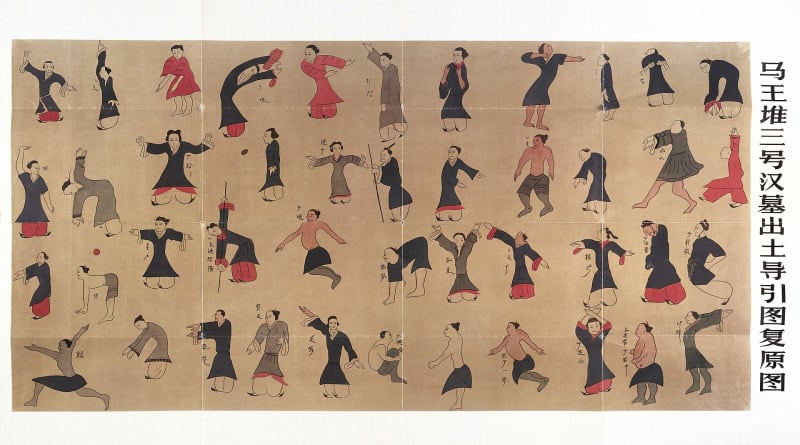
In 1973 a tomb was opened at Mawangdui near Changsha that had been sealed in 168 BCE. Among its contents was the Daoyintu (導引圖), an exercise chart painted on silk with forty-four figures in various postures.
It is the oldest known exercise chart in the world. And it is not a text with a questionable preface, not an attributed manual, not a legend — it is a dated object from a sealed tomb.
This is where qigong differs from most origin claims in this field. For Shaolin kung fu the documentary record reaches back to the 16th century; for Wudang the attribution hangs on a text from 1669. Here there is a painted piece of silk from 168 BCE.
What the chart does not provide: instructions. The forty-four images are static postures with brief captions; how the exercises were performed and how they were linked is not stated. Anyone seeing a reconstruction today is seeing an interpretation — a well-argued one perhaps, but not a transmission.
What the practices were called before
Before the word qigong there was no collective term. There was a whole series of words, each for something specific:
| Term | Literally | What was meant |
|---|---|---|
| Daoyin (導引) | guiding and pulling | physical exercises with stretching and movement |
| Tuna (吐納) | expelling and taking in | breath work |
| Xingqi (行氣) | circulating qi | directing sensation within the body |
| Neigong (內功) | inner work | a collective term for internal practice |
| Neidan (內丹) | internal alchemy | Daoist practice within a religious frame |
| Yangsheng (養生) | nourishing life | the umbrella term for health-oriented living |
| Zhan Zhuang (站樁) | post standing | standing practice |
That there was no common word for all of this is itself a finding: these things were not understood as one subject. They became one when somebody made them one.
On the associated terms: daoyin and tuna appear repeatedly in this corpus as parent arts and are
deliberately left as text — they are practices within this article rather than systems of their own.
1950: the term is made
The decisive figure is Liu Guizhen (1902–1983), a physician regarded as the founder of medical qigong in the 1950s. He established at Tangshan the first sanatorium to use these exercises systematically in clinical treatment.
And here is the sentence that matters: Liu worked with officials to simplify the methods and remove the religious elements — and named the result qigong.
The term is therefore not neutral. It denotes the practices in a particular preparation: secularised, simplified, fitted into a state health system. What had been Daoist internal work within a religious frame was retold as a therapeutic procedure.
Anyone saying today that qigong is a Daoist practice is half right on both counts historically: the exercises come partly from there. The word comes from a hospital.
The 1980s: the fever
In the 1980s and 1990s this became a mass movement that entered contemporary history as qigong fever (气功热). Estimates for its peak range from 60 to 200 million practitioners.
It was carried from high places: senior officials promoted qigong as a specifically Chinese healing tradition and as the harbinger of a new scientific revolution. A flourishing subculture emerged, with masters, magazines, mass gatherings and far-reaching promises of healing.
Precisely that mixture — mass following, quasi-religious devotion and organisations outside party structures — led to the break.
1999 and 2002: reorganised
In 1999 the state moved systematically against qigong organisations seen as challenging state control: a ban on mass practice, closure of qigong clinics, prohibition of individual groups. The trigger with the greatest effect was the action against Falun Gong from July 1999.
From 2000 the field was rebuilt. The Chinese Health Qigong Association was established, and in 2002/2003 it published four standardised sets as state-ordered health qigong:
- Yi Jin Jing (易筋經) — transformation of muscles and tendons
- Wu Qin Xi (五禽戲) — five animal frolics
- Ba Duan Jin (八段錦) — eight pieces of brocade
- Liu Zi Jue (六字訣) — six healing sounds
With that the circle closes, and it is remarkable: the same movement that arose in the 1950s through state standardisation was restored, after the undergrowth of the 1980s, through state standardisation. Twice it was the same measure.
And one detail with particular point: the Yi Jin Jing is one of the four official sets. It is the same 17th-century text whose preface martial arts scholarship has rejected as a forgery — it is the source of the Bodhidharma legend (see Shaolin kung fu). A work with a discredited preface is today a state-standardised health programme. That does not devalue the exercises — it merely shows how independent an exercise’s usefulness is from the authenticity of its origin story.
The same pattern as nanquan and duanwei
Lay this site’s articles side by side and a recurring process appears:
| Year | What was standardised |
|---|---|
| 1950s | qigong emerges as a term; practices unified and secularised |
| 1958 | changquan assembled as a competition style |
| 1960 | nanquan likewise |
| 1998 | duanwei grading introduced (see Grading Systems) |
| 2002 | four health qigong sets standardised |
Five processes, one mechanism: a grown practice becomes an administrable subject as soon as an institution has to order it. For grading systems that was the thesis of a whole article; for qigong it is even the origin of the name itself.
Technical basis
| Element | Expression |
|---|---|
| Breathing | long, open, exhalation clearly longer than inhalation |
| Movement | slow, without terminal stops, mostly standing |
| Attention | on breath, bodily sensation, or a point |
| Repetition | few forms, very often |
| Exertion | low and steady; fatigue is not sought |
| Frame | health, not combat |
Qigong is not a martial art. It appears in this corpus because it cannot be separated from the practice of the Chinese systems — in taijiquan it belongs to the teaching, and in Wudang schools likewise. But it contains no application against an opponent, and schools promising fighting ability from qigong are promising something that is not in it.
What can be said about the effects
Restraint is called for here, in both directions.
One mechanism is documented, and well documented: slow breathing with a lengthened exhalation acts on the baroreflex, whose resonance frequency lies at about six breaths per minute. That is exactly the pace at which qigong breathing moves. It is set out in Breathing Methods Compared — and it is the point at which a centuries-old prescription meets physiology.
The rest is not documented. Reviews of qigong for particular conditions regularly conclude that study quality is low: small groups, absent blinding, short durations. Individual indications of effects on balance and quality of life are plausible and weakly supported. Anyone offering qigong as therapy for a specific illness goes beyond what the data carry.
And the healing promises of the 1980s are the reason for being precise here. The fever of those years ran on claims far beyond respiratory physiology — and it ended in prohibition.
Connections to other martial arts
- Taijiquan — the closest connection; barely separable in teaching
- Breathing Methods Compared — the documented mechanism and its limits
- Ki, Chi and Prana — the conceptual apparatus qigong works with
- Wudang — taught there within the monastic frame
- Shaolin kung fu — connected via the Yi Jin Jing, in a convoluted way
- Changquan and nanquan — the same history of standardisation
Today
In China qigong is a mass participation activity within a state framework, and worldwide one of the most widespread body practices there is — in adult education, clinics, workplace programmes and martial arts schools. The four standardised sets are the basis of most courses; alongside them exist countless lineages with their own forms.
Two questions are useful for practitioners. First: is this a standardised set or a lineage of its own? Both are legitimate, but only the first is verifiably documented. Second: what is being promised? Calmer breathing and better mobility are reasonable expectations. Anything beyond that should be evidenced — and that is usually the point at which things go quiet.