Shuai Jiao — Chinese Wrestling
Shuai Jiao is China's wrestling tradition — throws from the jacket grip, decided standing, and one of the four base categories of Chinese martial arts.
Lineage
Contents
Shuai Jiao (摔跤, “to throw and bring down”) is China’s wrestling tradition and the part of Chinese martial arts that least resembles the Western picture of kung fu. No forms practice, no animal styles, no weapons — instead two wrestlers in short jackets, gripping the cloth and bringing each other down. It is decided standing: whoever first touches the ground with anything other than their feet has lost the bout. There is no ground fighting.
That rule shapes everything. Because no continuation on the ground follows, the throw must succeed immediately and completely, and because both want to stay upright, an unusually dense contest for grip, balance and angle emerges. In the classical division of Chinese martial arts, shuai is one of four base categories alongside ti (kicking), da (striking) and na (seizing and controlling) — wrestling is therefore not a side branch but one of four pillars.
History
Popular accounts trace Shuai Jiao to jiao di (角抵, “butting horns”), an ancient contest in which fighters are said to have worn horned headgear. Jiao di is attested in Han-period sources and images and was at times part of court performance. The widely repeated claim that the art is “6,000 years old”, by contrast, belongs to federation prose: it rests on a legendary attribution to the Yellow Emperor, not on sources.
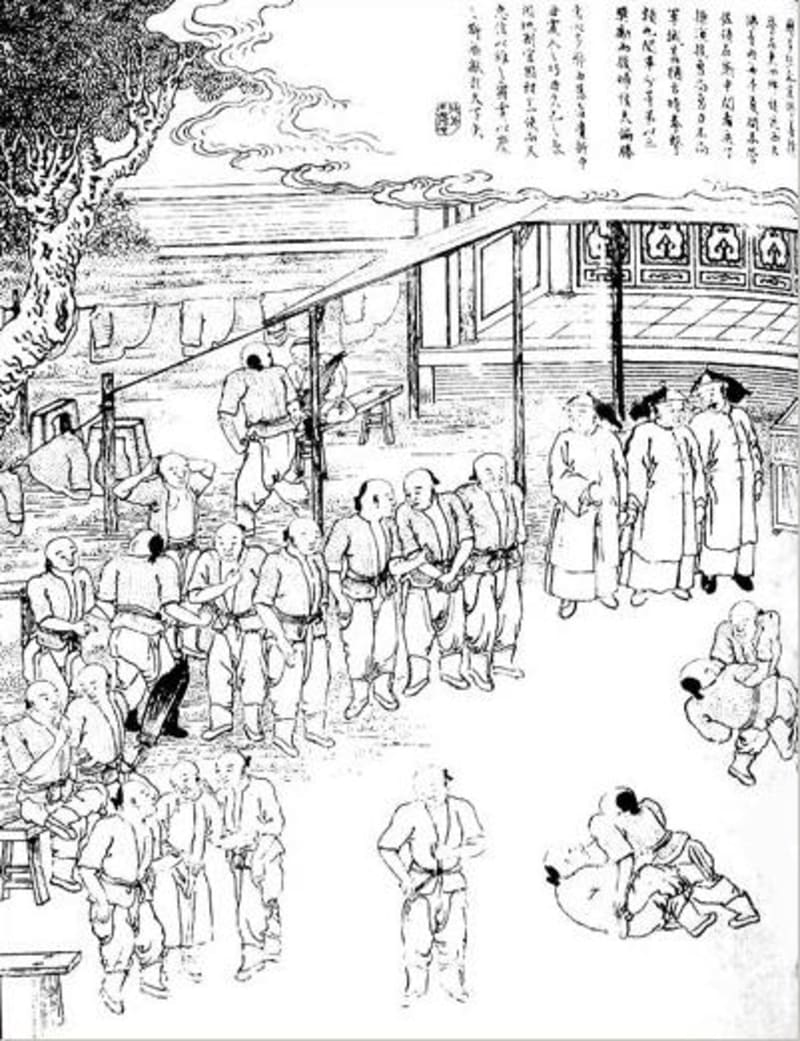
The transmission becomes solid in the Qing period. The imperial court maintained a professional wrestling corps, the Shan Pu Ying, within the Imperial Household Department; under the Kangxi Emperor the techniques were systematised in the late seventeenth century. This unit recruited from Chinese and Mongolian traditions alike — the northern connection is not a later addition but constitutive.
The present name dates from the twentieth century: in 1928 the Central Guoshu Academy in Nanjing introduced the designation Shuai Jiao, as part of the same national modernising project that produced modern wushu. After 1949 Shuai Jiao was organised as a competitive sport and later supplied the throwing technique for sanda, Chinese full-contact kickboxing.
Technical Foundations
Wrestling takes place in a short-sleeved jacket, the da lian, whose sturdy cloth carries the grips; some rulesets add leggings that permit further grips. Bouts are traditionally contested on a raised platform, the leitai.
| Area | Content |
|---|---|
| Grip fighting | collar, sleeve, armpit, belt — the contest begins before the throw |
| Throws | hip, shoulder, leg and pulling throws, often driven through the jacket |
| Leg work | reaps, hooks, blocks — sweeping techniques are central |
| Scoring | points by cleanness and height of the throw; no ground fighting |
A bout ends the moment a wrestler touches the ground. Whoever remains standing receives full score; whoever falls with them, considerably less. From this follows the style’s most distinctive trait: Shuai Jiao wrestlers throw upright. Sacrificing one’s own position, as sutemi-waza does in judo, is not rewarded here.
Core Techniques
- Bie (掤) — leveraging throws over the turned-in arm, steering the opponent’s body around one’s own axis
- Kao (靠) — shoulder and hip strike at close range, related to the principle of the same name in taijiquan
- Leg reaps — sweeping the supporting leg at the moment of weight transfer; technically the heart of the art
- Da bao — a body grip followed by lifting and setting down
- Pull–push reversal — the opponent is pulled one way and thrown the other at the moment they resist; the sport’s basic tactical pattern
Characteristic is the short fighting range and the fact that Shuai Jiao must work without any ground follow-up. Its training forms — partnered single-throw drills, work on the bag and the throwing dummy, stability exercises — almost all aim at the same instant.
Philosophy
Shuai Jiao has no elaborated doctrine comparable to Japanese budō. As part of the Chinese martial tradition it does share its vocabulary: ting jin, “listening” to the opponent’s force through contact, and the idea of redirecting rather than blocking force, are not theory here but practical necessity — anyone working against strength in a jacket grip loses.
Historically Shuai Jiao was simultaneously a professional skill and popular entertainment: the Qing court wrestlers performed at receptions and festivals, while wrestling also took place in markets and teahouses. It shares this dual position — militarily useful and publicly entertaining — with sumo and Turkish oil wrestling.
Styles and Schools
| Style | Region | Character |
|---|---|---|
| Beijing | the capital | rapid grip changes, extensive leg work |
| Tianjin | Hebei coast | power-oriented, direct throws |
| Baoding (kuai jiao) | Hebei | ”fast wrestling”, close range, explosive |
| Shanxi | northwest | no jacket, leg grabs permitted |
| Boke / Mongolian style | Inner Mongolia | its own jacket (zhaogele), related to Mongolian bökh |
The differences are not cosmetic: the jacketless Shanxi style functions technically closer to freestyle wrestling, while the jacket styles sit nearer to judo and sambo.
Connections to Other Martial Arts
- Wrestling — the same basic question, a different answer: Shuai Jiao decides standing, Olympic wrestling rewards the pin on the ground
- Sanda — took over the throwing technique directly; that throws are legal in sanda is Shuai Jiao’s legacy
- Judo and sambo — jacket-grip systems with comparable mechanics, but with ground fighting
- Chin Na — the sibling category na; many Shuai Jiao grips flow into locks
- Mongolian bökh — historically closely interwoven, still present in northern China
- MMA — Chinese fighters bring Shuai Jiao as a throwing base, much as wrestling serves elsewhere
Today
Shuai Jiao is practised in China as a competitive sport in its own right and organised through the International Shuai Jiao Federation in several dozen countries; it is not Olympic. Within China it is a fixture of sports universities and police training.
The picture is mixed. On one hand, Shuai Jiao is the most testable of the Chinese martial arts: it has competition with clear rules, against resisting opponents, without the interpretive latitude that forms practice allows. That is precisely why it enjoys a good reputation among critics of modern wushu. On the other, it suffers from low visibility — internationally it stands in the shadow of judo and wrestling, and domestically competitive wushu has received more support.
The substantive debate concerns its relationship to sanda: because sanda combines Shuai Jiao’s throws with striking, many athletes move there, and Shuai Jiao risks being reduced to the role of a supplier. Equally contested is whether the absence of ground fighting is a tradition worth preserving or a gap — set against BJJ and MMA, it is conspicuous.
Related Articles
- Wrestling
- Kung Fu / Wushu
- Chin Na
- Sanda
- Judo
- Sambo
- MMA
- Throwing — One Principle, Seven Rule Sets — short sleeves, shorter lever
- From Folk Wrestling to Sport — type state programme: the Guoshu Academy gave the name in 1928