Engolo — Capoeira's Cousin, Not Its Mother
A herders' combat game from the Kunene, barely played since 1975. The story that it mothered capoeira is younger than television.
Contents
Overview
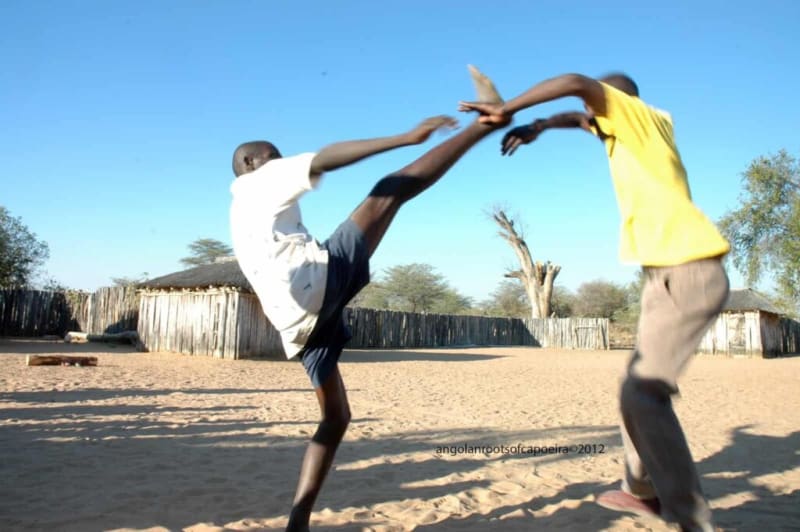
Engolo (also n’golo) is a combat game of the cattle herders on the Kunene in south-west Angola. Two players face each other inside a circle of onlookers who clap, hum and sing; the attacks are almost exclusively kicks, and the defence consists of evasion.
In the martial arts world engolo is known as the ancestor of capoeira. This article examines that claim — and reaches a different conclusion from the one this project’s research backlog expected.
The short version: the game genuinely exists; it has been filmed and described. But the story of capoeira’s Angolan mother can be traced to one person, one place and one decade — to the painter Albano Neves e Sousa and the 1950s and 1960s. And the historian Matthias Röhrig Assunção, whose team has researched engolo most thoroughly, holds the two arts to be cousins, not mother and daughter.
Who plays it
And here stands the finding that makes the whole story wobble.
Engolo is the practice of a single ethnic group: the Nkhumbi. They are a sub-group of the colonial umbrella category Nyaneka-Khumbi, which altogether makes up about four per cent of Angola’s population. None of the other sub-groups — Handa, Mwila, Gambwe — play engolo.
By comparison: slap boxing (khandeka, kambangula) and stick fighting are widespread across the whole of south-west Angola, from the Ovimbundu of the highlands to the Kwanyama in Namibia. Both are general practice, both without any particular spiritual meaning — and both are attested as far as the port city of Salvador, where a British consul described slap boxing in the 1850s.
Engolo by contrast is narrow, late-attested and ethnically bounded. The chief ethnographer of the Angolan south-west, Carlos Estermann, does not mention it once in his three-volume study (1956–61).
What it looks like
The description rests on the fieldwork of the historian Matthias Röhrig Assunção and his team, who between 2006 and 2011 interviewed some fifteen men and a few women in their sixties to eighties — all of them had played before 1975.
| Area | What the players show |
|---|---|
| Basic movement | small jumps, mostly side-on to the opponent, forwards and back — no ginga |
| Kicks | frontal kicks between meia-lua de frente and chapa; circular kicks; one kick like the rabo de arraia; chapa de costa out of a turn |
| Throws | rare; a kind of vingativa with one leg behind the opponent |
| Sweeps | four forms, among them one like the banda and the rasteira — one of them to the knee |
| Defence | five forms: propping on one hand, evading upright, ducking under the kick, entering with the face guarded, jumping away |
| Absent | headbutts, wrestling, groundwork, attacks with the arms |
The arms touch but do not attack. The players stay very close to the opponent, almost adhering — which would be impossible in capoeira, because there it would expose you to the headbutt.
And there is no system of names. Players say mussana (kick), ngatussana (to kick), koyola (to drag). A codified technical catalogue of the sort the Asian arts have does not exist.
The circle without instruments
The game takes place in a circle, accompanied by hand clapping, humming and singing. No musical instrument was used in any of the recordings.
That is the difference that says the most. Capoeira without the berimbau is incomplete — the instrument’s sound sets the tempo and the kind of game. Engolo does without.
The songs are short verses, often from the everyday life of herders. The most important runs:
Wassanwa engolo kalilwa — whoever dies in engolo is not wept for.
This line is the key to the game’s social place. Anyone killed in engolo is buried on the spot, without a proper funeral; his opponent and that man’s family bear no blame. The game thus stands outside the ordinary order — and it explains why not every man was keen to play it.
It was played at the corral beside the homestead, on the riverbanks and on the distant pastures where the herders spent the dry season with the animals. It was not a children’s game: slap boxing was learned from early childhood, engolo mostly only between eighteen and twenty-five.
Kalunga and inversion
The most widespread interpretation comes from the historian T. J. Desch-Obi, who in 1997 was the first to visit engolo players in the Kunene region and made a dissertation and a book of it (Fighting for Honor, 2008).
His thesis: the inverted techniques — kicks in which the player supports himself on his hands — connect to the kalunga cosmology, in which the ancestral world is an inverted world. Standing on your head brings you closer to the ancestors. Desch-Obi dates the art “to the close of the settlement of the Kunene floodplains sometime before the twelfth century”.
That dating does not survive examination, and the objection is concrete.
- Not one primary source before Neves e Sousa’s testimony from the 1950s mentions engolo or describes a combat game with foot kicks in this region.
- Desch-Obi merges sources from different centuries, setting late-20th-century descriptions beside accounts from the slave-trade era that deal with other matters.
- He describes a timeless “Kunene people” with a “pastoral pugilism” — as though the dramatic upheavals of the last two centuries had changed nothing in culture and combat games.
The formal mastership Desch-Obi asserts for engolo is not confirmed by the players either: there was no recognised teacher, only elders who watched and corrected.
The possession practice, by contrast, is well attested. Ancestors can act through the player, and the same holds for the khankula dance and for playing the musical bow mbulumbumba. Engolo thus sits inside a larger cultural context of the Nkhumbi — it is not that context’s only door.
Where the capoeira story comes from
And this is a chain that can be traced year by year.
| Year | What happened |
|---|---|
| c. 1955 | Albano Neves e Sousa, painter and ethnographic collector, draws engolo players in Mucope on the Kunene |
| 1963 | He is in Luanda, where the Brazilian folklorist Luís da Câmara Cascudo gets to know him |
| 1965 | Neves e Sousa travels to Brazil for the first time, sees capoeira in Salvador and is struck by the resemblance |
| 1965 ff. | He puts the idea to the capoeira masters, above all Mestre Pastinha, who adopts it and passes it to his students |
| 1967 | Cascudo takes the engolo story into his book on Brazilian folklore, quoting Neves e Sousa at length |
| 1972 | He adds engolo to the entry “Capoeira” in his Dicionário do Folclore |
| 1980s | The Angola-style schools around the GCAP adopt the story in the orbit of the Brazilian Black Movement |
| 2000 ff. | Desch-Obi builds it into the thesis that capoeira is “nothing more than a slightly altered form of engolo” |
Neves e Sousa had a declared purpose: he was the son of a Portuguese colonial administrator, grew up in Luanda, trained in Porto — and he wanted to show that Angola was the mother of Brazil, culturally as well as biologically.
That puts engolo in the same row as other origin stories in this stock. With hwarangdo a warrior code was built in the colonial period; here an ancestral line was donated by a single painter and certified by folklorists. The difference matters: the practice Neves e Sousa pointed at exists. Only the kinship is his interpretation.
What the comparison yields — and what it does not
| Engolo | Capoeira | |
|---|---|---|
| Basic movement | small jumps, side-on | ginga, swaying |
| Kicks | yes, the core of the game | yes, the core of the game |
| Headbutts | none | yes |
| Wrestling / groundwork | none | yes, especially the Angola style |
| Arms as attack | no | yes |
| Music | clapping, humming, singing | berimbau, orchestra, fixed rhythms |
| Ritual | little; you leave the circle without formality | pronounced; you never turn your back on the opponent |
| Malícia | absent | central |
The correspondence on which everything rests is a single one: the favoured use of the feet, and in particular the circular kick — in capoeira the meia-lua de compasso or rabo de arraia. That kick is rare enough among martial arts for the resemblance to stand out; the comparison of roundhouse kicks shows how differently the movement is built elsewhere.
One detail turns the usual story around. The ground game counts as the most African thing about capoeira Angola. It is entirely absent from engolo — and that is no accident: who would want to kneel on ground full of dung? The ground game probably arose only on the flat stone surfaces of Brazilian port cities. The very feature taken for African inheritance is the most Brazilian one.
The numbers
If engolo contributed anything, somebody had to bring it. The order of magnitude can be estimated:
- For the Nkhumbi one historian’s extrapolation gives about 11,900 people enslaved and taken to the Americas, the great majority to Brazil; for the Nyaneka about 5,700.
- In lists of runaways in Rio de Janeiro for 1810–30 there are more than a dozen people classified as Muhumbe — precisely the word by which the Nkhumbi identify themselves to this day.
- The Nkhumbi arrived late, not before the end of the 18th century.
And that explains a puzzle. Capoeira appears in the written record only around 1800; the earliest mention dates from 1789. If the practice came with a late-arriving, small group, the timing fits.
A small group can form the core of a creole development — there are parallels: the Jeje made up only 3.5 per cent of the Africans taken to Maranhão, and yet “Mina” became the dominant Afro-Brazilian religion there.
Why this stock leaves the ancestor field alone
The capoeira article lists as its predecessor the collective term “African martial arts” — a slug with no article of its own. This project’s research backlog had noted that engolo would be “the concrete answer to that”.
After this research it is not, and entering it would be a mistake.
Assunção, whose team carried out the most extensive fieldwork on engolo, states the relationship expressly as kinship within the same generation — brothers or cousins, not mother and daughter. Anyone writing engolo into the frontmatter as a predecessor asserts exactly what the best available research denies.
The field therefore stays as it is, and this article explains why.
Today
Engolo has hardly been played since 1975. Cunene province was a war zone: the Angolan civil war, the South African incursions from 1978, the occupation of large parts of Cunene in 1980, the withdrawal in 1988, and the war itself until 2002. Anyone wanting to hold a celebration could light no fire and make no noise.
When the researchers arrived in 2010, that became an occasion. In and around Mucope three groups formed, took the game up again and enlisted some younger men. In 2014 the documentary Body Games — Capoeira and Ancestry appeared, recording the movements.
Whether a revival comes of it is open. The younger generations grew up with television and the internet and show little interest in traditional Nyaneka-Nkhumbi culture.
Common fallacies
“Engolo is the mother of capoeira.” At best it is a cousin. The only strong correspondence is the circular kick; headbutts, wrestling, groundwork, arm attacks, instruments and malícia are all absent from engolo.
“Engolo is over a thousand years old.” The first attestation is from the 1950s. Everything earlier is back-projection.
“Engolo means zebra dance, and it is about the right to marry.” That story goes back to Neves e Sousa and from there into the folklore literature. The players interviewed between 2006 and 2011 do not tell it.
“If not engolo, then nothing came from Angola.” A false conclusion. Slap boxing and stick fighting were widespread across the whole south-west and are attested in Brazilian ports — only not as one art with a name and a line.
“Capoeira was disguised as a dance.” That too is interpretation. The Angolan material suggests that the closeness of game, fight and dance is a shared grammar rather than a ruse — the word engolo itself covers dance, culture and custom alike, the players use both okumama (to dance) and okussana (to kick) for what they do, and asked what it is, they answer: a game.
Related Articles
- Capoeira — the art whose Angolan descent is examined here
- Mestre Bimba — whose Regional style pushed back the ground game that engolo does not have at all
- Musangwe — a second African fist fight, attested differently
- Nguni Stick Fighting — the far more widespread combat form in southern Africa
- Sisemba — another African kicking game, independent of the capoeira question
- Roundhouse Kicks Compared — the kick on which the whole resemblance rests
- From Folk Wrestling to Sport — engolo would be the case there with no codification at all
- Hwarangdo — the same construction of an origin story, with a different author
- Dambe — a second African combat game whose attestation begins just as late