Kabaddi — India's Ancient Contact Team Sport
Kabaddi is India's ancient contact team sport — a raider must tag multiple defenders on one breath while chanting 'kabaddi' continuously, and escape before their breath fails.
Contents
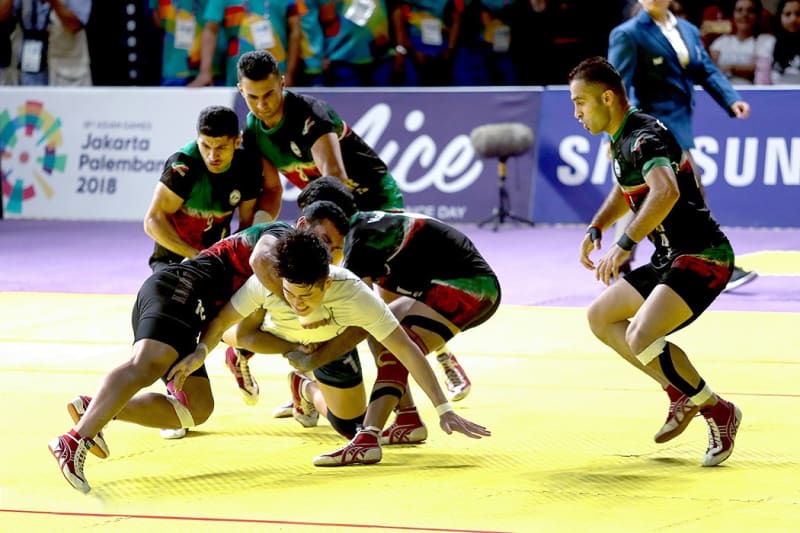
Kabaddi (कबड्डी) is one of the world’s most extraordinary team sports — and possibly one of the oldest. It is the only known contact team sport system in which a single fighter (raider) enters the opponent’s half, attempts to tag multiple opponents, and — in a single breath — returns to their half, while continuously shouting “Kabaddi! Kabaddi! Kabaddi!” aloud. The constant chanting proves the raider is still fighting on one breath — if they stop chanting, they are disqualified. Seven defenders attempt to stop and hold the raider until their breath fails. Kabaddi is a fascinating combination of sprint, grappling, tactics, and breath control — all compressed into a single breath. Historically, Kabaddi connects to Vedic hunting and war techniques; the Mahabharata episode of Abhimanyu’s raid on an enemy camp is cited as an early analogy. Today, with the Pro Kabaddi League (founded 2014), Kabaddi has become a professional sport with a TV audience of millions in India.
History
Vedic Precursors (c. 1500–500 BCE)
Kabaddi reportedly arose in India’s prehistoric past — as a training method for hunters and warriors who needed to quickly penetrate hostile territory, inflict damage, and escape.
The Mahabharata episode of Abhimanyu’s raid on the Chakravyuha formation (a deadly circular military formation of enemies) is cited as a mythological parallel to Kabaddi: a single fighter penetrates a formation he can no longer leave.
Tamil Nadu — The Historical Center
Tamil Nadu is considered the geographical origin center of Kabaddi. The three Tamil dynasties (Chera, Chola, Pandya) reportedly used Kabaddi as a training method for their warriors.
Modern Codification (1921)
1921: First written rules for Kabaddi in Maharashtra.
1938: Kabaddi declared a national sport of India and introduced at the National Games.
1990: First Kabaddi World Championship.
2014: Pro Kabaddi League (PKL) founded — modeled after the Indian Premier League for cricket. The league exploded in popularity: 435 million TV viewers in the first season.
Rules and Game Principle
Teams: Two teams of 7 players each on the field.
Field: Rectangular field divided by a center line.
The Raid:
- The raider enters the opponent’s half
- Must continuously chant “Kabaddi” — on a single breath
- Attempts to touch (tag) one or more defenders
- Must return to their half before their breath ends
Points:
- Raider earns points for each successfully tagged defender
- Defenders earn a point if they hold the raider until their breath fails
Core Techniques
For Raiders:
- Kick Touch — leg kick to a defender for greater reach
- Hand Touch — quick hand touch
- Escaping Holds — breaking free from defender grips
- Ankle Hold — gripping a defender’s ankle to drag them
For Defenders:
- Chain Tackle — collective holding of the raider by multiple players
- Ankle Hold — gripping the raider’s ankle
- Back Hold — gripping the raider’s back
Philosophy
Kabaddi teaches uniquely: breath control as combat principle. The fighter who controls their breath longest wins. This connects Kabaddi to Yoga and Pranayama — the ancient Indian breath control tradition.
“In Kabaddi, the breath is the weapon. Who controls their breath controls the game.” — Kabaddi tradition
Connections to Other Martial Arts
- Malla-Yuddha and Pehlwani — both Indian combat systems share with Kabaddi the emphasis on physical strength and grappling
- Sumo — both are non-Western combat sport traditions with deep cultural anchoring and spectacular live sport
Today
Kabaddi is India’s second most popular sport after cricket. The Pro Kabaddi League has professional leagues in India, Iran, Bangladesh, Nepal, and other countries. International interest grows through the South Asian diaspora.