Kalaripayattu — The Mother of All Martial Arts
Kerala's martial art with the flexible Urumi sword: attested from the 11th century, traced in myth to Parashurama, closely bound to Ayurveda.
Lineage
Contents
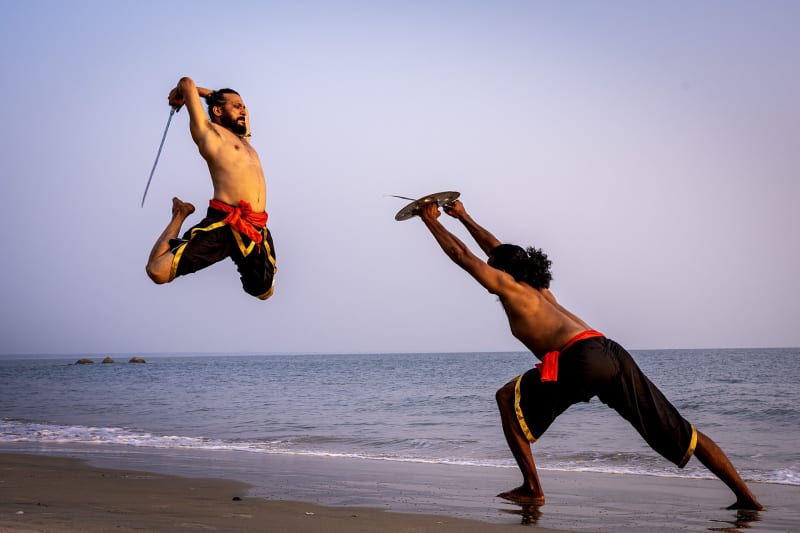
Kalaripayattu (കളരിപ്പയറ്റ്, literally “practice in the Kalari” — Kalari = training room) is considered the world’s oldest martial art — originated in Kerala, the coastal state in southwestern India. With a legendary history of over 3,000 years, Kalaripayattu unites body combat, weapons combat, acrobatic body work, and medical knowledge (Ayurveda) in a unique system. The mythological founder is Parashurama — the sixth avatar of Vishnu and creator of Kerala — who reportedly transmitted the art to 21 Indian masters. The technical pinnacle is the Urumi (ഉറുമി) — a two-meter-long, hair-thin, flexible metal sword that swings like a whip and is one of the most dangerous and difficult weapons in the world. Kalaripayattu influenced many Southeast Asian martial arts (Silat, Muay Boran) according to historians and — following Bodhidharma’s visit to China — possibly also Chinese Kung Fu traditions. This last point is historically contested but culturally widespread.
History
Mythological Dimension
Parashurama (परशुराम) — sixth avatar of Vishnu and legendary warrior-Brahmin — reportedly created Kerala by hurling his axe (Parashu) into the sea and the sea receded. He then taught 21 masters Kalaripayattu as the divine combat knowledge.
This mythology is religiously and culturally significant — it anchors Kalaripayattu in the core of Keralan Hindu tradition.
Historical Documentation (11th–12th century)
The historically confirmed evidence for Kalaripayattu begins in the 11th–12th century — a period when Kerala was locked in constant wars between rival ruling families. Warrior castes (Nairs and Ezhavas) developed Kalaripayattu as their central combat system.
British Colonial Period — Ban and Suppression
The British colonial administration banned Kalaripayattu in the mid-19th century as a threat to colonial order. The art survived in secret Kalari schools (eastern Kerala) and in the guise of ritual performances.
Modern Revival
After Indian independence (1947), Kalaripayattu experienced institutional revival. Masters systematized and spread the art. Today it is taught in Kerala in state-supported Kalari schools.
The Four Training Stages
Kalaripayattu teaches in a fixed progression:
| Stage | Name | Content |
|---|---|---|
| 1 | Maithari | Body control, stretching, jumps, basic movements |
| 2 | Kolthari | Wooden weapons: long staff (Kettukari), short stick, curved stick |
| 3 | Ankathari | Metal weapons: sword, shield, spear, Urumi |
| 4 | Verumkai | Empty hand: grips, strikes, acupressure points |
The progression from wood to metal to empty hand is pedagogically and philosophically deliberate: first safety and coordination, then precision with real blade, then the highest art — controlling the opponent without weapons.
The Urumi — The World’s Most Flexible Weapon
The Urumi (ഉറുമി) is Kalaripayattu’s most iconic element:
- Form: Two-meter-long, hair-thin metal strip — similar to a whip
- Weight: Very light, almost like paper
- Movement: Swings in circular arcs, can strike in all directions
- Damage: Can inflict deep wounds at several meters distance
- Difficulty: Considered one of the world’s hardest weapons to master — dangerous for the wielder themselves
The Urumi is taught only after years of foundational training.
Medicine — Ayurveda Dimension
Kalaripayattu masters (Gurukkal) are traditionally also healers. The system integrates:
- Marmam (pressure points): Knowledge of vital body sites — both for combat and healing
- Ayurvedic massage: Chavutti Thirumal (foot massage using the therapist’s body weight)
- Healing herbs: Traditional oils and herbal treatments for injuries
Philosophy
Kalaripayattu embodies the Indian principle of the unity of Dhanurveda (warrior art) and Ayurveda (life art). The complete Kalaripayattu master heals and fights — with the same body knowledge.
“The best fighter is one who wins without fighting. The best healer is one who heals without healing.” — Kerala Gurukkal tradition
Connections to Other Martial Arts
- Silambam — South Indian sister art; both from Tamil-Kerala tradition; Silambam is staff-focused, Kalaripayattu more comprehensive
- Pehlwani — other major Indian combat system; where Kalaripayattu is striking and acrobatic, Pehlwani is ground combat
- Muay Boran and Pencak Silat — historically possibly influenced; Keralan seafarers carried Kalaripayattu into the Southeast Asian region
Today
Kalaripayattu is state-supported in Kerala and taught in schools. International interest grows through Bollywood films and the global yoga movement (many yoga asanas have Kalaripayattu connections). The Kerala Kalaripayattu Association coordinates training and competition.
Related Articles
- Silambam
- Pehlwani
- Ki, Chi & Prana
- Budo
- Thang-Ta — the second great Indian art with weapons, ritual and healing parts