MMA — Mixed Martial Arts
MMA combines striking, wrestling and ground fighting under one ruleset — descended from Brazilian vale tudo, globally visible through the UFC since 1993.
Lineage
Contents
Mixed martial arts is an attempt to answer an old question empirically: what happens when fighters from different systems meet under a shared ruleset? Punches, kicks, knees, throws, ground fighting and submissions are permitted — what is prohibited is essentially techniques against eyes, throat, spine and groin. MMA therefore covers three ranges that traditional martial arts usually treat separately: stand-up, clinch and ground.
The answer MMA gave in its early years had consequences. The first tournaments showed that a fighter without ground-fighting knowledge stood little chance against a competent grappler — a finding that shook the self-image of many traditional systems and changed training practice worldwide within a decade. Thirty years on, the sport has itself become the answer: anyone practising MMA today learns not an assortment of styles but a distinct, integrated system.
History
The idea is old. From 648 BCE the Greek pankration combined fist fighting and wrestling under minimal rules, and contests between representatives of different arts have occurred in many cultures.
The direct lineage, however, begins in Brazil. After the Japanese jūdōka Mitsuyo Maeda taught there from 1914, the Gracie family developed his ground fighting into Brazilian jiu-jitsu and tested it in open contests — vale tudo (“anything goes”). The Gracie Challenge, an open invitation to representatives of other systems, served for decades as both advertisement and proof.
On 12 November 1993, Rorion Gracie and Art Davie brought this format to the United States: UFC 1 in Denver, an eight-man tournament with no weight classes and no time limit, promoted as a contest of styles. Royce Gracie, at 80 kilograms the lightest serious entrant, won by submission — supplying exactly the argument the event had been designed to make.
What followed was near-extinction. Attacked as “human cockfighting”, the UFC lost cable television access in the mid-1990s and was banned in several US states. Salvation came through regulation: the Unified Rules of Mixed Martial Arts, developed from 2000–01 by the athletic commissions of New Jersey and Nevada, introduced weight classes, rounds, gloves, prohibited techniques and medical oversight. In 2001 the Zuffa group bought the UFC; in 2005 the reality series The Ultimate Fighter made it profitable. In 2016 New York became the last US state to legalise MMA.
In parallel, Japan developed its own scene with Pride FC (1997–2007) under differing rules — knees to a grounded opponent were permitted, which markedly changed fighting style.
Technical Foundations
MMA divides into three ranges, whose transitions are the sport’s real area of expertise:
| Range | Content | Source arts |
|---|---|---|
| Stand-up | punches, kicks, knees | boxing, kickboxing, muay thai, karate |
| Clinch | body locks, knees, throws, cage work | wrestling, muay thai, judo, sambo |
| Ground | positional fighting, ground and pound, submissions | BJJ, catch wrestling, sambo |
Central is the concept of positional hierarchy contributed by BJJ: back control beats mount, mount beats side control, side control beats guard. In MMA this hierarchy shifts, because strikes are legal — the closed guard, serviceable in pure grappling, becomes dangerous once the top fighter may punch.
Bouts run three rounds of five minutes, or five rounds for title fights. Outcomes are decided by KO/TKO, submission (tapping out), judges’ decision, or stoppage by referee or physician.
Core Techniques
- The takedown and takedown defence — wrestling is arguably the single most consequential skill in MMA, because it determines where the fight happens. A fighter who reliably stops takedowns can force the opponent onto their own ground.
- The sprawl — throwing the legs back against a double-leg attempt; the base defence that gave the hybrid “sprawl-and-brawl” style its name.
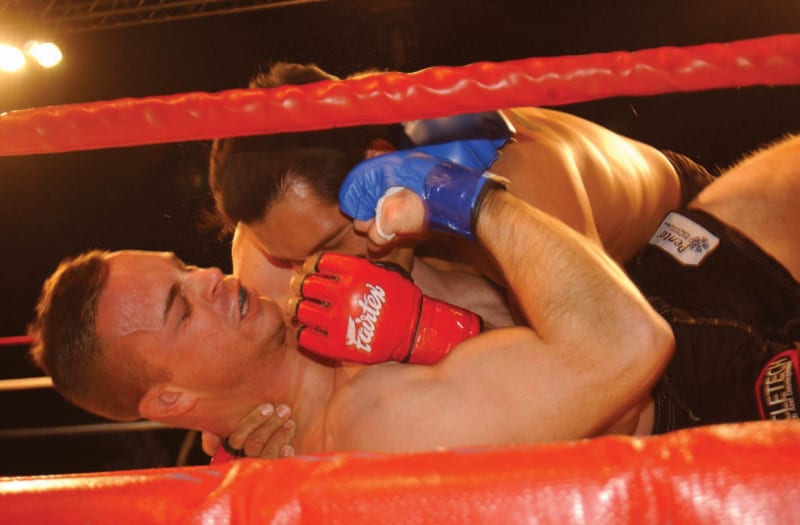
- Ground and pound — striking from the top position. Shaped by Mark Coleman and Randy Couture, and the reason pure sport BJJ does not transfer unchanged to MMA.
- Submissions — rear naked choke, armbar, guillotine, kimura, leg locks. The rear naked choke remains statistically the most frequent finishing submission.
- Cage work — control against the fence, standing up along the wall (wall walk), takedowns from the cage clinch. A technical family that existed in none of the source arts and that MMA itself produced.
Equally important are the transitions: catching a takedown with a guillotine, standing up from the ground without absorbing strikes, striking out of the clinch. It is exactly here that integrated MMA training separates itself from the mere addition of several martial arts.
Philosophy
MMA has no inherited ethic, and that is no accident — it is a late twentieth-century sport born of an intention to prove something. What it has is an epistemic stance: competition is the criterion, and techniques that fail there are discarded.
That stance was articulated before the sport existed. In Jeet Kune Do, Bruce Lee called for keeping what is useful, discarding what is not, and following no style as a system — which is why he is occasionally described as a forerunner of MMA. Historically that is somewhat generous, but it captures the method.
The limits of this stance are equally clear. “Works in competition” means: works under these rules, in this weight class, with gloves, against a single unarmed opponent. The common leap to concluding that MMA is therefore the “most realistic” martial art omits precisely that. Conversely, MMA has made a genuine contribution: it forced an entire generation of martial arts to ask whether their techniques function at all against a resisting opponent.
What has genuinely established itself as a value in the sport is acknowledgement of the opponent — the tap as a gesture of trust, by which a fighter places their wellbeing in another’s hands, is the ethical core of the discipline.
Styles and Schools
MMA has no styles in the traditional sense, but it does have fighter profiles that have succeeded one another historically:
| Profile | Method | Peak period |
|---|---|---|
| Grappler | takedown, positional control, submission | 1993–1997 |
| Sprawl-and-brawl | takedown defence, fighting on the feet | from c. 1998 |
| Ground-and-pound | takedown, strikes from the top | from c. 1997 |
| Complete fighter | offensively and defensively sound in all ranges | from c. 2005 |
The development ran as an arms race: the dominance of grapplers was answered by strikers with takedown defence, and by wrestlers with striking in turn. Since roughly 2005, specialisation alone has ceased to be competitive.
Institutionally the UFC dominates economically; alongside it stand ONE Championship (Singapore, with its own rules permitting knees on the ground in certain formats), PFL with a season structure, which acquired Bellator in 2023 and folded the brand into its own from 2025. The amateur field is organised by the IMMAF.
Connections to Other Martial Arts
- Brazilian jiu-jitsu — the art that triggered MMA; its positional system remains the basis of ground fighting
- Wrestling (freestyle and Greco-Roman) — statistically the most successful background for MMA fighters, because it determines where the fight takes place
- Sambo — the Soviet synthesis of judo and regional wrestling styles; combat sambo is structurally very close to MMA and predates it by decades
- Catch wrestling — the Western submission tradition, which entered the early MMA scene via Japan (Shooto, Pancrase)
- Muay thai and kickboxing — the standard for stand-up fighting
- Pankration — the ancient precursor with a comparable basic idea
- Vale tudo — the Brazilian proto-form; luta livre also emerged in this environment as a rival to the Gracie system
Today
MMA is the fastest-growing combat sport of the past three decades and is regulated and legal in most countries. The Unified Rules apply internationally with variations; the sport is not Olympic and will not be for the foreseeable future — the IMMAF seeks inclusion but is not recognised by the IOC.
Its open conflicts are structural rather than sporting:
- Athlete pay. The share of revenue going to fighters in the UFC is well below what is customary in established US professional leagues. A class action brought by former fighters in 2021 alleging anticompetitive practices ended in a 2024 settlement of 375 million dollars. No athlete representation body exists to this day.
- Weight cutting. Acute dehydration before the weigh-in is widespread, medically hazardous and has already caused deaths. Counter-models such as ONE Championship’s hydration testing exist but are not standard.
- Long-term effects. As in boxing, the question of repeated head impacts arises. MMA bouts are shorter than boxing matches and end early more often, which may lower cumulative risk relative to boxing — but robust long-term studies are still largely lacking, simply because the sport is too young.
As a training form, MMA has established itself independently of competition: a large share of practitioners never compete, valuing instead the combination of athletic conditioning and the experience of testing technique against real resistance.
Related Articles
- Brazilian Jiu-Jitsu
- Boxing
- Kickboxing
- Muay Thai
- Sambo
- Catch Wrestling
- Pankration
- Jeet Kune Do
- Freestyle Wrestling — where the leg attack comes from that decides where a fight takes place
- Bartitsu — the same idea in 1898 — what was missing was the competition to test it
- Bare-Knuckle Boxing — strike and grip were already united once — until 1867
- Shoot-Wrestling — the Japanese link between professional wrestling and early MMA
- Gongkwon Yusul — the Korean answer to the same situation of the late 1990s
- Karl Gotch — the start of the chain that ends in MMA