Pankration — The Total Combat System of Antiquity
Pankration was the ancient Greek total combat sport — introduced to the Olympics in 648 BCE, combining boxing, wrestling, joint locks, and chokes: the oldest precursor to modern MMA.
Lineage
Contents
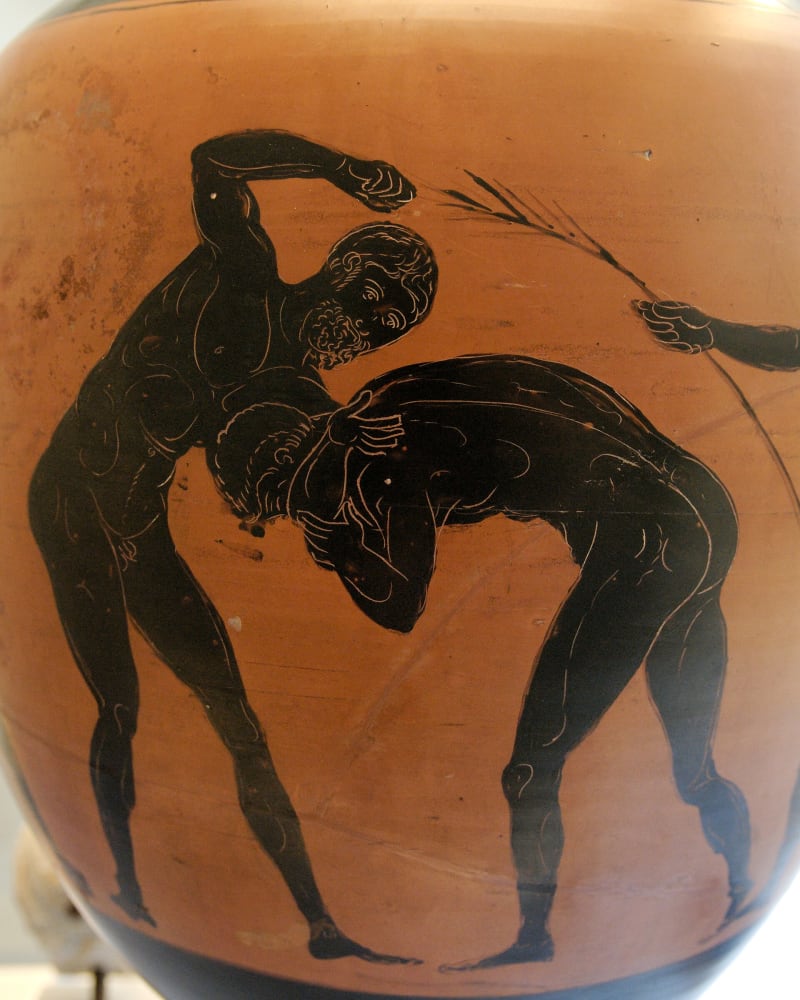
Pankration (Παγκράτιον, “all power” or “total strength”) was the total combat sport of ancient Greece — introduced to the Olympic Games 648 BCE and thus the oldest documented mixed martial arts system in history. Pankration combined boxing (Pygmachia) and wrestling (Pale) into a system with no weight classes, no time limits, and only two forbidden techniques: eye-gouging and biting. Everything else was permitted: kicks, knee locks, chokes, headbutts, strikes to any body part. Most Pankration fights ended by submission — the defeated raised a finger to surrender. In extreme cases fighters died in the arena. Military significance: Alexander the Great preferred Pankration-trained fighters in his forces as the most effective close-combat soldiers. No combat system of antiquity was more comprehensive — and no modern system has fully restored it. Modern MMA is the closest approximation to what the Greeks developed 2,600 years ago.
History
Mythological Origins
The Greeks attributed the invention of Pankration to Heracles and Theseus — both divine heroes who reportedly used all techniques combined in mythological battles. This mythological legitimation anchored Pankration in the culture of heroic Greece.
Olympic Era (648 BCE–393 CE)
648 BCE: Pankration is introduced at the 33rd Olympic Games — initially for adult men, from 200 BCE also in a youth category.
The great Pankration champions became Greek national heroes:
- Dioxippos of Athens (4th century BCE) — three-time Olympic champion, defeated an armed Macedonian soldier in single combat with bare hands
- Arrichion of Phigalia — died during his third Olympic victory, choking his opponent into submission while being killed himself — declared posthumous winner
Military integration: Sparta used Pankration as military training. Alexander’s Macedonian army preferred Pankration-trained fighters for close combat; they accompanied his campaigns to India.
393 CE: Emperor Theodosius I bans the Olympic Games as a pagan ritual — Pankration ends.
Technical Foundations
Pankration knew no technique categories — it was free combat with everything. Historical sources describe:
Standup: Fist strikes (without gloves) · Kicks · Knee strikes · Elbows · Headbutts
Clinch and takedown: Standing throws · Leg grabs · Double-leg takedowns
Ground (Kato Pankration): Chokes · Joint locks on arms and legs · Strikes on the ground · Suffocation
Forbidden: Eye-gouging · Biting (at Olympia; in competitions outside Olympia even these were sometimes permitted)
Philosophy
Pankration was not a self-defense system — it was performance sport and warrior test in one. The Greeks saw physical superiority as an ethical virtue: Kalokagathia (beauty + goodness) — the complete person was simultaneously physically outstanding and morally virtuous.
The Pankratiast embodied the Greek ideal: complete physical competence in a body mastering all combat arts.
“The best fighter is he who can do everything. Not the best wrestler, not the best boxer — but he who masters both worlds.” — Greek athlete philosophy
Neo-Pankration
Jim Arvanitis (USA) is considered the reviver of modern Pankration from 1969 — he attempted to reconstruct historical techniques. In 1973 he appeared on the cover of Black Belt Magazine and brought Pankration to the martial arts scene. Arvanitis’s work is considered a precursor to the MMA movement.
Connections to Other Martial Arts
- MMA — Pankration is the direct historical ancestor of modern Mixed Martial Arts; UFC founders explicitly referenced Pankration
- BJJ — Pankration’s ground system contained submissions; BJJ has most fully developed this area
- Catch Wrestling — parallel development of complete combat systems with submissions
Today
Neo-Pankration exists as a competition sport — regulated by FILA (international wrestling federation) and various Pankration organizations. It remains a niche sport, far from the significance the ancient original held.