Sisemba — The Toraja Harvest Kick-Duel
Sisemba is the traditional harvest kick-duel of the Toraja in South Sulawesi — a communal kick-fighting ritual that settled disputes and celebrated the harvest for generations.
Contents
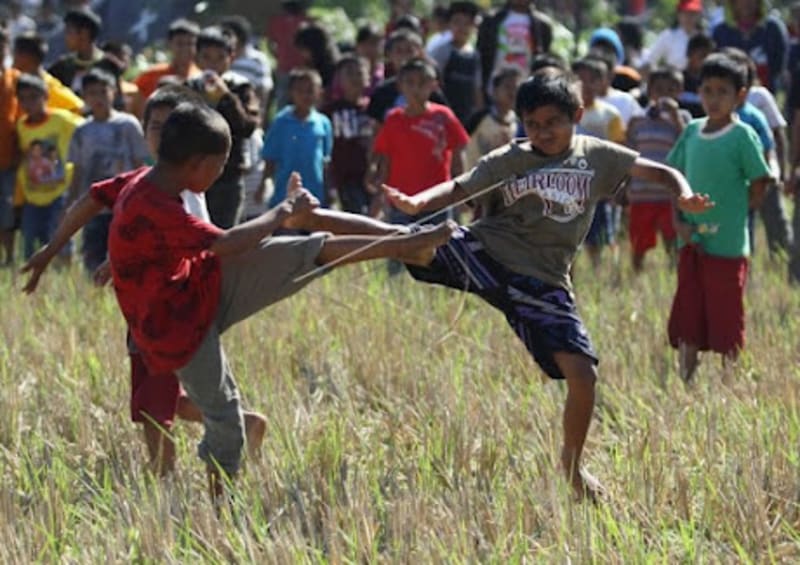
Sisemba is one of the world’s most unusual martial arts — not an individual combat sport, but a community kick ritual of the Toraja (To Raja = “highland people”), an ethnic group in the highlands of South Sulawesi, Indonesia. In Sisemba, two village communities compete against each other — every man of the village participates in massive, chaotic group fights on harvested rice fields. There are no weight classes, no individual matches, no individual winners: the victorious village is the one that through injuries decimates the opposing community until only a few remain combat-capable. Sisemba was originally the only combat form of the Toraja — no Pencak Silat, no wrestling, no other weapon arts exist in traditional Toraja culture. Sisemba was self-defense, dispute settlement between villages, and harvest festival combined. Today Sisemba is a harvest festival spectacle that can last weeks and is contested daily.
History
Origins — The Only Martial Art of the Toraja
The Toraja lived in the difficult-to-access mountains of South Sulawesi in relative isolation. They did not develop an extensive weapons tradition like their coastal neighbors with Pencak Silat — instead Sisemba arose as mass defense: every man of the village fights collectively against any attacker.
This collective self-defense made Sisemba surprisingly effective: an attacking village faced not a single warrior but the entire male population.
Dispute Settlement Function
Sisemba also served as a ritualized means of settling disputes between villages: instead of open warfare, conflicts were decided through Sisemba fights. The village that kept more men standing was in the right.
This semi-ritualized character usually prevented total annihilation — though injuries (especially to the face) remain frequent to this day.
Modern Form — Harvest Festival
Today Sisemba is primarily a harvest festival spectacle. After the rice harvest it takes place on the harvested rice fields — for days, with several hours of combat daily. The audience surrounds the field; village music accompanies the combat.
Technical Foundations
Sisemba is exclusively foot fighting — hand strikes are not permitted. This makes it one of the purest kick-fighting systems in the world.
Combat principle:
- Free kicking to any body part (except downed opponents)
- No grappling
- No palm strikes
Tactics (village level):
- Village-wise coordinated advance
- Attack weaker opponents first
- Group encirclement of isolated opponents
Common target zones: Face · Ribs · Thighs
Philosophy
Sisemba embodies a deep community philosophy: Collective strength over individual excellence. There are no heroes, no individual winners, no personal trophies. The village wins or loses — as a unit.
This philosophy stands in fundamental contrast to almost all other martial arts in the world, which celebrate individual mastery.
“In Sisemba you are never alone. Your village fights with you — even when you stand alone.” — Toraja tradition
Connections to Other Martial Arts
- Pencak Silat — kicking elements overlap; but Pencak Silat is individual and comprehensive, Sisemba collective and purely foot-based
- Lethwei — both are Southeast Asian martial arts without gloves, with high injury tolerance
- Kabaddi — both are community combat sports; Kabaddi is tactically individual, Sisemba chaotically collective
Today
Sisemba is conducted annually at harvest time in Torajaland (Kabupaten Tana Toraja, South Sulawesi). It is a magnet for tourists and anthropologists wanting to observe one of the world’s most unusual living combat traditions.
Related Articles
- Pencak Silat
- Lethwei
- Kabaddi
- Engolo — a second African kicking game, here with the sources fully examined
- Dambe — the hand side of what happens here with the legs