Tahtib — Egypt's Pharaonic Stick Fighting Art
Egypt's stick fighting: depicted as a regulated contest in the New Kingdom, attested as folk practice since Ottoman times, UNESCO heritage in 2016.
Contents
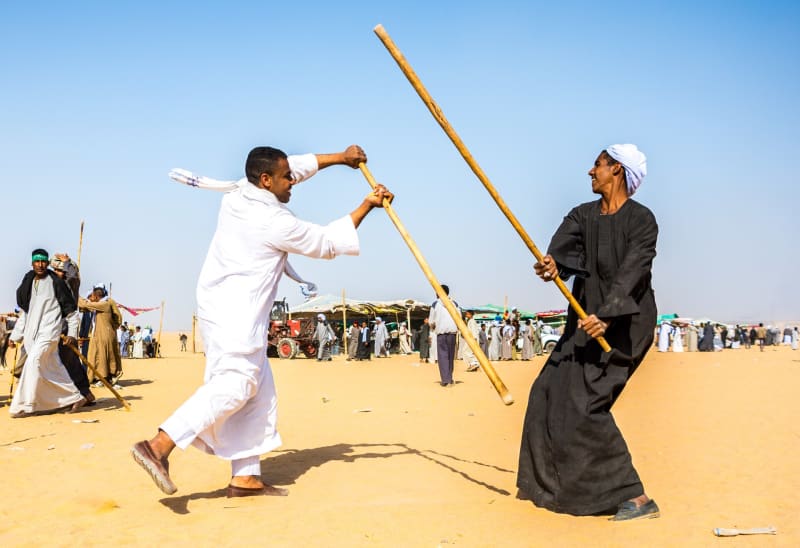
Tahtib (تحطيب, also: Tahteeb) is Egypt’s ancient stick fighting art — and possibly one of the oldest documented martial arts in the world. The earliest pictorial representations of Tahtib were found in the Necropolis of Abusir — tomb paintings from the Old Kingdom of Egypt (~2649–2130 BCE). Over 4,000 years this art was practiced — from Pharaonic warriors to peasant militias to modern athletes. Tahtib uses a long stick (Asa, ~180 cm) guided in large, circular movements. The characteristic: Tahtib is masculine, ritual, and community-building — practiced almost exclusively in Upper Egypt (Saʿid) by men and deeply connected to local identity, weddings, and festivals. In 2016 UNESCO recognized Tahtib as Intangible Cultural Heritage of Humanity. Simultaneously the art is experiencing a modern revitalization as a combat sport with a formalized rule system and twelve standardized forms.
History
Pharaonic Era — The Oldest Evidence
The oldest representations of Tahtib come from the Old Kingdom (~2649–2130 BCE) — tomb paintings in the Necropolis of Abusir show male fighters with long sticks in clear combat posture.
Pharaohs were trained in Tahtib. Reliefs from the tomb of Ptahhotep (Old Kingdom) and from Medinet Habu (New Kingdom) show stick fights as a regular component of military and athletic practice.
What the pharaonic evidence gives is more than a picture. The reliefs at Medinet Habu (New Kingdom, 20th Dynasty, under Ramesses III) show stick fights with a referee holding a trumpet — a contest under fixed rules, not a brawl. And sticks about a metre long were found in the tomb of Tutankhamun. Image, rules and equipment: unusually dense evidence for an art of the second millennium BCE.
What it does not give is the line to the present. Between the New Kingdom depictions and the rural practice of Upper Egypt under Ottoman rule (1517–1798) lie some two and a half millennia for which this article cites no evidence — and the scholarly literature cites none either. Earlier versions of this article stated that Tahtib “survived the Pharaonic era, the Greco-Roman period, and Islam — each era adapted it slightly, but the basic form remained recognizable”. That is a claim, not an observation.
The distinction is not pedantry. A stick is the simplest weapon there is; that people in Upper Egypt fight with sticks need not be transmission from the New Kingdom — it may simply have arisen again. Whoever asserts the continuity carries the burden of proof, and here it is not carried. The article on the Zurkhaneh puts the same question to Iran, with the same result.
What is secure is quite enough: a fighting form demonstrably practised as a regulated contest in pharaonic Egypt, and a living practice in Upper Egypt attested since Ottoman times and inscribed by UNESCO in 2016 as intangible cultural heritage. Two fixed points are worth more than one unsecured line.
Ottoman period and folk culture
Under Ottoman rule (1517–1798) Tahtib is attested as part of the rural folk culture of Upper Egypt, far from the urban centres.
19th–20th Century — Transformation to Folk Dance
With the end of active warrior life, Tahtib increasingly transformed from a combat to a ceremonial art. At weddings, festivals, and religious celebrations Tahtib is today performed as a stick dance — two men moving to traditional music (Tabla, Mizmar), the sticks swinging in ritual patterns.
Modern Revival (20th–21st century)
Adel Boulad is the key figure in the modern Tahtib revival. He formalized the art into a structured combat sport system with twelve forms (equivalent to Kata in Karate) and international competition rules. His work led to UNESCO recognition in 2016.
The Tahtib Stick
The Asa (عصا) — the Tahtib stick:
- Length: ~180 cm (similar to the Japanese Bō)
- Material: Hardwood (traditionally bamboo or cane from the Nile Delta)
- Use: One-handed or two-handed, in circular, striking movements
The Twelve Forms
Adel Boulad’s formalization: 12 Tahtib forms (equivalent to Kata), from fundamental striking patterns to complex combination techniques.
Core Techniques
Circular movements (Dara’a): the stick is guided in large, circular arcs — characteristic and visually impressive.
Double-sided strikes: Left-right alternation in rapid combinations.
Defense techniques: Parries with the stick — blocking opponent’s attacks.
Ground work: In combat form: kicks and body movements complement the stick fighting.
Two Worlds — Dance and Combat
Tahtib exists today in two parallel forms:
| Form | Context | Characteristic |
|---|---|---|
| Traditional folk dance | Weddings, festivals | Ritual, choreographed, to music |
| Modern combat sport | Competitions, training | Technical, formalized, competitive |
Both forms are authentic — and both share the characteristic stick guidance of the ancient system.
Philosophy
Tahtib is masculinity in motion — in the cultural context of Upper Egypt, Tahtib competence is part of male identity. The art conveys dignity, courage, and community belonging.
“The stick in the Tahtib fighter’s hand is not a tool of violence. It is the expression of his soul.” — Egyptian tradition
Connections to Other Martial Arts
- Escrima/Arnis — parallel stick fighting development; Escrima in Southeast Asia, Tahtib in North Africa — both with similar rotation-striking patterns
- Silambam — Indian staff martial art; all three cultures developed staff fighting systems independently
- Bōjutsu — Japanese parallel; interesting convergence without cultural contact
Today
Tahtib is maintained in Egypt as a living cultural heritage. International schools exist in Canada, the USA, the United Kingdom, and France. The 2016 UNESCO status has massively increased global interest.
Related Articles
- Escrima / Arnis / Kali
- Silambam
- Bōjutsu
- Stick Fighting in Eight Systems — combat, festival and dance in the same weapon