Zurkhaneh — Iran's House of Strength
Iran's House of Strength: conditioning, martial arts, music and Shia-Sufi piety in one ritual. Documented since the fourteenth century.
Lineage
Contents
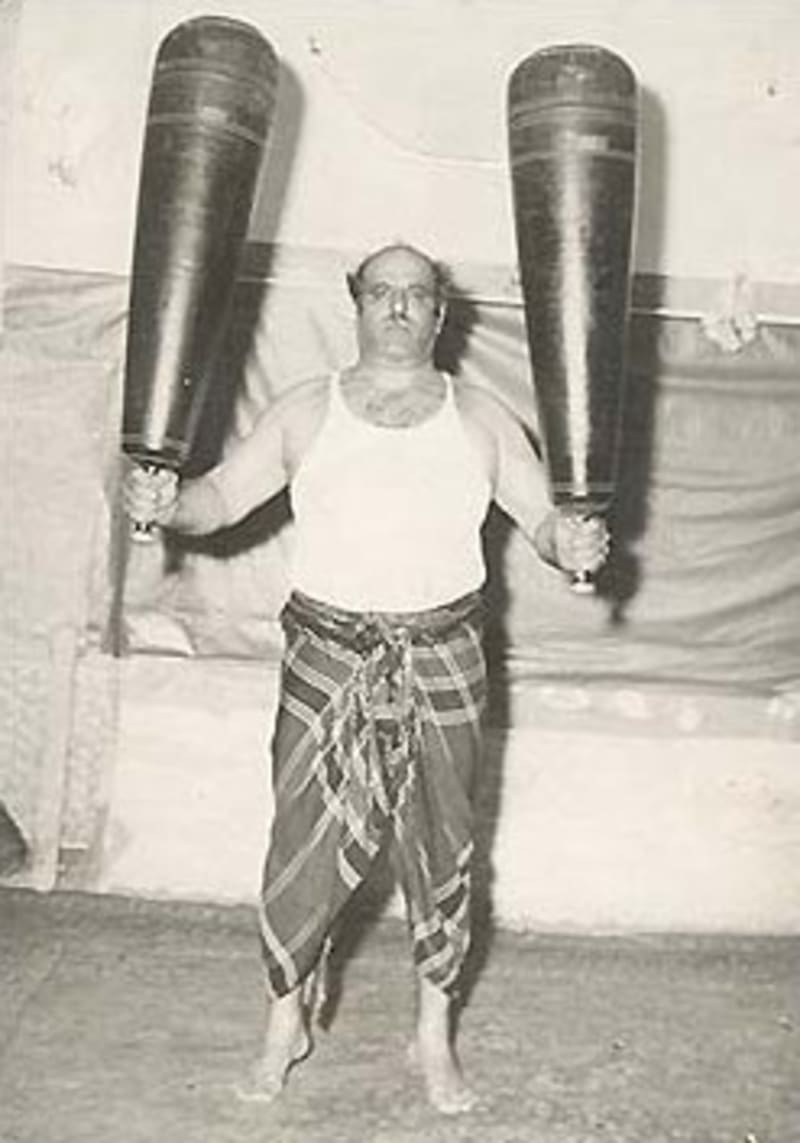
The Zurkhaneh (زورخانه, “House of Strength”) is one of the world’s most extraordinary training systems — an Iranian institution demonstrable since the fourteenth century, in which physical strengthening, martial arts, music, and spirituality fuse into an inseparable ritual. The practice is called Varzesh-e Bastani (ورزش باستانی, “Ancient Sport” or Varzesh-e Pahlavani, “Heroic Sport”). In the Zurkhaneh not only bodies are trained — it is simultaneously prayer room, musical performance, social center, and ethical school. Each training session is accompanied by the Morshed — a singing drummer — whose song and drumbeat set the pace and intensity of training. The trainees (Pahlavans) move in a circle, execute ritual movements with heavy implements (wooden clubs, bow, shields), and conclude with Koshti Pahlavani — traditional Iranian wrestling. UNESCO registers the Zurkhaneh as world heritage under the name “Pahlevani and Zoorkhaneh Rituals.”
History
The claimed origin — and when the claim was made
Almost every account traces the zurkhaneh to the Parthian era (132 BCE–226 CE) and reads its architecture and ritual as a Mithraic inheritance. This encyclopedia carried that dating for a long time. It does not hold up — and the moment the claim arose can itself be dated.
The Encyclopaedia Iranica, in its article ZUR-ḴĀNA, records that until about 1938 the exercise was simply called varzeš-e qadim — the “old sport”. Only afterwards did varzeš-e bāstāni take hold, the “ancient sport”, and that change of a single word asserts a pre-Islamic origin. It falls in the years of Reza Shah Pahlavi, when the Iranian state was deliberately invoking a pre-Islamic heritage.
What is actually documented begins a millennium and a half later:
| Pourya-ye Vali | first figure known by name, 14th century (Ilkhanid period) |
| Tumar | the transmitted code of conduct, a fragment of the Safavid era (16th–17th c.) |
| Height | 19th century under the Qajars; Naser al-Din Shah has bouts held at court for Nowruz |
| UNESCO | Pahlevani and zoorkhaneh rituals recognized in 2010 |
None of this devalues the zurkhaneh. An institution demonstrable since the fourteenth century needs no Parthian ancestors — and the Sufi and Shia layer that actually carries it is far better attested than any Mithraic one. The same construction appears at Hwarangdo and Sibpalgi: a young art acquiring an old pedigree. The Iranian case is the tidiest of the three, because the date of the renaming is known.
The tale of secret resistance (637 CE)
It is widely told that after the Arab conquest of Persia the zurkhanehs became secret centres of resistance, where Iranian warriors kept their skills alive in disguise — hence the sunken pit and the single hole in the roof. There is no contemporary evidence for this either. The story belongs to the same layer as the Parthian dating. The low door and the sunken pit have a plainer explanation: a gesture of humility on entering, exactly as the Tumar’s code of conduct requires.
Safavid Era — Islamic Integration (1501–1736)
Under the Safavid kings the Zurkhaneh was officially merged with Islamic spirituality — particularly Sufi mysticism and Shia piety. The Morshed’s song texts quote Shia prayers and Sufi poetry (Hafez, Rumi).
UNESCO Recognition (2010)
UNESCO recognized Pahlevani and Zoorkhaneh Rituals in 2010 as Intangible Cultural Heritage of Humanity.
The Zurkhaneh — The Sacred Space
The Zurkhaneh is architecturally unique:
- Gaud (training pit): A round or octagonal pit, 1 meter deep in the ground — the training space
- Sardam (musician’s balcony): Elevated seat of the Morshed with drum and microphone
- Dome roof: A single opening in the roof — traditionally the only ventilation and light source
The Training Implements
| Implement | Name | Weight | Function |
|---|---|---|---|
| Wooden club | Mil | 5–50 kg | Shoulder and arm strength |
| Wooden bow | Kaman | variable | Shoulder strength, flexibility |
| Wooden shield | Sang | 20–60 kg | Body strength |
| Chains | Zanburak | variable | Strength and coordination |
Training Sequence
A typical Zurkhaneh session:
- Entry and reverence: All bow upon entering
- Stretching: Guided warm-up to the Morshed’s rhythm
- Mil swinging: Swinging clubs — first slowly, then rapidly
- Sang lifting: Chest shield lifting to the beat
- Kaman exercises: Bow movements
- Koshti: Concluding wrestling
- Recitation and prayer
Philosophy
The Zurkhaneh unites body, mind, and soul in an inseparable unity:
Pahlavani ethics (honor code): Humility · Helpfulness · Courage · Honesty · Respect for elders
The Pahlavan — the worthy fighter — is not merely an athlete but an ethical human. A Pahlavan who does not cultivate character is no true Pahlavan.
“Strength without goodness is tyranny. In the Zurkhaneh, we train both.” — Pahlavani principle
Connections to Other Martial Arts
- Pehlwani — directly related; Koshti Pahlavani (Zurkhaneh wrestling) and Pehlwani share the same Persian origin
- Systema — structurally parallel concept: a complete training system integrating body, mind, and ethics
- Sumo — both combine sport with spiritual rituals and a formalized ethics
Today
Today there are ~500 active Zurkhanehs in Iran. The system is experiencing international interest through the Iranian diaspora. Competitions in Varzesh-e Bastani take place at national and international level.
Related Articles
- Pehlwani
- Ki, Chi & Prana
- Budo
- Koshti Pahlevani — the wrestling with which the session ends