Brazilian Jiu-Jitsu — The Art of Ground Fighting
Brazilian Jiu-Jitsu is the martial art of ground fighting — brought to Brazil by Mitsuyo Maeda, perfected by the Gracie family, immortalized by Royce Gracie at the first UFC.
Lineage
Derived
Contents
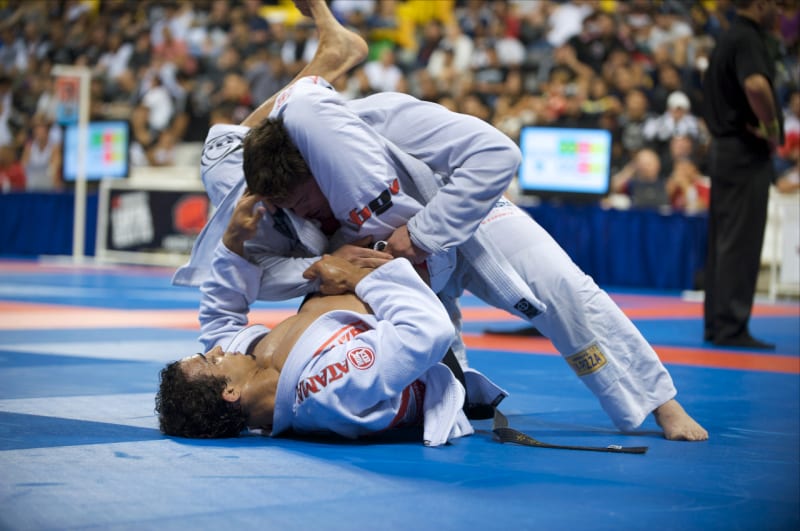
Brazilian Jiu-Jitsu (BJJ, Portuguese: Jiu-Jitsu Brasileiro) is the martial art of ground fighting — the system that in the 1990s, through Royce Gracie’s victories in the early UFC, revolutionized the combat sports world. BJJ teaches how a smaller, weaker person can control and defeat a larger, stronger opponent — through superior positioning and submissions (joint locks and chokes) that force the opponent to tap out. The art arose from the fusion of a Japanese combat tradition with Brazilian creativity: Mitsuyo Maeda (1878–1941), a world-class Kodokan Judo fighter, taught in Brazil. His students, the Gracie brothers, took the system and developed it through decades of Vale Tudo fights (open fights without weight classes) into an independent ground-fighting system. Today BJJ is the foundation of virtually all professional MMA careers and one of the fastest-growing martial arts in the world.
History
Mitsuyo Maeda (前田光世, 1878–1941) was a student of Tomita Tsunejirō, the first student of Judo founder Jigoro Kano. Maeda left Japan in 1904 and toured Europe, America, and finally South America — demonstrating Judo and taking on challengers from every combat sport. He arrived in Brazil in November 1914.
In Belém do Pará, Maeda met Gastão Gracie, who helped him politically. In gratitude, Maeda taught Gastão’s eldest son Carlos Gracie (1902–1994). Carlos opened the first Gracie Academy in Rio de Janeiro in 1925.
The decisive element was Hélio Gracie (1913–2009) — Carlos’ smallest brother. Hélio was physically frail and could not execute many strength-dependent Judo techniques. He began modifying everything — reducing force dependence, increasing leverage and position principles. From this necessity BJJ arose as an independent system: more ground fighting, fewer throws, focus on control and submission.
For decades the Gracies tested their system in Vale Tudo fights — open challenges without weight classes or ruleset. No fight they lost went unanalyzed and unimproved.
1993: Royce Gracie won UFC 1 — a tournament pitting fighters from all combat styles against each other. Royce defeated three opponents in one night, all larger and heavier, through submissions. The martial arts world was shaken — and BJJ became the world’s most sought-after martial art.
Technical Foundations
BJJ is based on a positional hierarchy: not all ground positions are equal. Some give total control, others none. The system aims to achieve the best position and then apply a submission.
| Position | Value | Control |
|---|---|---|
| Rear Mount | Highest | Full control, back |
| Mount | Very high | On top, both sides |
| Knee on Belly | High | Pressure, mobility |
| Side Control | Medium | Lateral, no leg guard |
| Guard | Varies | Bottom, but active |
Core Techniques
Submissions force the tap-out:
- Rear Naked Choke — carotid choke from behind
- Triangle Choke — leg-triangle choke
- Armbar — elbow hyperextension
- Kimura — shoulder rotation lever
- Guillotine Choke — front neck choke
Guard system: The Guard (lying bottom, legs around the opponent) is BJJ’s unique contribution — from this position one can attack while appearing defensive.
Variants: Closed Guard · Open Guard · De La Riva · Butterfly Guard · Spider Guard
Philosophy
BJJ teaches humility through the mat: rank and size are irrelevant on the mat — proof lies in the roll (free sparring). A white belt can dominate an experienced fighter from another discipline; a black belt is challenged daily by another black belt.
The tap-out principle: surrendering is not weakness — it is the mechanism that makes training safe and learning possible. BJJ is a culture of constant learning through failure.
“A black belt is a white belt who never quit.” — a widely circulated jiu-jitsu formula; usually attributed to Renzo Gracie, not Hélio
Belt System
BJJ has its own grading system: White → Blue → Purple → Brown → Black (adults)
Black belt grading typically takes 10+ years — one of the slowest grading systems in combat sports.
Connections to Other Martial Arts
- Judo — direct precursor via Maeda; BJJ took throws but dramatically expanded Ne-Waza (ground fighting)
- Jujutsu — oldest shared root; BJJ is its most ground-based successor system
- MMA — BJJ is the foundation of modern MMA; virtually all top MMA fighters train BJJ
- Wrestling — most important supplement to BJJ; Wrestling provides takedown skills that BJJ alone doesn’t train
Today
BJJ is one of the fastest-growing martial arts worldwide. Estimates cite over 5 million practitioners globally. The IBJJF (International Brazilian Jiu-Jitsu Federation) organizes world championships in all age and weight classes.
No-Gi BJJ (without kimono) and submission grappling are growing particularly strongly in the MMA environment.
Related Articles
- Jujutsu
- Judo
- Budo
- Breakfalls Compared — when the back is not defeat but an attacking position
- Grading Systems Compared — why the IBJJF waives the minimum time for world champions
- Breakfall Programme — a breakfall plan in which nobody throws for the first eight weeks
- Freestyle Wrestling — there the ground is the goal; here it is only a place passed through
- Kosen Judo — the sibling, not the ancestor — the descent story fails on a date
- Hélio Gracie — the co-founder who adapted the system to the lighter body
- Gongkwon Yusul — what the groundwork of a Korean art of 1996 takes its bearings from
- Euclydes Hatem — the man who beat George Gracie in 1940, and the start of the rivalry