Naban — Burmese Grappling
Naban is traditional Burmese grappling — wrestling with joint locks, chokes, and pressure point techniques, a direct descendant of Indian Malla-Yuddha in the Pagan Empire.
Lineage
Origins
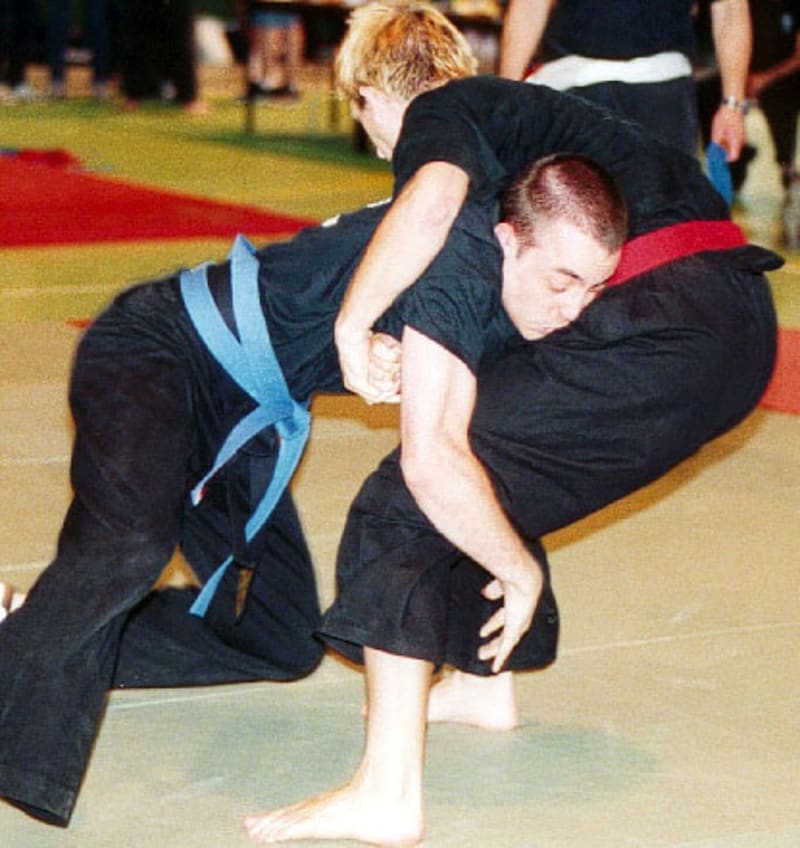
Naban (နဘမ်, literally “wrestling”) is the traditional Burmese grappling system — a comprehensive combat system of throws, joint locks, chokes, and pressure point techniques. Unlike Lethwei (Burmese striking combat) and Bando (the animal style-based unarmed system), Naban focuses purely on ground combat and takedowns — the Burmese equivalent of Japanese Jujutsu or Indian Malla-Yuddha, from which it directly descends. Naban is part of Thaing — the umbrella term for all Burmese martial arts — and forms the grappling pillar of this system, while Lethwei forms the striking pillar and Bando the defensive system. Historically, Naban derives from contact with Indian martial arts in the 11th century, when the Pagan Empire maintained intensive religious and cultural connections with India. During British colonial rule, Naban was banned and survived underground among ethnic minorities (Chin, Kachin, Karen, Shan). After Myanmar’s independence in 1948 it experienced institutional revival.
History
Pagan Empire (11th–13th century)
The earliest evidence for Naban comes from the Pagan Empire (1044–1287) — the first great Burmese kingdom maintaining intensive trade and religious relations with India. Buddhism brought not only spirituality but also cultural practices — including martial arts influenced by Indian Malla-Yuddha.
Wall paintings from the Pagan era show fighters in grappling positions resembling Naban techniques.
Burmese Kingdoms — Military Integration
In the later Burmese kingdoms (Ava, Toungoo, Konbaung), Naban was a fixed component of military training. Soldiers learned Naban as close-combat supplement to weapons training.
British Colonial Period (1824–1948) — Ban and Underground
Like all Burmese martial arts, Naban was banned under British rule. It survived in rural communities and monasteries — particularly among ethnic minorities like the Chin (mountain tribe) and Kachin (northern Myanmar), who preserved Naban as part of their tribal identity.
Independence and Revival (1948–present)
After 1948, Naban was officially rehabilitated as part of the national Thaing system. Today there are national Naban competitions in Myanmar.
Technical Foundations
Naban is a complete grappling system — unlike modernized folk wrestling systems, it permits the full arsenal:
| Category | Techniques |
|---|---|
| Throws | Hip, shoulder, leg throws |
| Joint locks | Elbow, knee, shoulder, wrist |
| Chokes | Neck and arm chokes |
| Pressure points | Attacks on vital body sites |
| Strikes | Palm and foot strikes (in combination with grappling) |
Characteristic feature: Naban permits strikes as part of the grappling system — like historical Malla-Yuddha, but unlike modern Pehlwani. A Naban fighter can deploy strikes to initiate throws or break out of grips.
Connections to Other Martial Arts
- Malla-Yuddha — direct ancestor; through Indian influence in the Pagan Empire; Naban is the Burmese adaptation
- Lethwei — Burmese striking combat counterpart; together Naban and Lethwei form the complete Thaing system
- Bando — third element of Thaing; Bando is defensive-animal style-based, Naban is offensive-grappling-based
- Pehlwani — Indian counterpart; both descended from Malla-Yuddha; Pehlwani is more sport-oriented, Naban more militarily oriented
Today
Naban is contested in national competitions in Myanmar — but less internationally known than Lethwei. The Myanmar Traditional Sports Federation coordinates Naban competitions alongside Lethwei and other Thaing disciplines.