Pehlwani — India's Sacred Wrestling
Pehlwani is India's traditional wrestling — practiced in earthen pits (Akharas), refined under the Mughal Empire with Persian influence, still today both life philosophy and sport.
Lineage
Contents
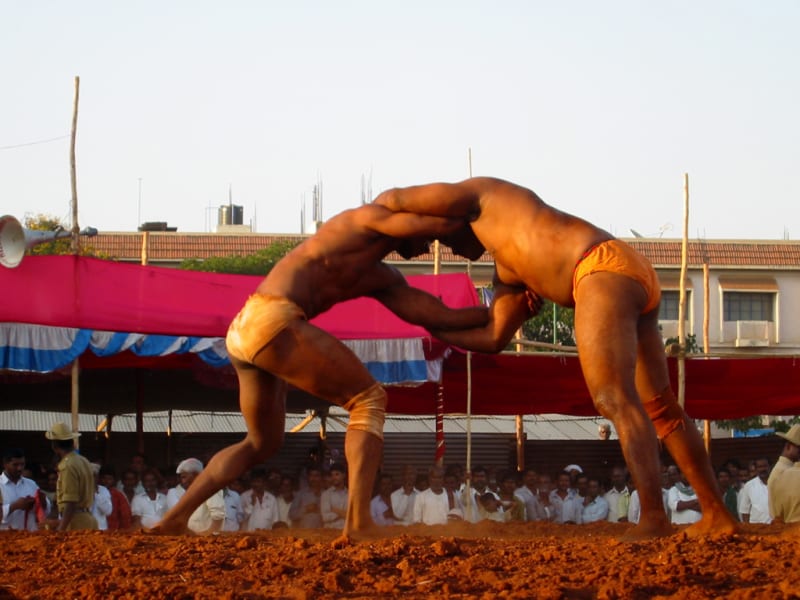
Pehlwani (پہلوانی, also: Kushti, कुश्ती) is India’s traditional wrestling art — one of the oldest still actively practiced martial arts in the world, with roots in the Vedic epics. The name derives from Persian: Pahlavan means “hero” or “warrior.” Pehlwani arose through the fusion of the ancient Indian Malla-Yuddha (warrior wrestling) with Persian Koshti Pahlevani under the Mughal Empire in the 16th–17th century. The result: a wrestling system as unique as the culture from which it arose. Fighters (Pehlwans) train in Akharas — traditional earthen-pit training communities that simultaneously serve as gymnasium, monastery, and community center. Pehlwani is not a sport in the modern sense — it is a life philosophy: strict dietary discipline, abstinence, spiritual practice, and physical conditioning form an inseparable whole. Legendary Pehlwans like The Great Gama (1882–1960) — who remained undefeated for 50 years and is regarded in the West as one of the greatest wrestlers in history — embody this holistic tradition.
History
Vedic Origins — Malla-Yuddha
The oldest evidence for wrestling in India appears in Vedic texts — the Rigveda and Atharvaveda (c. 1500–1000 BCE) mention combat techniques. The epics Ramayana and Mahabharata describe Malla-Yuddha (मल्लयुद्ध, warrior wrestling) extensively: Hanuman fights, Krishna wrestles Jarasandha, Arjuna with Kichaka.
Malla-Yuddha was a comprehensive combat system with strikes, kicks, throws, and joint locks — far more brutal than modern Pehlwani.
Mughal Empire — The Persian Synthesis
Under the Mughal emperors (1526–1857), Malla-Yuddha fused with Persian Koshti Pahlevani into Pehlwani. Emperor Babur (1483–1530), the first Mughal ruler, was himself a wrestler and made wrestling matches court entertainment and festival fixture. This imperial patronage refined the system.
The Mughal Empire introduced Persian concepts: Pahlavani ethics (hero code), the Akhara structure, and the spiritual foundation of wrestling as worship.
The Great Gama (1882–1960)
Ghulam Mohammad Baksh — known as “The Great Gama” — is the most famous Pehlwan in history. He remained undefeated from 1895 until his death in 1960 — over 5,000 matches without a single defeat. In 1910 he defeated the then-world champion Zbyszko Cyganiewicz in London. Bruce Lee admired his training system.
Technical Foundations
Pehlwani is practiced in the Akhara — a circular earthen pit, prepared with:
- Multani Mitti (fuller’s earth): gives the earth consistency and has healing properties
- Turmeric (Haldi): antiseptic properties, worked into the ground
Competition rules: Victory by pin (both shoulders touch the ground) or if the opponent submits. No strikes, no kicks — pure grappling.
| Technique Area | Techniques |
|---|---|
| Takedowns | Leg grabs, body throws, hip throws |
| Throws | ”Dhobi Patchad” (laundryman’s throw) · Shoulder throws |
| Ground control | Pins, locks (without strikes) |
| Grip work | Wrist, shoulder, hip |
Lifestyle — The Pehlwan Code
Pehlwani is more than sport — it is an ascetic way of life:
- Diet: Several liters of milk daily, almonds, ghee (clarified butter), fresh vegetables. Meat consumption is taboo for many Pehlwans.
- Abstinence: Sexual abstinence is traditionally required — as in Sumo (Heya) or ancient Pankration
- Early rising: Training begins before sunrise
- Spiritual practice: Morning prayers, respect for the Akhara ground as sacred space
“The Pehlwan does not seek victory — he seeks character. Victory then comes by itself.” — Akhara tradition
Connections to Other Martial Arts
- Sumo — structurally related: both are folk martial arts with earthen ring, spiritual foundation, and way-of-life character; both arose as court entertainment
- Ssireum — Korean counterpart; similar folk combat tradition, sand arena
- Greco-Roman Wrestling — both are pure wrestling systems; Pehlwani however permits leg techniques
Today
Pehlwani is taught in Akharas across India, Pakistan, and the diaspora. Stars like Sushil Kumar (two-time Olympic medalist) have their origins in the Kushti tradition. But the system faces pressure — modern gyms and western wrestling replace the traditional Akhara culture in cities.
Related Articles
- Sumo
- Ssireum
- Greco-Roman Wrestling
- Koshti Pahlevani — where this wrestling gets both its Persian names — and why only the names came
- From Folk Wrestling to Sport — the comparison’s null case — no moment of codification, and that is the finding
- Laamb — the opposite pole to the null case: codified three times, and ritual all the same