Schwingen — Traditional Swiss Wrestling
Schwingen is Switzerland's traditional wrestling — alpine herdsman's pastime, formalized since 1805, with sawdust ring and jute breeches, today a national sport drawing 90,000 spectators.
Contents
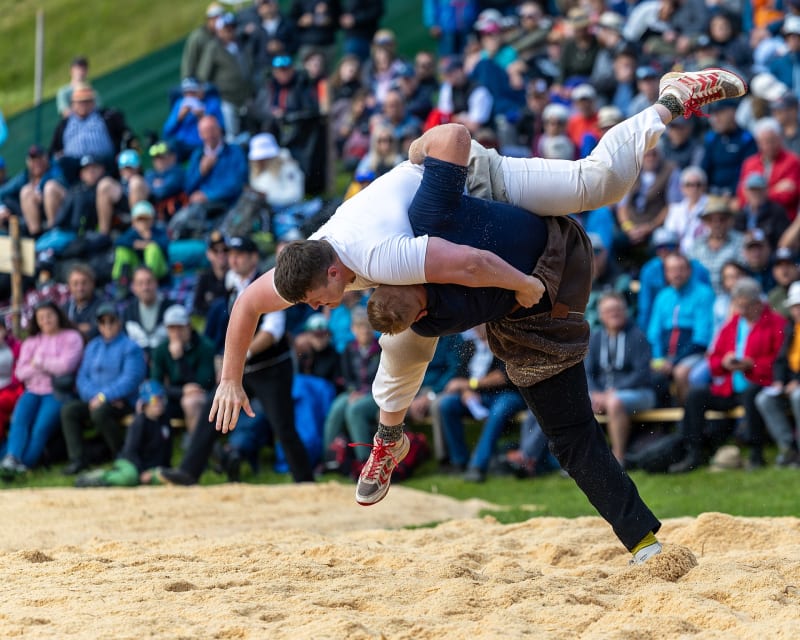
Schwingen (from Swiss German “schwingen” — to swing back and forth) is Switzerland’s traditional wrestling — a folk sport from the pre-alpine regions of German-speaking Switzerland, today counted alongside Hornussen and Steinstossen as one of the three Swiss national sports. Schwingen is visually immediately recognizable: two fighters wear short jute breeches (Schwingerhosen) over their regular clothing and grip each other at the hip area of the breeches. The bout takes place in a circular ring of sawdust — 12 meters in diameter, soft ground, ideal for throws. The goal: throwing the opponent onto their back while maintaining at least one hand on their breeches. The Schwingerkönig (Wrestling King) — winner of the federal Schwingfest — is one of Switzerland’s most celebrated sports heroes. The largest tournament, the Unspunnen-Schwinget (every six years), draws over 90,000 spectators.
History
Alpine Folk Art (Middle Ages)
Schwingen arose as leisure activity of Swiss Sennen — alpine herdsmen and farmers of the pre-alpine region. At village festivals and alp gatherings, the strongest men measured their strength in wrestling. The specific jute breeches grips developed as a practical solution: one grabbed what was available — the opponent’s trousers.
The exact origin time is unknown, but Schwingen was certainly widespread in the alpine cantons before 1800.
Unspunnen Festival 1805 — The Birth Moment
The Unspunnen Festival of 1805 near Interlaken was a cultural-political event: the organizers wanted to ease tensions between urban and rural Swiss populations — through a celebration of alpine folk culture. Schwingen was a centerpiece of this festival.
From then on Schwingen was systematically institutionalized: tournaments, rules, records.
Eidgenössisches Schwingfest
The Eidgenössisches Schwing- und Älplerfest (ESAF) — the largest Schwingen tournament — takes place every three years and is Switzerland’s largest regular folk festival. The Schwingerkönig is crowned here.
Technical Foundations
Combat grip: Both wrestlers grip each other with both hands at the belt area of the Schwingerhosen — right hand in front, left hand at the back (or reversed).
Victory condition: The opponent lies with both shoulders on the sawdust. The winner must keep at least one hand on the breeches — otherwise the throw does not count.
Post-victory tradition: The winner brushes the sawdust from the defeated’s back — a symbol of respect.
Main techniques (with their Swiss German names):
| Technique | Description |
|---|---|
| Kurz | Short hip throw |
| Übersprung | Overstepping throw |
| Wyberhaagge | Women’s hook — leg throw technique |
| Brienzer | Regional specialty throw |
| Hüfter | Hip throw |
Philosophy and Ethos
Schwingen has a strongly developed honor ethos. Fairness is the supreme commandment — wrestlers are disqualified for unfair combat methods. The tradition of brushing sawdust from the defeated symbolizes: the competition is play, not enmity.
Schwingen is deeply connected to Swiss identity — it stands for alpine spirit, groundedness, and popular accessibility. Wrestlers are cultural heroes, not just athletes.
“In Schwingen, the strongest doesn’t win — the cleverest who tries hardest does.” — Swiss wrestling tradition
Connections to Other Martial Arts
- Glima — Icelandic counterpart; both are European folk wrestling arts with grip systems; Glima-Brókartök and Schwingen share the trouser-grip approach
- Sumo — both are culturally deeply-rooted wrestling systems with their own ethos and fixed combat zone
- Judo — technical similarities in hip throws and leg hooks; Judo is however an international sport, Schwingen a folk sport
Today
Schwingen is an active professional sport with national media coverage. Top wrestlers are celebrities in Switzerland. The ESAF regularly draws over 200,000 spectators across three days.
Internationally there are Swiss diaspora Schwingen clubs in Germany, Austria, and overseas.
Related Articles
- Glima
- Sumo
- Greco-Roman Wrestling
- Throwing — One Principle, Seven Rule Sets — the grip sits at the centre of gravity — the shortest lever of the seven
- From Folk Wrestling to Sport — with 1805 the earliest of the seven cases — type national revival
- Laamb — the same fall criterion, but a trigger from 1805 instead of a cinema owner