Aikido — The Way of Harmonious Energy
Aikido is a Japanese martial art that seeks harmony over force — founded by Morihei Ueshiba as a synthesis of Daito-ryu, Zen philosophy and Omoto-kyo spirituality.
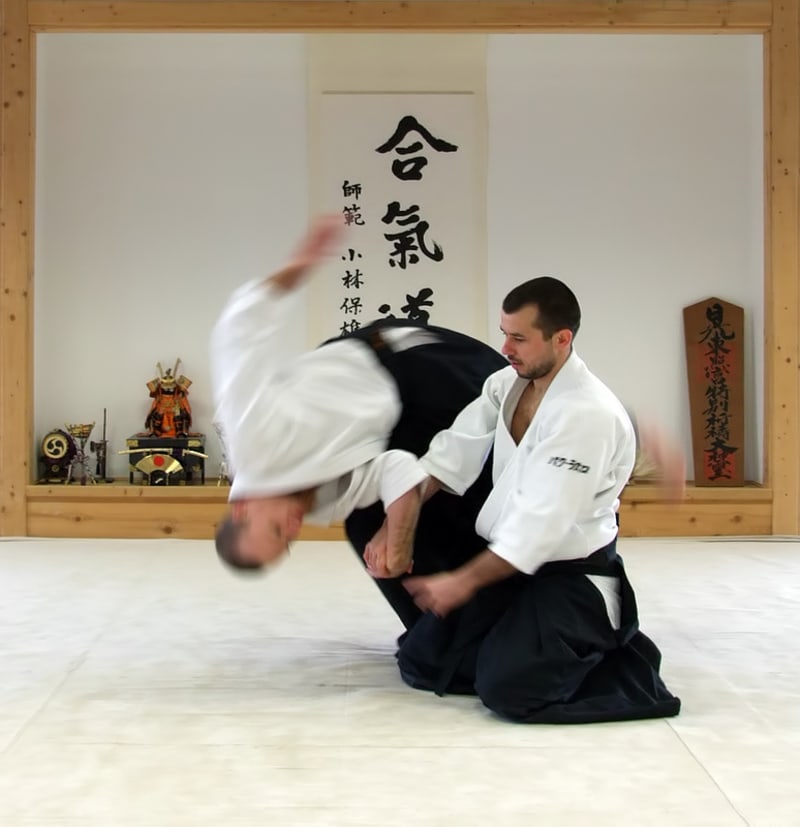
Lineage
Contents
Aikido is a Japanese martial art developed by Morihei Ueshiba (1883–1969). Rather than meeting an attack with opposing force, the practitioner redirects the attacker’s own energy — neutralising aggression without causing serious injury. The name combines ai (harmony), ki (energy or spirit) and do (way): the Way of Harmonious Energy.
Aikido stands apart from most martial arts through its explicitly non-competitive philosophy. There are no tournaments, no rankings by combat record. The practice is a path — physical, ethical, spiritual — that Ueshiba called budo: the martial way as a vehicle for self-development and, ultimately, world peace.
From its origins in early 20th-century Japan, Aikido has spread to over 140 countries. Its fluid joint-locks, circular throws and emphasis on non-resistance have attracted practitioners who seek a martial art aligned with the values of compassion and non-violence.
Morihei Ueshiba — O-Sensei
Born in 1883 in Tanabe, Wakayama, Ueshiba was a sickly child who drove himself toward physical mastery. He studied sumo, various jujutsu schools, kenjutsu (swordsmanship) and spear fighting.
1915 — He encountered Sokaku Takeda, grandmaster of Daito-ryu Aiki-jujutsu. This meeting provided the technical core of what would become Aikido. Ueshiba studied intensively under Takeda for years.
1919 — He joined the Omoto-kyo spiritual community under Onisaburo Deguchi, spending nearly a decade there. The spiritual dimension of Aikido — its ethics, its universalism — crystallised during this period.
1925 — After a practice encounter with a naval officer, Ueshiba experienced a profound spiritual awakening: “A golden spirit sprang from the ground… The universe itself is my home.” His art became progressively softer, more circular, more philosophical.
1942 — The name “Aikido” was officially adopted. Ueshiba continued teaching until his death on 26 April 1969, aged 85.
After the war the occupation administration banned the martial arts; Ueshiba withdrew to Iwama in Ibaraki prefecture and went on working there. In 1948 the ban was lifted and the foundation re-registered under the name Aikikai. Expansion abroad began shortly afterwards: in 1951 Minoru Mochizuki travelled to France — aikido’s first appearance in the West — and in 1953 the Hombu sent Koichi Tohei to Hawaii, where he established the first dojos. That is regarded as the formal introduction of aikido to the United States.
Technical Foundations
| Aikido Technique | Daito-ryu Origin | Principle |
|---|---|---|
| Ikkyo | Ippondori | Shoulder/elbow control |
| Nikkyo | Kotezume | Inner wrist lock |
| Sankyo | Makizume | Spiral rotation |
| Kotegaeshi | Kotegaeshi | Outward wrist turn |
| Shihonage | Shihonage | Four-direction throw |
Aikido preserves the joint-lock and throwing repertoire of Daito-ryu but removes competitive randori and restructures training around cooperative kata: practitioner (tori) and receiver (uke) work together to refine movement quality.
Core Techniques
Irimi (入り身) — Entering directly into the attacker’s space; decisive, forward movement.
Tenkan (転換) — Rotating pivot away from the attack line; flowing, indirect redirection.
Kyo control forms: Ikkyo · Nikkyo · Sankyo · Yonkyo · Gokyo
Throwing forms: Iriminage · Kotegaeshi · Shihonage · Kokyunage
Weapons: Bokken (wooden sword) · Jo (127.5 cm staff) · Tanto (knife)
Philosophy
Ki (気) — Life energy, directed and redirected rather than blocked or overcome.
- Mushin (無心) — Mind free of fixation; open, responsive awareness
- Fudoshin (不動心) — Immovable mind; inner stability under pressure
- Zanshin (残心) — Sustained awareness after a technique; no relaxation of attention
“If you think that Budo means to have opponents and enemies and to be strong and defeat them, you are mistaken. The true spirit of the martial arts is to be one with the universe and have no enemies.” — Morihei Ueshiba, recorded in Kisshōmaru Ueshiba, Aikido (1985)
Styles and Schools
| Style | Founder | Year | Characteristic |
|---|---|---|---|
| Aikikai | Kisshomaru Ueshiba | — | World’s largest organisation |
| Yoshinkan | Gozo Shioda | 1955 | Sharper, used in police training |
| Shodokan | Kenji Tomiki | 1967 | Includes randori and competition |
| Iwama-ryu | Morihiro Saito | — | Weapons-body integration |
| Ki Society | Koichi Tohei | 1974 | Ki development as primary focus |
Connections to Other Martial Arts
- Judo — Shared Jujutsu roots; Kano and Ueshiba were contemporaries who knew each other
- Yoseikan Budo — the earliest offshoot, and it appeared almost simultaneously: Minoru Mochizuki (1907–2003) was Ueshiba’s uchi-deshi from November 1930 to August 1931 and built his own dojo in Shizuoka in November 1931. He was also a direct student of Kano and Funakoshi — his system combines Aikidō, Judo and Karate, while Ueshiba was still working out Aikidō itself
- Hapkido — Sister art: Choi Yong-sul studied under Sokaku Takeda, the same source as Ueshiba
- Tai Chi Chuan — Independently developed yet structurally related: yielding, circular motion, internal energy
- Daito-ryu Aiki-jujutsu — Direct technical parent; Aikido is its most widely practised descendant
Today — Reach and Critique
Aikido has approximately 1.5 million practitioners worldwide. Its non-competitive, inclusive character makes it accessible to people of all ages and builds.
Critique: Aikido’s cooperative training model — where uke (the attacker) takes falls cooperatively — raises recurring questions about combat effectiveness. Critics argue that techniques practised only against compliant partners may not transfer under genuine resistance. Several high-profile practitioners have publicly tested Aikido against resisting opponents with mixed results.
Strength: Aikido’s emphasis on posture, breathing, spatial awareness and non-escalation makes it a valuable complement to more combative systems — and a complete practice in its own right for those drawn to its philosophy.
Related Articles
- Judo — shared Jujutsu heritage, different competitive philosophy
- Daito-Ryu Aiki-Jujutsu — the art Ueshiba came from
- Hapkido — sibling art through the same teacher
- Bushido — the code Ueshiba appealed to
- Jujutsu — the genus Daito-Ryu, and through it Aikido, came out of
- Morihei Ueshiba — the founder
- Ki, Chi and Prana — the concept Aikido is built on
- Kyokushin Karate — the philosophical opposite: full contact, no yielding
- Breakfalls Compared — why the high fall is a consequence of the grip, not showmanship
- Shu-Ha-Ri — the art in which the model is most widely used
- Maai — ma-ai and the deliberate entry into the opponent’s reach
- Breakfall Programme — the body line below the head as an exercise in its own right
- Dō and Jutsu Compared — the special case without a generic predecessor, renamed in 1942 in the middle of the war
- Takeda Sōkaku — the step before, documented in fee ledgers: the aiki in 1922, the dō in 1942
- Shorinji Kempo — the other post-war art that puts education before competition
Further Reading
As an Amazon Associate I earn from qualifying purchases. This costs you nothing extra.