Judo — The Gentle Way
Judo is the martial art of the gentle way — founded in 1882 by Jigoro Kano, an Olympic discipline since 1964, built on maximum efficiency through throwing and groundwork.
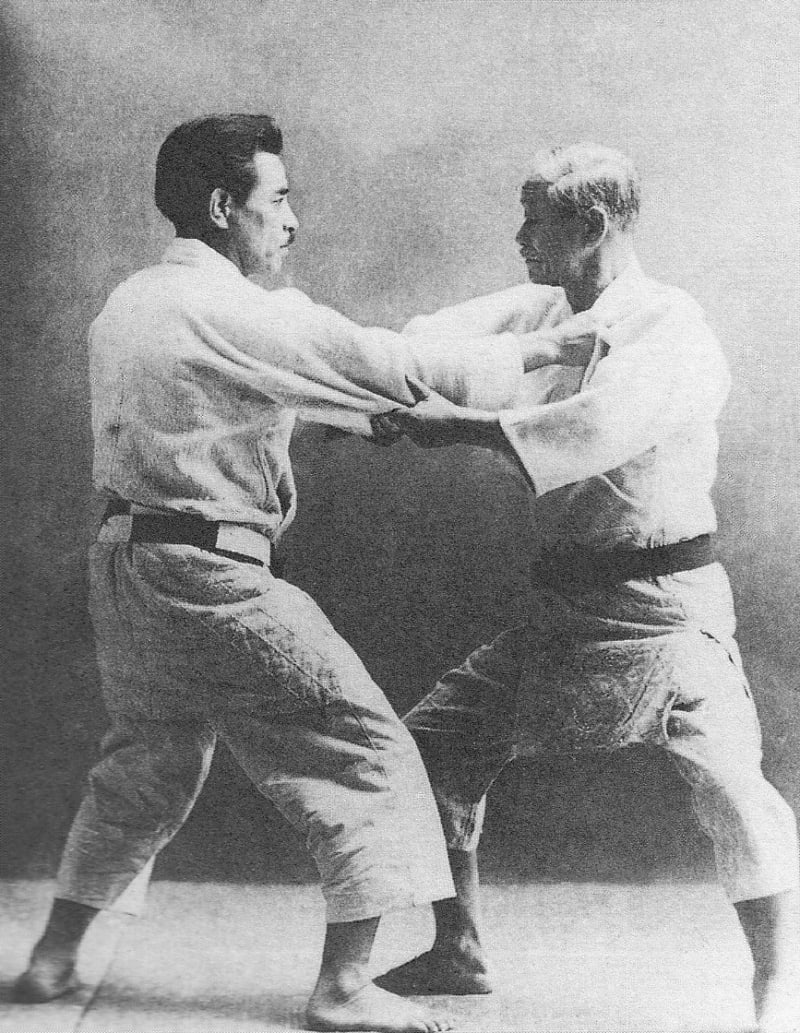
Lineage
Contents
Judo — 柔道, “the gentle way” — is a Japanese martial art and Olympic sport founded in 1882 by Jigoro Kano as a distillation of the ancient jujutsu schools of feudal Japan. Kano’s genius lay not in inventing new techniques but in articulating a governing principle: maximum efficiency with minimum effort. Rather than meeting strength with strength, the judoka reads and redirects the opponent’s momentum — throwing them with their own force.
Judo became the first martial art admitted to the Olympic Games, debuting at Tokyo 1964. Today it is one of the world’s most widely practised combat sports: the world federation IJF unites 200 national federations. The often-quoted figure of 40 million practitioners comes from the IJF itself — elsewhere the same body gives 20 million. Its influence extends far beyond the mat: Brazilian Jiu-Jitsu and Russian Sambo both trace their technical lineage directly to Kano’s Kodokan.
Jigoro Kano — The Visionary
Kano Jigoro was born on 28 October 1860 in Mikage (present-day Kobe). A slight, sickly child, he resolved at eighteen to master a martial art — against his family’s wishes.
He studied under two jujutsu masters: Fukuda Hachinosuke of the Tenjin Shinyo-ryu school and Iikubo Tsunetoshi of the Kito-ryu school. Rather than simply accumulating techniques, Kano analysed their underlying mechanics. Why did certain throws work? What principles could be generalised?
1882 — The Kodokan: At twenty-two, Kano opened his own school in the Eishoji temple, Tokyo — the Kodokan, “Hall for Studying the Way.” It began with twelve mats and nine students. He named the art judo to distinguish it from the older jujutsu schools.
Educator and diplomat: Kano was not only a martial artist but also a leading educator and Japan’s first IOC member (1909). He campaigned for Tokyo as an Olympic host city and died aboard a ship returning from an IOC congress in Cairo in 1938, aged 77.
Technical Foundations
| Group | Technique Type | Description |
|---|---|---|
| Nage-waza | Throwing techniques | Standing and sacrifice throws |
| Tachi-waza | Standing throws | Hip, shoulder, foot techniques |
| Sutemi-waza | Sacrifice throws | Thrower sacrifices own balance |
| Ne-waza | Ground techniques | Holds, chokes, arm locks |
| Osaekomi-waza | Hold-downs | Pinning the opponent |
| Shime-waza | Strangulation | Carotid compression |
| Kansetsu-waza | Joint locks | Elbow joint techniques |
Atemi-waza (strikes) exist in the kata but are excluded from competition — Kano removed them to enable safe practice and sport.
Core Techniques
Ippon-seoi-nage (一本背負い投げ) — One-arm shoulder throw; technically demanding, devastating when executed cleanly.
O-soto-gari (大外刈) — Major outer reap; sweeps the opponent’s leg from the outside, sending them backward.
Uchi-mata (内股) — Inner thigh throw; one of the most elegant and frequently scored Olympic techniques.
Harai-goshi (払腰) — Sweeping hip throw; combines hip rotation with a sweeping leg motion.
Juji-gatame (十字固め) — Cross arm-lock; the most common submission in Judo competition.
Scoring: Ippon (immediate win) · Waza-ari (half point; two = ippon) — former scores like yuko have been removed.
Philosophy
Kano articulated two interdependent principles that elevate Judo beyond a mere fighting system:
Seiryoku Zenyo (精力善用) — Maximum efficiency. Physical and mental energy must always be used to the best effect. Not force against force, but force through leverage, timing and balance disruption.
Jita Kyoei (自他共栄) — Mutual welfare and benefit. Judo is not zero-sum: both partners grow together. Without a strong uke (the one who falls), tori (the thrower) cannot improve. The practice community advances together.
“The essence of Judo is nothing other than the cultivation and utilisation of the best of humanity.” — attributed to Jigoro Kano; no source for it can be found. What is documented are his two principles, seiryoku zen’yō and jita kyōei
Styles and Regional Schools
Judo has no competing styles in the sense of Karate — the system is largely unified globally. Regional emphases exist:
| Region | Characteristic |
|---|---|
| Japan (Kodokan) | Technical completeness, kata preservation |
| Russia / CIS | Strong ne-waza, Sambo influence |
| France | World power, tactical sophistication |
| Georgia | Physical dominance, unorthodox grips |
| Korea | Athletic, dynamic throwing |
Kosen judo — a college ruleset emphasising ne-waza and submission. The common claim that it produced Brazilian jiu-jitsu does not hold: Maeda left Japan in 1904, the Kosen tournament began in 1914.
Connections to Other Martial Arts
- Jujutsu — Direct parent; Kano distilled the best elements of Tenjin Shinyo-ryu and Kito-ryu
- Aikido — Ueshiba was a judoka before studying Daito-ryu; Kano and Ueshiba knew each other
- Brazilian Jiu-Jitsu — Mitsuyo Maeda, a Kodokan student, taught Carlos and Hélio Gracie in Brazil
- Sambo — Vasili Oshchepkov studied at the Kodokan and synthesised Judo with indigenous Russian wrestling
- Wrestling — a similar aim (throwing, controlling) within a different rule framework
Today — Reach and Critique
Judo is one of the world’s most widely practised combat sports; federation figures for the number of practitioners range between 20 and 40 million. Olympic inclusion (men since 1964, women since 1992) has driven its global spread.
Rule evolution as tension: The IJF rulebook has been progressively restricted since the 1980s — leg-grab bans, passive play penalties, limited ground-fighting time. Traditional judoka argue that competition Judo has drifted far from Kano’s complete system. The prohibition of direct leg grabs (since 2010) has made the sport more athletic but technically narrower.
Breadth sport: Judo is a central school sport in many countries. Its safe falling technique (ukemi) and cooperative training structure make it accessible across all ages.
Related Articles
- Aikido — Shared Jujutsu roots, contrasting philosophy
- Kyokushin Karate — Parallel development of Japanese Budo
- Taekwondo — Korean Olympic counterpart
- Breakfalls Compared — why judo of all systems teaches slapping
- Throwing — One Principle, Seven Rule Sets — how far the grip on the gi carries the lever arm
- Reigi — why the bow marks the beginning and the end of practice
- Grading Systems Compared — why the black belt comes from the game of go and appeared only in 1886
- Breakfall Programme — why osoto-gari is trained last rather than first
- Kosen Judo — the pre-1925 version of the rules, preserved in the college system
- Bartitsu — Kanō staffed London’s mixed-fighting club in 1900 — four years before Maeda
- Keiko Fukuda — Kanō’s last living student — and the case that makes the dan scale visible
- Edith Garrud — the neighbouring London line: Tani and Uyenishi came from the same milieu
- Rusty Kanokogi — who made women’s judo Olympic — with a mortgage and a threat of litigation
- Throwing Principles Programme — the programme for the two principles all 77 throwing techniques reduce to
- Dō and Jutsu Compared — the 1882 case stands there thirty-seven years ahead of every other renaming
- Vasili Oshchepkov — the Kodokan student through whom judo reached the Soviet Union
Further Reading
As an Amazon Associate I earn from qualifying purchases. This costs you nothing extra.