Jujutsu — The Original Martial Art of the Samurai
Jujutsu is the original unarmed combat system of the Japanese samurai — ancestor of Judo, Aikido, and Brazilian Jiu-Jitsu, built on the principle of yielding.
Lineage
Contents
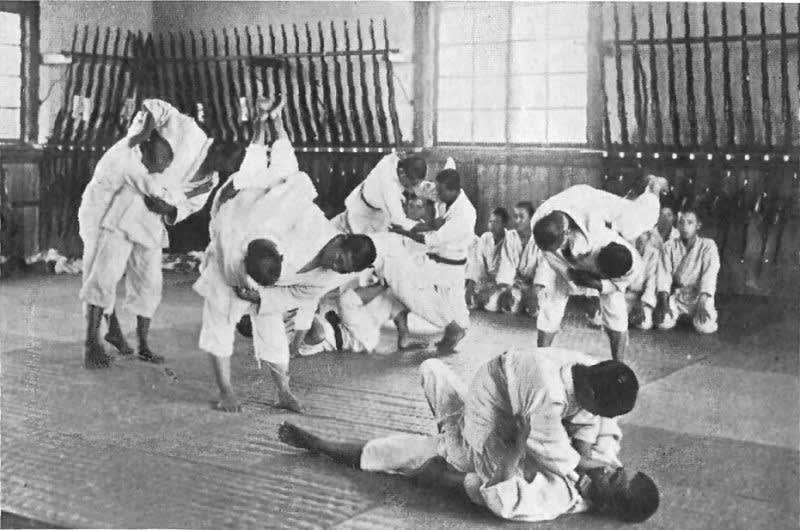
Jujutsu (柔術, “gentle art” or “art of yielding”) is the classical unarmed combat system of the Japanese samurai — and one of the most influential martial arts in human history. From Jujutsu emerged Judo (Jigoro Kano, 1882), Aikido (Morihei Ueshiba), and Brazilian Jiu-Jitsu (Gracie family). The core principle: Ju (柔, yielding) — the opponent’s strength is not blocked but absorbed and redirected. Developed for combat in full armor against armed opponents, Jujutsu encompasses throws, joint locks, chokes, strikes, and disarming techniques. The term “Jujutsu” first appears in the late 8th century; systematization as a warrior combat art began in the Kamakura period and reached its peak in the Sengoku era. Today hundreds of Jujutsu schools exist worldwide.
History and Founders
The historical roots reach back to the Nara period (710–794 AD). The term appears in this era but initially described a rough mixture of early Sumo and simple combat techniques without systematic school structure.
Systematization began in the Kamakura period (1185–1333), shaped by the rise of the samurai class. Samurai in full armor could not effectively strike — the armor absorbed blows. Instead, techniques were developed to throw, control, and wound armored opponents with short weapons in close quarters. Various terms circulated for these techniques: Yawara, Taijūtsu, Torite, Kogusoku — all later subsumed under the term Koryu Jujutsu.
The oldest documented schools:
Shinden Fudo-ryu (~1130) — one of the earliest documented Jujutsu lineages.
Tenshin Shoden Katori Shinto-ryu (~1447) — Iizasa Ienao called his unarmed techniques “Yawara” and integrated them into a comprehensive warrior combat system alongside Kenjutsu and Naginatajutsu.
Takenouchi-ryu (1532) — founded by Takenouchi Hisamori (竹内久盛) in Mimasaka Province. This is the oldest fully documented independent Jujutsu school. The tradition: Hisamori practiced 37 days in a temple and received the combat secrets from a Yamabushi mountain monk. The system encompassed locks, throws, chokes, small weapons, and the Koshi no Mawari (“hip methods”).
In the Sengoku era (1467–1615), Jujutsu schools proliferated massively. In the Edo period (1603–1868), an era of prolonged peace, Jujutsu transformed from pure war technique to physical and character cultivation.
Technical Foundations
| Category | Term | Techniques |
|---|---|---|
| Throws | Nagewaza | Shoulder, hip, leg, and sacrifice throws |
| Joint locks | Kansetsuwaza | Elbow, shoulder, wrist, knee |
| Chokes | Shimewaza | Neck, arm, and leg chokes |
| Holds | Osaekomi | Ground control and pinning |
| Strikes | Atemi | Vital point strikes, often secretly transmitted |
| Disarming | Torite | Weapon removal from grip |
The core principle Ju (柔):
“Softness overcomes hardness. Yielding defeats resistance.”
The attacker’s energy is not blocked but absorbed and redirected through levers, rotations, and throws — a principle drawn directly from the Chinese Tao Te Ching.
Core Techniques
Basic throws: Ogoshi (major hip throw) · Tani Otoshi (valley drop) · Tomoe Nage (circle throw)
Joint locks: Ude Garami (arm entanglement) · Ude Hishigi (arm crush) · Hiza Ude Garami (knee lock)
Chokes: Okuri Eri Jime (sliding collar choke) · Hadaka Jime (naked strangle)
Torite (捕手) — capture techniques for restraint: central to historical police and military applications, preserved for example in Edo-period Tori-te practice.
Atemi Waza — strikes to nerve points and vital body locations: part of the secret transmission in many Koryu schools, largely removed from modern Judo.
Philosophy
The concept of Ju (柔) is not merely technical but deeply philosophical. It draws on Taoist principles:
“The softest thing in the world overcomes the hardest. That which has no substance enters where there is no crevice.” — Daodejing, chapter 43
Not strength but efficiency and timing are decisive. Jujutsu teaches offering no resistance to resistance — a posture that extends far beyond combat.
Three levels of Jujutsu:
- Jutsu (術) — Technical skill, combat effectiveness
- Do (道) — Path of self-cultivation
- Ri (理) — Understanding the deeper universal principles
Styles and Schools
| School | Founded | Founder | Distinctive Feature |
|---|---|---|---|
| Takenouchi-ryu | 1532 | Takenouchi Hisamori | Oldest independent documented school |
| Tenshin Shoden Katori Shinto-ryu | ~1447 | Iizasa Ienao | Oldest comprehensive school with Jujutsu |
| Daito-ryu Aiki-jujutsu | Edo (Takeda Sokaku) | Takeda Sokaku | Direct ancestor of Aikido |
| Kito-ryu | Edo period | — | Major influence on Jigoro Kano / Judo |
| Tenjin Shinyo-ryu | ~1830 | Iso Mataemon | Second major Judo precursor |
Connections to Other Martial Arts
- Judo — Jigoro Kano (1860–1938) synthesized Kito-ryu and Tenjin Shinyo-ryu into Judo; Jujutsu is its direct ancestor
- Aikido — Morihei Ueshiba studied Daito-ryu Aiki-jujutsu under Sokaku Takeda; Aikido is spiritually deepened Jujutsu
- Brazilian Jiu-Jitsu (BJJ) — Mitsuyo Maeda (Kodokan expert) taught in Brazil; the Gracie family developed BJJ with its own ground-fighting emphasis
- Kenjutsu — samurai learned Kenjutsu and Jujutsu as an inseparable unit; Jujutsu supplemented the sword in the closest combat range
- Hapkido — Korean martial art also influenced by Daito-ryu Aiki-jujutsu (through Choi Yong-sul)
Today
Jujutsu exists today in three main forms:
Koryu Jujutsu — strictly traditional schools like Takenouchi-ryu that preserve original techniques in direct master lineages. Small, exclusive circle; access often by personal invitation.
Goshin Jujutsu — modern self-defense systems drawing from the tradition but adapted for contemporary contexts. Widespread in Europe and America.
Sport Jiu-Jitsu — competition-oriented system, partially influenced by BJJ. The JJIF (Ju-Jitsu International Federation) organizes world championships.
Criticism: The word “Jiu-Jitsu” / “Jujutsu” is today applied to very different systems — from historical Koryu to modern MMA submission wrestling. Purists of Koryu Jujutsu emphasize the fundamental difference between historical war art and modern sport interpretations.
Related Articles
- Judo
- Aikido
- Kenjutsu
- Bushido
- Budo
- Breakfalls Compared — the breakfall as a question of rules, not of style
- Grading Systems Compared — what the menkyo did that the dan does not replace
- Breakfall Programme — training the mat track and the hard-surface track separately
- Kosen Judo — where the groundwork specialists of around 1900 sent their ne-waza next
- Bartitsu — the first organised export to Europe — recruited through Kanō himself
- Keiko Fukuda — her grandfather’s Tenjin Shin’yō-ryū line, on account of which Kanō brought her in
- Edith Garrud — what became of the British version once it was put to political use
- Tessenjutsu — the art of the iron fan: a weapon for places where swords were forbidden
- Dō and Jutsu Compared — what disappeared in the transition to jūdō, and why the name is younger than the practice
- Takeda Sōkaku — under this genus his books record the teaching until 1922
- Shorinji Kempo — where the soft methods of a Japanese post-war foundation lead back to