Kendo — The Way of the Sword
Kendo is modern Japanese swordsmanship with bamboo sword and armour — descended from the kenjutsu of the samurai, known by this name since 1920.
Lineage
Contents
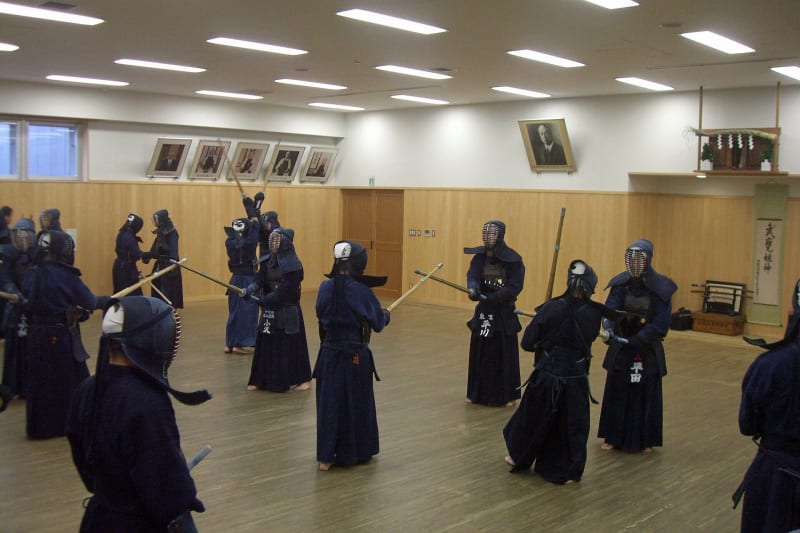
Kendo (剣道, “way of the sword”) is the modern form of Japanese swordsmanship: two practitioners in armour, armed with bamboo swords, in a contest punctuated by sharp shouts and the crack of feet on wood. It is the answer to a problem every weapons art faces — that its decisive technique cannot be practised without injuring the partner. Kendo’s solution is technical: the shinai, a sword made of four bamboo staves, and the bōgu, armour protecting precisely those target areas that are meant to be struck. Only this combination makes full contact possible.
From that solution follows kendo’s particular character. Valid targets are reduced to four — head, wrist, torso side, throat — and a strike does not score because it lands, but only when posture, trajectory, shout and the awareness that follows all coincide. Kendo is therefore less an exchange of blows than a contest for the single moment in which everything aligns. It is administered today by the All Japan Kendo Federation and its international partner bodies. Its figures separate two things that are often conflated: 2.03 million registered dan grades in Japan (as of March 2023) — a register that only grows — against some 477,000 active practitioners by the federation’s own survey.
History
Kendo’s prehistory is that of kenjutsu, the swordsmanship of the samurai, which during the Sengoku period differentiated into hundreds of ryūha — schools with their own transmissions. Practice took place in fixed partner forms with the wooden bokutō; free sparring was barely possible without accepting serious injury.
The solution emerged during the long peace of the Edo period. In the early eighteenth century Naganuma Shirōzaemon developed protective armour for training bouts with the bamboo sword. Building on this, Chiba Shūsaku (1793–1855) systematised free practice, reduced the sprawling technical repertoire to a teachable number, and introduced kirikaeshi — the rapid, repeated striking sequence against a partner that remains the foundational exercise of every kendo session. What emerged was called gekiken (“striking sword”) and was at first a training method and exhibition contest rather than a way in its own right.
After the Meiji Restoration of 1868 the samurai class lost its status and the wearing of swords was banned. Swordsmanship survived in two niches: with the police, who had a practical use for it, and as a demonstration discipline. In 1895 the Dai Nippon Butoku Kai was founded to consolidate and standardise the inherited martial arts; in 1920 it renamed gekiken to kendō — the choice of word marking the intention to turn a technique into a way, in parallel with jūdō and karate.
The interwar period tied kendo closely to militarist education, and precisely for that reason it was banned by the occupation authorities after 1945. Its return came by a detour: in 1950 a defused competitive sport called shinai kyōgi was permitted. In 1952, the year sovereignty was regained, the All Japan Kendo Federation was founded, explicitly re-establishing kendo as an educational sport. The International Kendo Federation followed in 1970 with the first World Championship.
Technical Foundations
Equipment and target areas determine one another:
| Armour piece | Term | Protects |
|---|---|---|
| Helmet with grille | 面 men | head, face, throat, shoulders |
| Gauntlets | 小手 kote | hands and forearms |
| Torso cuirass | 胴 dō | ribcage and flanks |
| Waist guard | 垂れ tare | abdomen and thighs |
Valid target areas (datotsu-bui) are men (head, straight or angled), kote (wrist), dō (torso side) and tsuki (thrust to the throat). Because of the risk of injury, tsuki is prohibited for juniors and beginners in many federations.
A point (ippon) is awarded only when four things coincide — the principle ki-ken-tai-ichi, “spirit, sword and body as one”:
- Ki — fighting spirit, audible in the kiai, the shout naming the target struck
- Ken — the strike with the correct part of the shinai (its forward third) and the correct edge
- Tai — bodily commitment, visible in fumikomi, the stamping forward step
- Zanshin — alert readiness after the strike
A technically clean strike without zanshin does not count. This rule is the core of what separates kendo from mere point accumulation.
Bouts are fought from the basic posture chūdan no kamae, the sword tip directed at the opponent’s throat. A match runs to three points, won by whoever scores two; three referees decide with flags.
Core Techniques
- Kirikaeshi — the foundational exercise: a straight men strike, then continuous angled men strikes moving forward and back. Trains distance, breathing and trajectory at once.
- Suburi — swinging practice without a partner, the basis of every striking motion
- Shikake-waza — initiating techniques: debana-waza (at the moment of the opponent’s intent), harai-waza (sweeping the opponent’s sword aside), renzoku-waza (combinations)
- Ōji-waza — responding techniques: suriage-waza (sliding up), nuki-waza (evading), kaeshi-waza (deflecting and reversing)
- Nihon Kendō Kata — ten partner forms with wooden swords, codified from 1912. They are the bridge to older kenjutsu and a required component of every dan examination.
Central to all of this is maai, combative distance. The transition from tōma (far distance) through issoku ittō no maai (one step, one strike) into chikama (close distance) often decides the bout before any strike is made.
Philosophy
The official purpose formulated by the All Japan Kendo Federation in 1975 describes kendo as “the discipline of the human character through the application of the principles of the sword”. This is not decorative: the scoring rules enforce it. A competitor who strikes but loses composure receives no point.
The four classical obstacles — shikai — are surprise, fear, doubt and confusion. Recognising them in oneself and provoking them in the opponent is part of the technique. Closely related is sen no sen, forestalling: not reacting to the attack but acting at the moment of its formation. Miyamoto Musashi described this level of combat at length in the Gorin no Sho, long before kendo existed.
Etiquette (rei) frames every session: a bow to the dōjō, to the teacher, to the partner. The saying “kendo begins and ends with rei” is shorthand for an attitude that treats the opponent as the condition of one’s own practice — without them there is no training.
Styles and Schools
Kendo is strongly unified in competition; unlike karate it has no competing style federations. Differences run along other lines:
| Setting | Character |
|---|---|
| University kendo | high tempo, uncompromising attack, sets the tone in elite sport |
| Police kendo (keisatsu) | professional training, technically dominant in Japan |
| Nitō kendo | two-sword kendo in Musashi’s tradition, permitted but rare |
| Classical koryū | kenjutsu schools such as Ittō-ryū or Kashima Shintō-ryū, from which kendo emerged and which continue independently |
Grading runs from 1st to 8th dan. The 8th dan examination is considered one of the hardest in all of budō; the pass rate is in the low single-digit percentages. Above the dan grades stand the teaching titles renshi, kyōshi and hanshi.
Connections to Other Martial Arts
- Kenjutsu — the direct predecessor; the Nihon Kendō Kata deliberately keep the connection open
- Iaijutsu and iaidō — drawing and cutting from the scabbard; many kendōka practise both, because kendo does not represent handling a live blade
- Naginatajutsu — the polearm art uses related armour and a comparable scoring system
- Jūdō and karate — siblings in the same modernising project: dan system, educational claim, federation structure
- Korean kumdo — a largely rule-identical parallel development rooted in the Japanese occupation period
Today
Kendo is practised in over 60 countries; the International Kendo Federation holds World Championships every three years, at which Japan has been almost consistently dominant. In Japan itself kendo is a fixture of school sport and police training.
Notably, the IKF does not seek Olympic inclusion. The official rationale: adapting to Olympic scoring requirements would damage precisely those subjective criteria — posture, spirit, zanshin — that constitute the core of the discipline. This decision is remarkably consistent by the standards of the martial arts world, but it is also cited as the reason kendo is far less internationally visible than judo or taekwondo.
Criticism focuses on three points: distance from reality in handling a live blade, since the shinai’s weight and balance differ substantially from a katana; the narrowing to four target areas, which excludes tactical options of historical fencing; and the severity of training, particularly for children and in the traditionally strict Japanese school clubs. In answer to the first point, many practitioners additionally take up iaidō or a classical koryū.
Related Articles
- Kenjutsu
- Iaijutsu
- Naginatajutsu
- Karate
- Budo
- Zanshin
- Miyamoto Musashi
- Shu-Ha-Ri — kihon and shiai as keeping and breaking the form
- Maai — the three distances and why they are measured in time rather than metres
- Reigi — why the gaze stays on the opponent during the bow
- Grading Systems Compared — why here of all places the licence to teach is separated from the grade again
- Haidong Gumdo — the Korean sword art that deliberately sets itself apart from kumdo
- HEMA — the European movement now standing at the same fork
- Sport Fencing — the second independent attempt at the same problem: protective gear, ruleset, sword art
- Jōdō — what an encounter with a sword looks like when nobody is counting points
- Dō and Jutsu Compared — shinai and bōgu as a technical enablement, not a philosophical decision