Kyokushin Karate — The Way of Ultimate Truth
Kyokushin is the world's hardest full-contact karate style — founded by Mas Oyama in Tokyo in 1953 as a synthesis of Shotokan, Goju-ryu and Southeast Asian striking arts.
Lineage
Derived
Contents
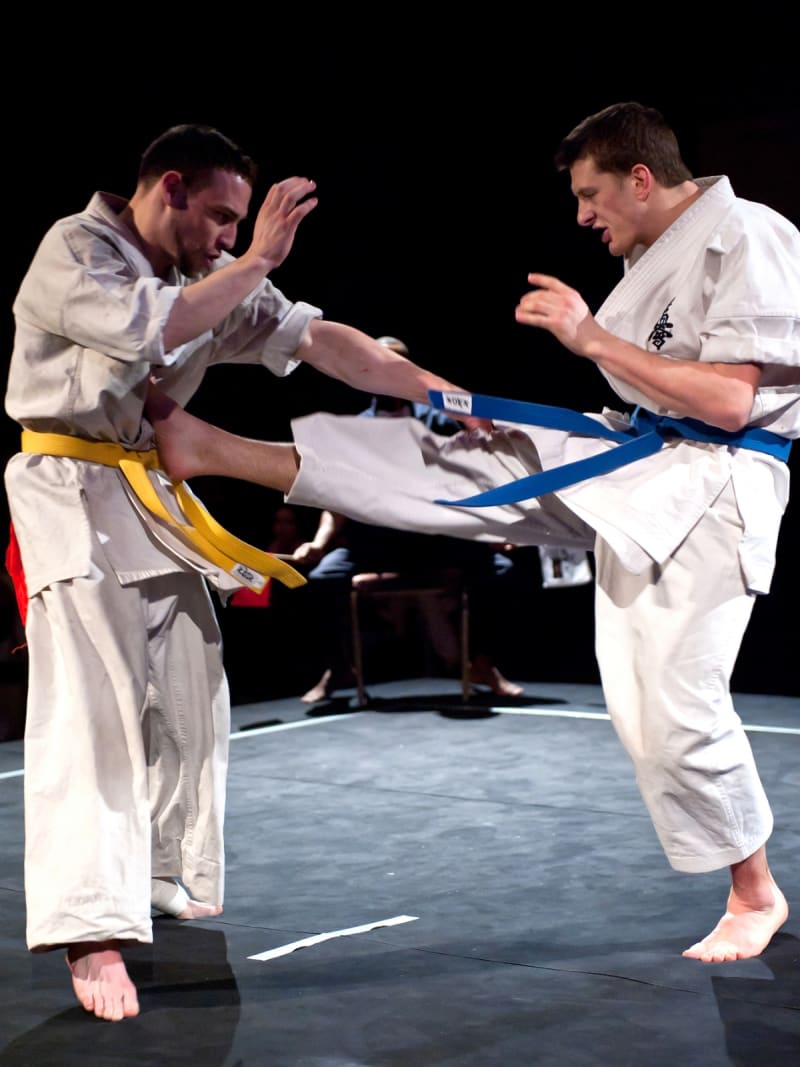
Kyokushin — “the ultimate truth” — is the world’s most widely practised full-contact karate style and one of the most demanding organised combat sports on earth. Founded in 1953 by Masutatsu Oyama in Tokyo, it distinguishes itself from other karate styles through an uncompromising realism: in competition, all techniques are delivered with full body contact — no pads, no light-touch scoring. Only knockdowns count.
Oyama himself was a legendary figure: he spent years in mountain isolation, fought bulls with his bare hands, and tested his karate against full-contact fighters from around the world. He synthesised Shotokan Karate, Goju-ryu, boxing and Muay Thai into a new, uncompromising system. Kyokushin became the founding school of modern full-contact karate and influenced K-1, kickboxing and international combat sports profoundly.
Today over 12 million people in more than 130 countries practise Kyokushin — divided across several organisations that emerged after Oyama’s death in 1994.
Masutatsu Oyama — The Sosai
Masutatsu Oyama, born on 27 July 1923 near Yeongseong, Korea, as Choi Yeong-eui, moved to Japan at age twelve. There he studied first Judo, then Karate under the legendary Gichin Funakoshi (Shotokan), then deepened his training in Goju-ryu under Nei-Chu So.
1946–1950 — Mountain retreat: Driven by his own failures in competition, Oyama retreated first to Mount Minobu (15 months), then to Mount Kiyosumi (18 months). He trained daily under waterfalls, studied Miyamoto Musashi’s writings and hardened his body through solitude and nature. These years shaped Kyokushin’s philosophical foundation.
From 1950 — The bull fights: Oyama fought 52 bulls. He killed three with a single strike, severing the horns of 49 others with knife-hand blows. These public demonstrations in Japan and the United States made him world-famous.
1953 — First dojo: Oyama opened his first school in Mejiro, Tokyo. The name Kyokushinkai — “the association for the search of ultimate truth” — was chosen.
1960s — Global expansion: Oyama sent his best students worldwide: Bobby Lowe (USA), Jon Bluming (Netherlands), Steve Arneil (England) built Kyokushin in their countries.
1994 — Death of the Sosai: Oyama died on 26 April 1994 of lung cancer. His death triggered a fragmentation of the organisation into several competing bodies.
Technical Foundations
| Area | Feature | Kyokushin Specifics |
|---|---|---|
| Punches | Jodan prohibited | No head punches in competition |
| Kicks | All heights permitted | Jodan (head-level) kicks score points |
| Contact | Full | No body protection except groin guard |
| Scoring | Knockdown only | Points only for putting opponent down |
| Kata | 11 required kata | Taikyoku through Kanku |
The defining feature: punches to the head (jodan-tsuki) are prohibited in kumite — so Kyokushin fighters develop powerful head kicks as their primary high-line weapon. The body and legs are the main targets and must be conditioned to absorb full-power strikes.
Core Techniques
Mawashi-geri Jodan — High roundhouse kick to the head; the most spectacular scoring technique.
Gedan Mawashi-geri — Low kick to the outer thigh; accumulates damage and fatigue.
Ushiro-geri — Spinning back kick; the most powerful linear technique.
Hiza-geri — Knee strike to the body, especially from the clinch.
Ashi-barai — Foot sweep, bridging between strikes and knockdown.
Kata: Taikyoku 1–3 · Pinan 1–5 · Tsuki-no-kata · Yantsu · Gekisai Dai/Sho · Sanchin · Tensho · Saifa · Seienchin · Kanku (highest kata)
Philosophy
Oyama combined brutal physical conditioning with the spirit of Budo. His guiding maxim:
“One day of training, one day of progress. No training, ten days of regression.”
Osu (押忍) — The ubiquitous greeting and affirmation of Kyokushin. The character signifies endurance, respect and the will to persist under pressure. It permeates every situation in the dojo.
The 100-Man Kumite (Hyakunin Kumite) is the ultimate test: 100 full-contact two-minute bouts in a single day. Oyama completed it three times. In the modern era, Akiyoshi Matsui (1986), Howard Collins and Steve Arneil are among the very few to have passed.
Organisations
The IKO has split into several bodies — the first already during Oyama’s lifetime, most of them after his death:
| Organisation | Leader | Founded | Characteristic |
|---|---|---|---|
| IKO 1 (Kyokushinkaikan) | Akiyoshi Matsui | 1994 | Direct succession |
| IKO 2 | Yukio Nishida | 1994 | Parallel structure |
| Shinkyokushin | Kenji Midori | 1998 | Sparring reforms |
| IFK | Steve Arneil | 1991 | Pre-dates Oyama’s death |
| Kyokushin Budokai | Jon Bluming | 1980 | Earliest major split; today the IBK |
| World Oyama | Shigeru Oyama | — | US-centred |
Connections to Other Martial Arts
- Shotokan Karate — Oyama’s first major training; the kata foundation comes from Funakoshi
- Goju-ryu — The hard breathing techniques (Sanchin, Tensho) come directly from this style
- Muay Thai — Oyama integrated low kicks and knee strikes; the influence is explicit
- K-1 and Kickboxing — Many K-1 pioneers came from Kyokushin: Andy Hug, Francisco Filho
Today — Reach and Critique
Kyokushin is globally established as the benchmark for full-contact karate, having produced some of the world’s toughest competition fighters. Critics note:
- Head punch prohibition creates a gap in self-defence realism
- No ground component — Kyokushin is pure stand-up
- Organisational fragmentation weakens the global movement
Despite this, Kyokushin remains the most popular full-contact martial art in the world — rawer, more direct and less sport-sanitised than competition karate under WKF rules.
Related Articles
- Judo — Japanese martial art with shared Budo values
- Aikido — Philosophy of harmony as counterpoint to Kyokushin’s ethos
- Muay Thai — Source art for low kicks and knee techniques
- The Roundhouse Kick in Six Systems — held against muay thai and taekwondo under motion capture
- Kime — what full contact does to terminal bracing
- Kicking Programme — why hip rotation is a shared foundation and not a stylistic edge
- Mas Oyama — the founder whose full-contact rule separated the style from the rest of karate
Further Reading
As an Amazon Associate I earn from qualifying purchases. This costs you nothing extra.