Kyūdō — The Way of the Bow
Kyūdō is Japanese archery as a way — descended from the war craft of kyūjutsu, known by this name since 1919, shot with the asymmetric yumi.
Lineage
Contents
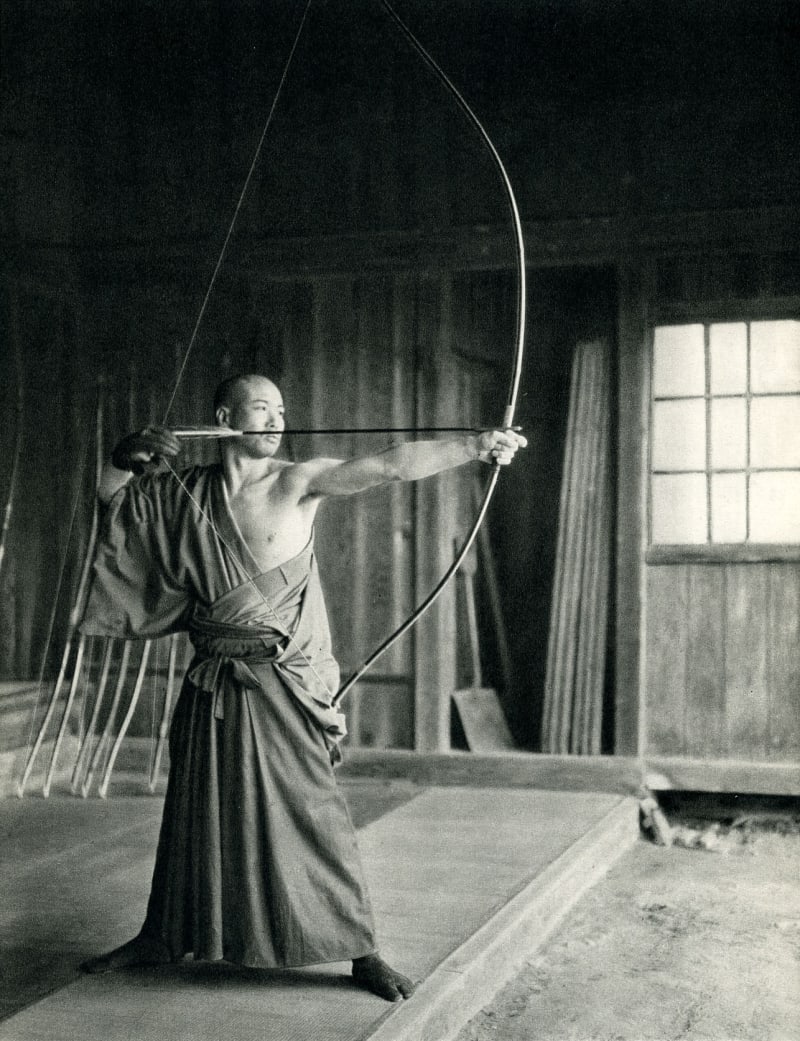
Kyūdō (弓道, “way of the bow”) is Japanese archery in its modern form — and probably the quietest of all martial arts. A shot takes minutes, not seconds: the archer steps up in a fixed sequence, aligns feet, torso and breathing, raises the bow above the head, draws it apart, holds, and releases. The target stands 28 metres away. Whether the arrow hits is not the only and often not the most important measure.
Its defining implement is the yumi, a bow over two metres long, of laminated bamboo, whose grip sits not at the middle but at roughly one third of its length. This asymmetry is unique worldwide and derives from the need to handle a long bow from horseback and from kneeling positions. It makes shooting technically demanding: the bow rotates in the hand on release, and that rotation — yugaeri — is regarded as the test of clean execution. Kyūdō is administered today by the All Nippon Kyūdō Federation, which counts some 140,000 members in Japan, just under half of them women.
History
The bow is older in Japan than the sword. Attested as early as the Yayoi period, it was the principal weapon of the warrior class through the Heian and Kamakura periods — the phrase kyūba no michi, “the way of bow and horse”, denoted the warrior ideal long before the sword took over that role. Mounted archery was cultivated in forms such as yabusame, still performed at shrines today.
With the arrival of firearms in the sixteenth century the bow lost its military significance. What followed is a pattern repeated in almost every Japanese martial art: the weapon became militarily obsolete and survived as a path of practice. The Edo period produced shooting formats such as the tōshiya in Kyōto, where archers tried to send as many arrows as possible down the 120-metre hall of the Sanjūsangen-dō within 24 hours — the record stands at over 8,000 hits.
After the Meiji Restoration, kyūjutsu too fell into crisis. Its reconstruction was shaped above all by Honda Toshizane (1836–1917), who taught at the University of Tokyo and developed a teachable hybrid from the martial and the ceremonial shooting schools — the Honda-ryū. In 1919, two years after Honda’s death, kyūjutsu was officially renamed kyūdō, within the same modernising project that produced jūdō, kendō and later karate.
Banned after the Second World War, kyūdō was reorganised in 1949 with the founding of the All Nippon Kyūdō Federation. In 1953 the federation agreed a common basis of shooting bridging the competing school forms — a compromise that still underlies instruction today.
In the West, kyūdō is known chiefly through one book: Eugen Herrigel’s “Zen in the Art of Archery” (1948), an account of his study under Awa Kenzō. The work fixed the association of kyūdō with Zen in Western awareness — though Japanology has established that Herrigel misunderstood his teacher through interpreters, and that Awa’s own idiosyncratic teaching was not representative of kyūdō. The book’s influence is therefore large and its reliability limited.
Technical Foundations
Equipment and range are highly standardised:
| Item | Term | Character |
|---|---|---|
| Bow | 弓 yumi | over 2 m, laminated bamboo, asymmetric grip |
| Arrow | 矢 ya | bamboo shaft, shot in pairs (haya and otoya) |
| Glove | 弽 yugake | deerskin, with a stiffened thumb forming the anchor |
| Target | 的 mato | 36 cm across, at 28 m (kinteki) |
| Hall | 道場 dōjō | fixed shooting range, ritualised procedure |
Alongside the near target kinteki stands long-distance enteki at 60 metres, which demands different technique and forms its own competitive category.
Core Techniques
The entire shot is articulated in eight stages — the shahō hassetsu, traditionally compared to the eight joints of a bamboo stalk:
- Ashibumi (足踏み) — footing, about shoulder width, aligned to the target
- Dōzukuri (胴造り) — settling and stabilising the torso
- Yugamae (弓構え) — readying: nocking the arrow, setting the grips, directing the gaze, ordering the breath
- Uchiokoshi (打起し) — raising the bow above the head
- Hikiwake (引分け) — drawing apart, evenly to both sides
- Kai (会) — full draw: outwardly still, inwardly still expanding
- Hanare (離れ) — the release, which is not triggered but allowed
- Zanshin (残心) — the posture after the shot, in which the tension continues to resonate
The stages are not a checklist but one continuous arc. The decisive problem for practitioners is kai: from outside it looks like waiting, but the expansion must in fact continue. Whoever merely holds at kai releases with the finger rather than out of the tension — the shot is technically wrong even if the arrow hits.
Philosophy
The three guiding terms of the All Nippon Kyūdō Federation are shin-zen-bi: truth, goodness, beauty. Not an embellishment but an order of merit — a shot that hits while being technically and posturally unclean counts as worse than a clean miss.
“If the shot does not hit, do not look for the fault in the target but in yourself.”
This formula — transmitted in various versions, and traceable in its essence to Confucius — describes the real structure of the discipline. Because the target is immobile and does not shoot back, there is no opponent to whom failure could be attributed. Among the martial arts, kyūdō is therefore the limiting case: an art without a counterpart, in which all attention falls back on one’s own execution.
Here zanshin is not, as in kendō, alertness towards an opponent, but the resonance of the form. And mushin — mind that does not attach — describes exactly the problem of release: whoever intends the moment of the shot distorts it.
On the frequently asserted Zen connection, precision is in order: historically, kyūdō and Zen are separate traditions that became entangled only in the twentieth century, partly through Western reception. Many Japanese teachers stress the link considerably less than Western accounts would lead one to expect.
Styles and Schools
Unlike karate, kyūdō has no competing competition federations, but it does have distinct shooting schools differing chiefly in footing, draw height and breath management:
| School | Character |
|---|---|
| Heki-ryū (several branches) | martial lineage, low draw, practically oriented |
| Ogasawara-ryū | ceremonial and courtly, formative for yabusame and etiquette |
| Honda-ryū | Honda Toshizane’s hybrid, basis of modern instruction |
| Shamen / shōmen | two basic forms of raising — obliquely before the body, or frontally |
Grading runs from 1st to 10th dan, above which stand the teaching titles renshi, kyōshi and hanshi. The 10th dan is in practice no longer awarded.
Connections to Other Martial Arts
- Kyūjutsu — the martial antecedent; kyūdō is its continuation as a path of practice
- Kendō and iaidō — siblings in the same modernising project, sharing the dan system and etiquette
- Yabusame — mounted archery from the same root, today largely ritual
- Zen in budō — the most prominent association in the West, and historically the most recent
- Korean gungsul and Chinese archery — independent East Asian traditions with symmetric bows and different anchoring
Today
Kyūdō is practised in Japanese schools, universities and clubs and is one of the few budō disciplines with a very high proportion of women. Internationally it is organised through the International Kyudo Federation in some twenty countries, but remains a small discipline — the bow is expensive, the range demanding, and without a teacher entry is practically impossible.
Like kendō, the federation does not seek Olympic inclusion. The reasoning is the same and in kyūdō’s case still more compelling: a scoring system counting only hits would surrender precisely the criteria — posture, procedure, zanshin — that constitute the discipline.
The internal debate turns chiefly on the relation of hit to form. Competitive practice in many formats scores hits first, while the examination system weights execution — a tension structurally similar to the sport-versus-way dispute in karate. To this is added the criticism that Western reception through Herrigel created a spiritually inflated picture with little bearing on the often matter-of-fact reality of Japanese training.
Related Articles
- Kyūjutsu
- Kendo
- Iaidō
- Budo
- Zanshin
- Mushin
- Zen in Budo
- Gungsul — 145 metres instead of 28 — the same task, the opposite answer
- Breathing Methods Compared — the only system that orders both breathing jobs in sequence
- Breathing Programme — why breath can only be tied to technique when there is no opponent
- Dō and Jutsu Compared — the 1919 renaming — the measure changed, not the technique
- Ogasawara Nagakiyo — the other great line beside Heki — and how etiquette accrued to it