Kyūjutsu — The Japanese Art of Archery
Kyūjutsu is the Japanese martial art of archery — a millennia-old Shinto ritual and the samurai's primary battlefield skill, embodied in the asymmetric Yumi bow.
Lineage
Derived
Contents
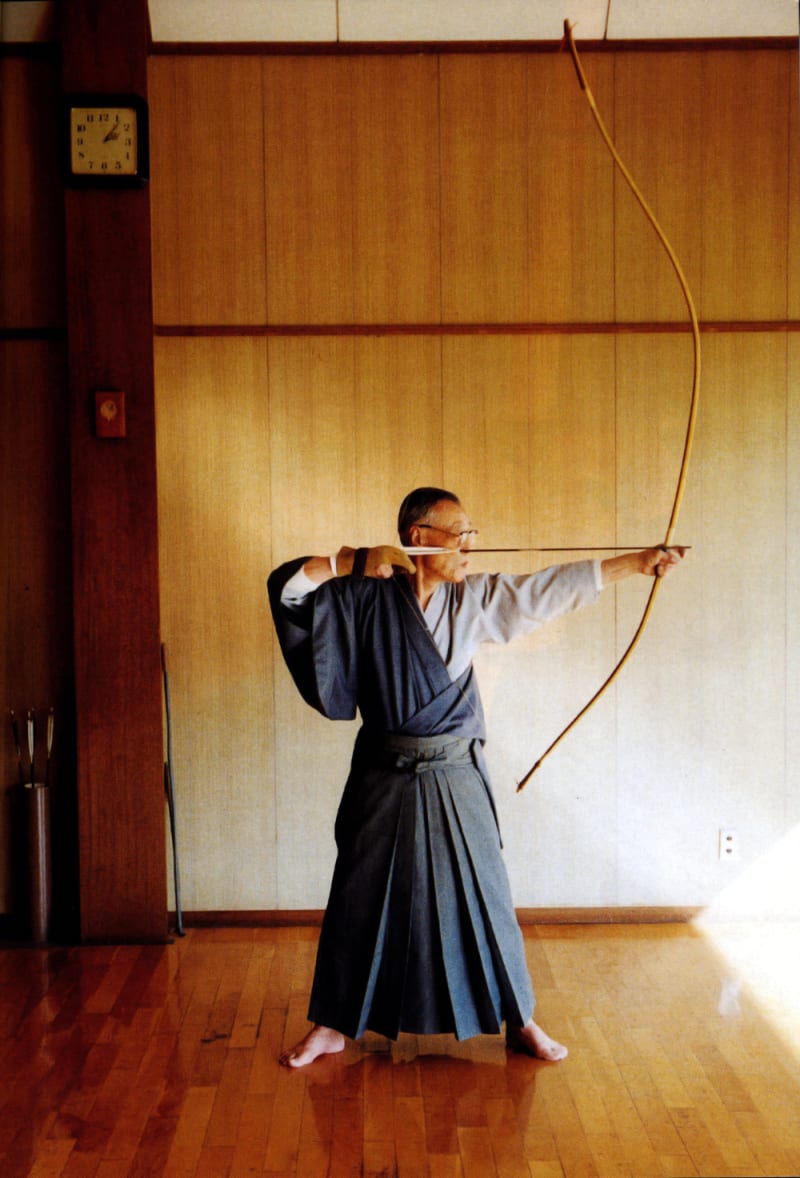
Kyūjutsu (弓術, “art of the bow”) is the traditional Japanese martial art of archery — one of the oldest and most sacred disciplines of Japanese warrior culture. Long before the Katana became the samurai’s symbol, the bow was his primary weapon: early samurai were first and foremost mounted archers. Kyūjutsu is inseparable from Shinto — arrow and bow are sacred objects, archery a purification ritual. The most important ceremonial form, Yabusame (流鏑馬), is still performed in Shinto ceremonies: galloping horse, three targets, three arrows, three shots in rapid succession. The Yumi — the Japanese bow — is perhaps the most extraordinary tool in the archery world: over two meters long, asymmetric, the grip at two-thirds of its height. No other culture has developed such a bow form. Today Kyūjutsu lives primarily in modern Kyūdō — as a path of bow cultivation, meditation, and character development.
History
Archery in Japan reaches back at least to the Yayoi period (~300 BCE–300 CE). The earliest Japanese chronicles (Kojiki, 712 AD) describe archers extensively in mythological and historical contexts.
In the Heian period (794–1185) the samurai was primarily a mounted archer — the sword was secondary close-combat weapon. The term “Kyūba no Michi” (弓馬の道, “Way of Bow and Horse”) designated the entire warrior ideal — not the sword.
The first formal school, Henmi-ryū, was founded in the 12th century by Henmi Kiyomitsu. From it descended Takeda-ryū and Ogasawara-ryū — both specializing in ceremonial and mounted archery.
The Sengoku era (1467–1615) brought revolution: mass formations with longbows (similar to English longbow tactics) and — following the introduction of firearms in 1543 — the gradual displacement of the bow in direct combat. Paradoxically, this militarization led to the spiritual deepening of Kyūjutsu: when it was no longer the best weapon, it became art.
Heki Danjō Masatsugu (~15th century) revolutionized archery with his approach “Hi, Kan, Chū” (飛·貫·中) — “Fly, Pierce, Center”: fast, precise, penetrating. His Heki-ryū became the most influential combat archery school.
The Yumi — The Asymmetric Bow
The Yumi (弓) is the most distinctive element of Japanese archery:
| Feature | Detail |
|---|---|
| Length | Over 2 meters (typically 220–228 cm) |
| Asymmetry | Grip at approximately 2/3 height from bottom |
| Material | Traditional: bamboo, wood, leather; modern: fiberglass |
| Draw weight | 8–20 kg (traditional war bows up to 30 kg) |
| Release | Right hand draws, arrow passes on the outside |
The asymmetry has a practical reason: a symmetrical bow of this length could not be shot from horseback — the lower portion of the bow must be shorter to clear the horse’s neck.
Yabusame — Mounted Archery
Yabusame (流鏑馬, “galloping arrow”) is the most spectacular expression of Kyūjutsu: an archer gallops along a prepared course and shoots at three wooden targets (~36 cm) in rapid succession — without stopping, at full gallop.
Yabusame is not sport — it is Shinto ritual:
- Origin: Kamakura period (1185–1333), introduced by Minamoto no Yoritomo
- Purpose: To please the gods and pray for blessings of harvest, land, and people
- Style: Silent, highly concentrated performance; archer wears Heian-period costumes
- Key locations: Tsurugaoka Hachimangu Shrine (Kamakura), Shimogamo Shrine (Kyoto)
Core Techniques
Archery in Kyūjutsu and Kyūdō follows a strict eight-phase sequence (Hassetsu, 八節):
| Phase | Term | Description |
|---|---|---|
| 1 | Ashibumi | Take stance position |
| 2 | Dozukuri | Align the body |
| 3 | Yugamae | Hold bow, nock arrow |
| 4 | Uchiokoshi | Raise the bow |
| 5 | Hikiwake | Draw the bow |
| 6 | Kai | Full draw — body as taut bow |
| 7 | Hanare | Release — not active, but naturally released |
| 8 | Zanshin | Follow-through — mind stays with arrow and target |
The release (Hanare) is considered decisive in Kyūdō philosophy: it should not be actively brought about, but release itself naturally from the physical and mental tension — as ripe fruit falls from a tree.
Philosophy
Kyūjutsu and Kyūdō are meditation in action. The central concept: Shin-Zen-Bi (真善美) — Truth, Goodness, Beauty. A good shot arises not from technical precision alone, but from the unity of mind, body, and bow.
Shinto dimension: The bow is sacred in Shinto — a purification instrument. Drawing and releasing the bow (Tsurumi) is a meditation that expels impurity. In shrines, bows serve as talismans.
“When mind, body, and bow become one, the arrow hits by itself. The goal is not the hit — the goal is the unity.” — Kyūdō principle
Styles and Schools
| School | Type | Distinctive Feature |
|---|---|---|
| Ogasawara-ryū | Ceremonial | Court archery, Yabusame, etiquette |
| Heki-ryū | Combat | ”Hi, Kan, Chū” — precise and fast; many branches |
| Henmi-ryū | Oldest | 12th century, precursor of all schools |
| Honda-ryū | Synthesis | Honda Toshizane, 19th c.; bridge between Kyūjutsu and Kyūdō |
Connections to Other Martial Arts
- Kenjutsu — both are samurai foundational disciplines; “Kyūba no Michi” named bow and horse — not sword — as the warrior ideal
- Sōjutsu and Naginatajutsu — all three belong to the core weapons training of the classical samurai
- Ninjutsu — Kyūjutsu is one of the 18 Ninjutsu disciplines
Today
Modern Kyūdō (弓道, “Way of the Bow”) has over 500,000 practitioners in Japan and has grown internationally. The Zennihon Kyudo Renmei (全日本弓道連盟) standardizes technique and grading.
Yabusame continues to be performed at important Shinto ceremonies and attracts international audiences.
Criticism: Modern Kyūdō has moved far from the martial art dimension. The philosophy of unity between archer and shot is admirable — but some critics see the combat practicability as completely lost.
Related Articles
- Kenjutsu
- Naginatajutsu
- Sōjutsu
- Bushido
- Budo
- Gungsul — the Korean horn bow and the examination system that carried it
- Dō and Jutsu Compared — the jutsu form compared; the target as the measure vanished only with kyūdō
- Ogasawara Nagakiyo — appointed by Yoritomo as instructor of bow and horse