Shito-ryu — The Encyclopedia of Okinawan Karate
Shito-ryu is Karate's most Kata-rich school — synthesized by Kenwa Mabuni from Shuri-te and Naha-te, with the broadest Kata repertoire of all major styles.
Lineage
Origins
Contents
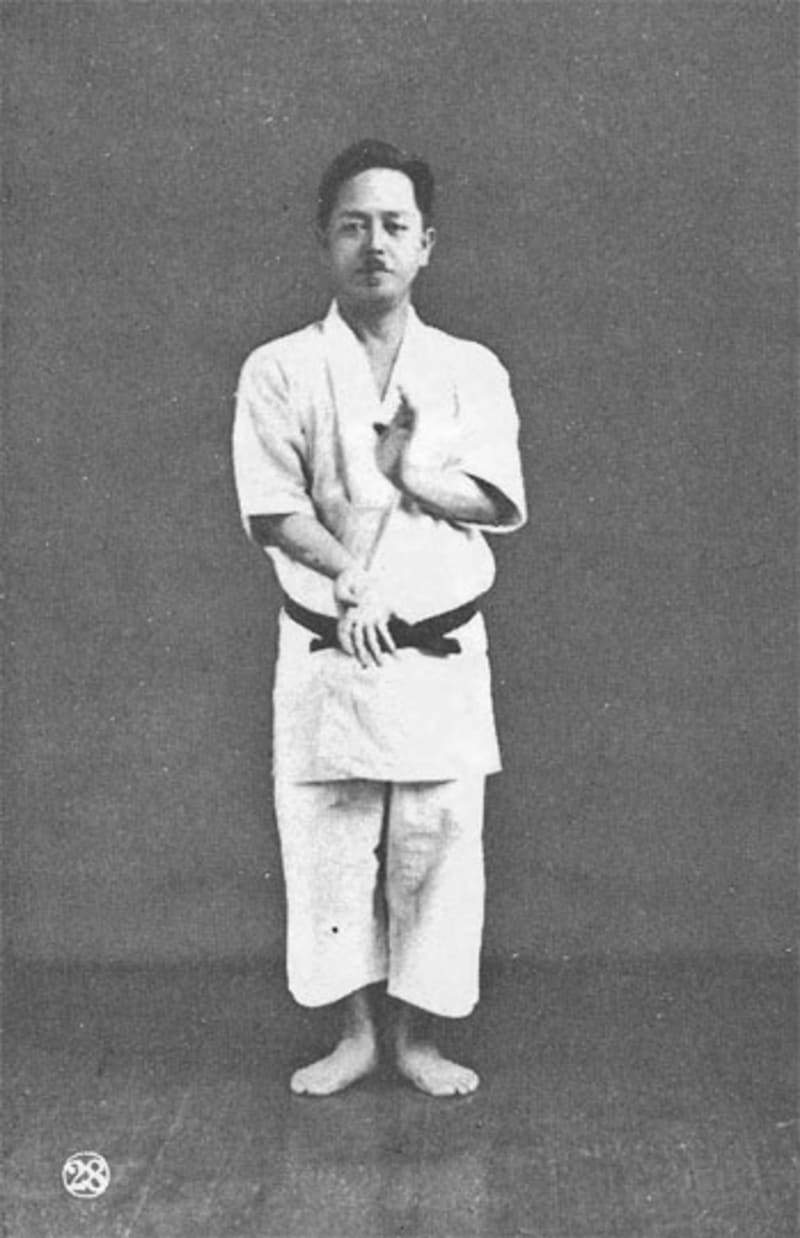
Shito-ryu (糸東流) is one of the four major traditional Karate styles — and by far the richest in Kata. Founded in 1934 by Kenwa Mabuni (1889–1952), Shito-ryu is the most ambitious attempt to preserve the entire breadth of the Okinawan Karate tradition. The name is a poetic acronym: the first Kanji characters from the names of Mabuni’s two main teachers — Itosu (糸洲, Itosu Anko) and Higashionna (東恩納, Higashionna Kanryu) — form Shito (糸東). Mabuni studied under both grandmasters: Itosu taught him the Shuri tradition of the court nobility, Higaonna the Chinese-influenced Naha tradition of the port town’s merchants and craftsmen. That these were two separate schools is a retrospective ordering — see Okinawan Karate. From this synthesis arose Shito-ryu: a system combining the physical strength and long stances of Shuri-te with the circular movements, breath power, and hard-soft characteristics of Naha-te. Mabuni was renowned for his encyclopedic Kata knowledge — Shito-ryu today contains over 50 Kata, more than any other major style.
History and Founders
Kenwa Mabuni was born in 1889 in Shuri, Okinawa — the ancient royal city. At 13 he began Karate under Ankō Itosu (糸洲安恒, 1831–1915) — the great reformer of Shuri-te who introduced Karate into Okinawa’s schools and developed the Pinan/Heian Kata.
Mabuni’s childhood friend Chojun Miyagi (founder of Goju-ryu) introduced him to Kanryu Higaonna (東恩納寛量, 1840–1915) — the master of Naha-te and direct student of Chinese Kung Fu masters in Fuzhou. Mabuni now studied under both grandmasters simultaneously.
He actively sought additional teachers: Seishō Aragaki, Wu Xianhui (Chinese master known as Go-Kenki), and others. Into the 1920s Mabuni was considered the leading authority on Okinawan Kata transmission.
1929: Mabuni moved to Osaka on the Japanese mainland. 1934: his style was officially registered as Shito-ryu — named after his two main teachers.
After his two primary teachers died (both in 1915), Mabuni saw it as his mission to completely preserve and transmit their knowledge — a mission that made him possibly the broadest Kata expert of his era.
Technical Foundations
Shito-ryu integrates two stylistically distinct traditions:
| Feature | Shuri-te heritage | Naha-te heritage |
|---|---|---|
| Stances | Long, deep, linear | Shorter, force-bound |
| Movement | Directional, explosive | Circular, eight-directional |
| Force | External muscle force | Breath force (Ibuki), internal |
| Character | Hard, fast | Hard-soft (Go-Ju) |
Kata are the heart: Shito-ryu preserves Kata from both traditions:
- Shuri-te Kata: Pinan Shodan–Godan · Naihanchi · Kushanku · Bassai · Jion · Jitte
- Naha-te Kata: Sanchin · Seisan · Saifa · Seiyunchin · Shisochin · Sanseru
Total repertoire: Over 50 Kata — the broadest of all major styles.
Bunkai — Kata Analysis
Mabuni placed particular weight on Bunkai (分解, Kata analysis and application): understanding the practical combat techniques hidden in each Kata movement. He published several books systematically explaining Bunkai — some of the most influential works in Karate literature.
Philosophy
Shito-ryu has no philosophy beyond general Karate ethics — but Mabuni’s life’s work was itself a philosophical statement: preservation is duty. In an era when Karate was being brought to the mainland and simplified, Mabuni insisted on preserving the original’s breadth and depth.
“A kata is not fixed or immoveable. Like water, it is ever changing and fits itself to the shape of the vessel containing it. However, kata are not some kind of beautiful competitive dance, but a grand martial art of self-defence — which determines life and death.” — Kenwa Mabuni
Connections to Other Martial Arts
- Goju-ryu — closest kinship: Mabuni and Miyagi (Goju-ryu founder) were childhood friends who jointly studied under Higaonna; their systems share the Naha-te core
- Shotokan — both from Shuri-te tradition (Itosu was both Shotokan-Funakoshi’s and Shito-ryu-Mabuni’s teacher)
- Uechi-ryu — both from Fujian-China tradition, but Uechi more direct (Kanbun learned in China), Shito-ryu more mediated (through Higaonna)
Today
Shito-ryu is one of the four major Karate styles recognised by the Japanese umbrella body and was therefore represented at karate’s only Olympic appearance to date. In Japan it is particularly strong in Osaka (Mabuni’s home). Several organizations (Seito Shito-ryu, Itosukai) represent different lineages.
Related Articles
- Goju-ryu
- Shotokan Karate
- Uechi-ryu
- Budo
- Kata and Kumite — bunkai as the actual bridge — and how much of it is reconstruction
- Ankō Itosu — the ito in the style name — Mabuni’s first principal teacher
- Kenwa Mabuni — the founder whose decision to collect explains the wide kata canon
- Okinawan Karate — why “Shuri-te” and “Naha-te” are place names rather than school names