Hapkido — The Korean Way of Harmonious Power
Hapkido is Korea's art of harmonious power — a complete combat system of joint locks, throws, and kicking techniques rooted in the Japanese Daito-ryu tradition.
Lineage
Origins
Contents
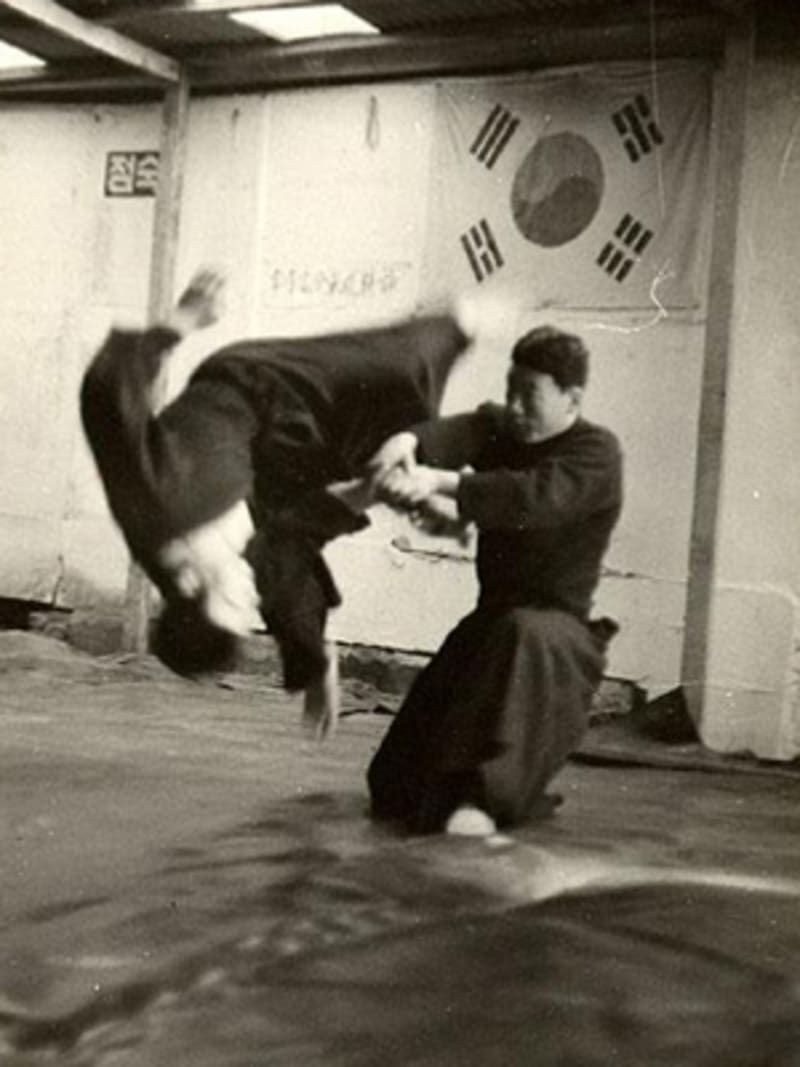
Hapkido (합기도, 合氣道, “Way of Harmonious Power”) is a Korean martial art distinguished by its unusual versatility: it combines explosive Korean kicking techniques, joint locks and throws from the Japanese Daito-ryu tradition, and weapons work into a complete self-defense system. Hap (합) stands for harmony and coordination — Ki (기) for life energy — Do (도) for the path of cultivation. Hapkido rests on three principles: circular motion, non-resistance, and the water principle. Opposing force is not blocked but redirected — through joint locks that bring bones to the point of failure, and throws that emerge from small finger-joint levers. The connection to Japanese Daito-ryu is historically established — though the exact nature of founder Choi Yong-sul’s training remains debated. Ji Han-Jae supplemented the system with Korean elements and brought Hapkido to worldwide attention.
History and Founders
Choi Yong-sul (최용술, 1904–1986) was brought to Japan at age 8 during the Japanese occupation of Korea. There he studied a form of Jujutsu he attributes to Daito-ryu Aiki-Jujutsu master Takeda Sōkaku (1859–1943). Choi claims to have lived and trained with Takeda as his adopted son for 30 years.
The exact nature of this relationship is historically unclear: Takeda’s own records do not include Choi’s name. Despite this debate, it is clear that Choi, on returning to Korea in 1948, taught a system showing strong resemblances to Daito-ryu — joint locks, throwing principles, and energy-redirection principles are identifiable.
In 1948 Choi began teaching in Daegu. His early student Seo Bok-seob — a brewery heir and judoka — provided his premises as the first training hall.
Ji Han-Jae (*1936) was Choi’s most significant student and for many the true architect of modern Hapkido. He:
- Added extensive Korean kicking and striking techniques (influenced by Taekkyeon and Tang Soo Do)
- Integrated weapons training (staff, cane, rope, gun defense)
- Added breathing exercises and meditation
- Became Hapkido instructor to the Korean Presidential Guard
Hapkido gained worldwide recognition through actor Bruce Lee, who consulted Ji Han-Jae, and through choreography in numerous martial arts films of the 1970s.
Three Core Principles
| Principle | Korean | Meaning |
|---|---|---|
| Circular motion | 원 (Won) | Force follows circular path rather than straight line |
| Non-resistance | 화 (Hwa) | Opposing force is absorbed, not blocked |
| Water principle | 류 (Yu) | Adaptation like water — the path of least resistance |
These principles are concrete, not abstract: a Hapkido joint lock never blocks an attacker’s wrist — it rotates it, follows its movement, and guides it to the control point.
Core Techniques
Joint Locks (Kwan Jul Ki Sul)
Hapkido’s centerpiece: precise manipulation of fingers, wrist, elbow, shoulder, knee, and ankle. Even the smallest joint lever can control large opponents — leverage is primary, strength secondary.
Kicking Techniques
Hapkido possesses a broad kicking repertoire influenced by Taekkyeon and Tang Soo Do:
- Low rotating heel kicks — characteristic of Hapkido
- High kicks — leg-height, hip-height, head-height
- Jumping and spinning techniques — visually spectacular, tactically targeted
Throws
Many Hapkido throws emerge from joint locks: the lever at the wrist leads into a shoulder throw — the technique flows seamlessly from the grip.
Weapons
- Short stick (Dan Bong) · Long staff (Jang Bong) · Cane (Ji Pang Ee) · Rope (Poh Bak Sool) · Firearm defense
Philosophy
The Ki (기) in Hapkido is central — not as mystical concept, but as practical principle: coordination, timing, and efficiency create force that muscles alone cannot generate. The joint lock that controls a 100 kg man is Ki in action.
The water principle: water does not resist — it flows around. Hapkido combat tactics are flowing around the attack, not countering it.
“Hapkido does not teach fighting force with force. It teaches using force — the opponent’s.” — Choi Yong-sul
Styles and Schools
| Style | Founder | Distinctive Feature |
|---|---|---|
| Choi Yong-sul Style | Choi Yong-sul | Most original lineage, close to Daito-ryu |
| Ji Han-Jae Style | Ji Han-Jae | Extended with kicks, weapons, meditation |
| Combat Hapkido | John Pellegrini | Modern self-defense, tactical |
| Kuk Sool Won | In-Hyuk Suh | Broadest Korean martial arts system |
Connections to Other Martial Arts
- Daito-ryu Aiki-Jujutsu — direct origin; joint locks and energy redirection derive from there
- Aikido — both from Daito-ryu; Aikido spiritualizes the same principles differently
- Taekwondo — Korean sister art; Taekwondo emphasizes kicks, Hapkido joint locks; many martial artists combine both
- Jujutsu — shared roots via Daito-ryu; Hapkido is culturally Korean-adapted Jujutsu
Today
Hapkido is taught in millions of schools worldwide — often as complement to Taekwondo. Korean police and military use Hapkido-based close-combat systems. In Hollywood, Hapkido became known through Ji Han-Jae’s choreography in films including “Once Upon a Time in China and America.”
The art is less competition-oriented than Taekwondo or Judo — its focus is on practical self-defense and control.
Related Articles
Verwandte Artikel