Hwarangdo — A Code That Reached Silla by Way of Japan
The hwarang really existed. But the code of honour that carries their name arose under Japanese rule, as a Korean counterpart to bushido.
Contents
Overview
Hwarangdo (화랑도) is two things, and the two are confused almost every time.
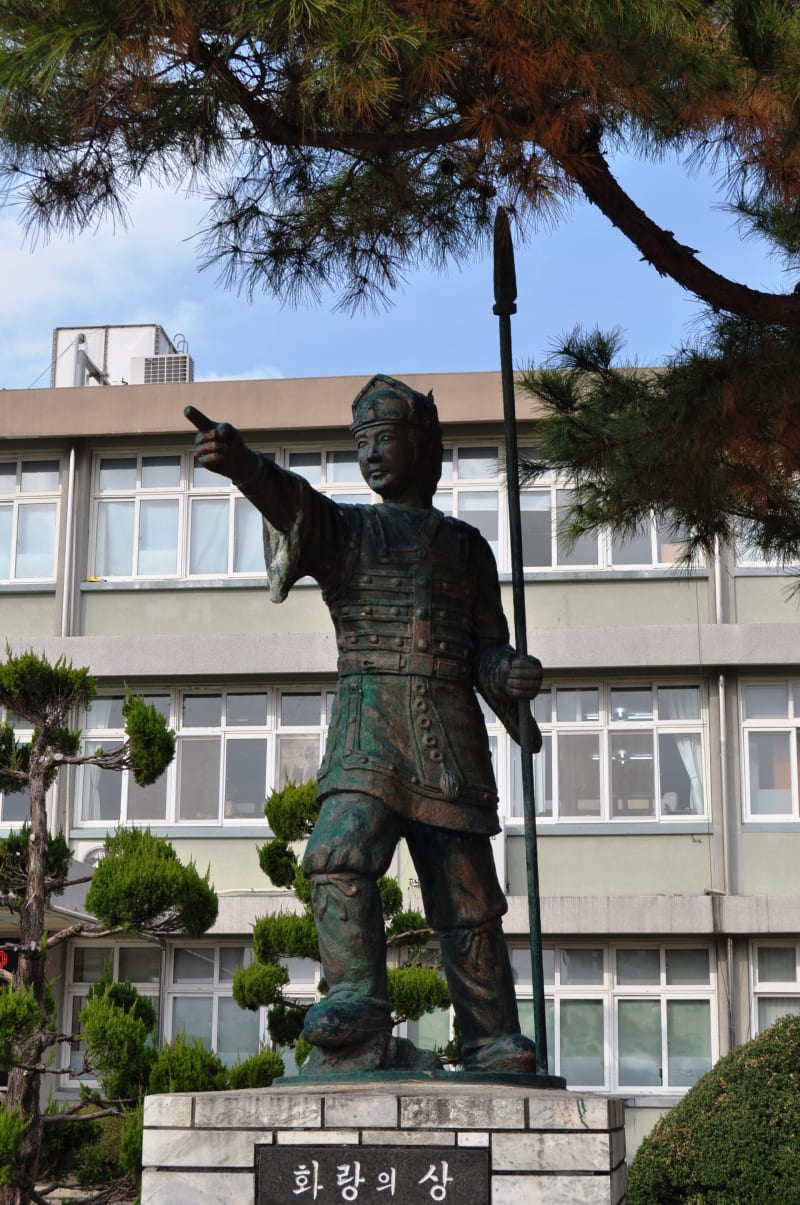
One is a youth organisation of the Silla kingdom in the 6th century, which really existed and appears in the Korean histories. The other is a martial art founded in Seoul in 1960 that claims to carry on its inheritance.
Between the two lies a third layer, and it is the most interesting: the term “hwarangdo” in the sense of a warrior code arose in the 20th century — under Japanese rule, as a Korean counterpart to bushidō.
That makes this the third case of the kind in the stock. Bushidō reached the West through Nitobe in 1900, wu de through Yang Jwing-Ming from the 1980s — both modern versions of old terms. Hwarangdo is the case where the borrowing is documented and deliberate: the code was built on a foreign model.
What the sources say about the hwarang
The hwarang are not an invention. They stand in the Korean histories, and what stands there is concrete enough.
Their predecessors were women. First came the wonhwa (원화, “original flowers”), led by two women, Nammo and Junjeong. Junjeong killed her rival, the wonhwa were dissolved — and young men took their place.
The founding date is uncertain. The institution falls in the reign of King Jinheung (540–576); the Samguk Sagi gives 576, the Tongguk Tonggam 540.
What they trained in the sources also state: riding, swordsmanship, archery, javelin and stone throwing, mounted ball games, ladder climbing — and beside that the five Confucian virtues, the six arts, poetry, music and shared journeys to sacred mountains.
The five secular precepts (sesok ogye, 세속오계) come from the Buddhist monk Won Gwang, around 600: loyalty to the king, filial piety, trust among friends, no retreat in battle, restraint in taking life. Of five precepts exactly one is military.
The most famous hwarang is Kim Yu-sin (595–673), the general under whom Silla unified the peninsula.
How far away the sources are
| Work | Date | Distance from the subject |
|---|---|---|
| Samguk Sagi (삼국사기) | 1145 | about 570 years |
| Haedong Goseungjeon (해동고승전) | 1215 | about 640 years |
| Samguk Yusa (삼국유사) | c. 1285 | about 710 years |
The contemporary source is lost. Kim Taemun’s Hwarang Segi (화랑세기) of the early 8th century is quoted by the later works but no longer exists. A manuscript that surfaced in Gimhae in the late 1980s bearing that title is regarded by most specialists as a forgery; the Koreanist Richard McBride has classed it so expressly.
The comparison with the neighbouring article makes the difference plain. For the martial arts of the Joseon military there is a printed manual of 1790, the sibpalgi: 24 named methods, each with a plate, plus an appendix on divergent execution. For the hwarang there is not one technique, not one method name, not one plate.
What the sources do not say
They do not say that the hwarang had a martial art.
The distinction is not a quibble. Riding, archery and swordsmanship are military skills — every army of the period trained them. A martial art in this encyclopedia’s sense is something else: a named system with a body of technique, an order of instruction and a line of transmission.
Of that there is nothing in any source. No name for a system, no list of techniques, no teacher and no student, no sign of a transmission after Silla fell in 935.
That is the same finding this stock records for subak: the mention of an exercise is not the transmission of an art.
The word itself
Hwarangdo is handed down in two spellings, and the commoner one is the unromantic one:
- 花郞徒 — the band of the hwarang. The character 徒 means following, retinue. Under each hwarang stood nangdo (郎徒), followers from the lesser nobility and the commons, from a few dozen to several thousand.
- 花郞道 — the way of the hwarang. The same organisation, but read as a doctrine.
The modern martial art builds on the second reading. That is not wrong — both forms are attested — but it is a choice. Read 徒 and you get a membership list; read 道 and you get a doctrine.
The detour through bushidō
And here comes the layer that most accounts leave out.
The image of the hwarang as a warrior cult arose in the 20th century. Richard Rutt and Vladimir Tikhonov have both described it that way: the military reading took hold in the period when the Japanese colonial administration was promoting bushidō to raise the fighting morale of its soldiers.
The term “hwarang-do” was coined in that situation — as an expression of the idea that the Korean cast of mind and Japanese bushidō were the same thing. This was assimilation policy: if Korea had its own warrior way, one that happened to look like the Japanese one, then Koreans would fit the more easily into a Japanese empire.
And then Korean intellectuals turned it around. The same term became evidence of a distinct, older, independent tradition — a spiritual pillar against Japanese hegemony. After 1945 it stayed in that role.
| Old core | Present form by | Purpose of that form | |
|---|---|---|---|
| Bushidō | yes | Nitobe, 1900 | explain Japan to the West |
| Wu De | yes | Yang Jwing-Ming, from the 1980s | explain China to the West |
| Hwarangdo | yes | colonial period, 1910–1945 | equate Korea with Japan — then: distinguish |
The third case is the most uncomfortable, because there the model was not merely an example but an instrument of rule. And because the result is nonetheless taken for the most authentically native thing of all.
The art of 1960
Joo Bang Lee and his brother Joo Sang Lee founded the martial art Hwa Rang Do in Seoul; the association gives the date as 15 April 1960.
The association’s account of its descent runs: from 1942, aged five and six, the brothers were the sole students of the Buddhist monk Suahm Dosa, who held the hwarang line. On his death in 1968 Joo Bang Lee took over the title and thereby became the 58th holder of that line. In 1969 and 1972 the brothers went to the United States.
Beside that stands a second descent, and that one is documented — by the association itself:
In October 1956 the brothers attained master level in Dae Dong Ryu Yu Sool under its founder Choi Yong-sool.
Dae Dong Ryu Yu Sool is the Korean reading of Daitō-ryū Aiki-jūjutsu. Choi Yong-sool is the man whose teaching produced hapkido — and whom this stock traces through Daitō-ryū back to Takeda Sōkaku.
| Claimed descent | Documented descent | |
|---|---|---|
| Teacher | Suahm Dosa, a monk | Choi Yong-sool |
| Date | from 1942 | October 1956 |
| Art | hwarang line from Silla | Daitō-ryū Aiki-jūjutsu |
| Evidence | none outside the association | the association’s own chronicle, hapkido grades |
Both statements come from the same source. The association carries them side by side without weighing one against the other. That is precisely the point at which a reader has to count: one of the two lines can be checked from outside, the other cannot.
The number 58 belongs to the same class as Takeda’s “32nd in the line”, which the Daitō-ryū article already carries with a qualifier. A numbered ancestry across 1,300 years and the fall of a dynasty is not a statement anyone can test — it is a claim in the shape of a figure.
What hwarangdo is technically
Independently of the question of descent: the art is extensive, and its composition is typical of Korea’s post-war decade.
| Area | Content |
|---|---|
| Throws and locks | joint control, throws, ground control — the Daitō-ryū layer |
| Strikes and kicks | hand and leg techniques, high kicks |
| Weapons | sword, stick, rope, throwing knife and others |
| Internal work | breath and energy work, in the vocabulary of ki |
| Grading | three tiers — Tae Soo Do with belts, then coloured sashes, then black sash degrees |
The three-tier grading is notable, because it doubles the usual arrangement: first a belt system for the basic stage, then a second sash system above it. The comparison of grading systems shows how young such machineries are throughout — this one included.
Today — and the criticism
Hwarangdo is spread today chiefly by the World Hwa Rang Do Association in the United States and is markedly less present in Korea itself than taekwondo or hapkido.
The objection to the art is not that it is poor. A system of Daitō-ryū locks, Korean kicks and weapons work can be good training, and the descent of its components is traceable.
The objection concerns the story. Anyone presenting an art of 1960 as the continuation of a 6th-century youth group asks for trust where checking would be possible — and obscures what actually happened: that Korean martial artists after the occupation built something of their own out of a Japanese body of technique. That is the more interesting story, and it is documented.
The same pattern already stands in the stock at haidong gumdo — founded 1982, invoking warriors of the 7th century — and at kuk sool won.
Common fallacies
“The hwarang were a warrior caste.” They were an aristocratic youth organisation with military, religious and aesthetic sides. A caste they were not, and their members stayed only a few years.
“The hwarang had a code of honour called hwarangdo.” They had the five secular precepts of the monk Won Gwang. The expression hwarangdo for a warrior code was coined in the 20th century.
“Hwarangdo is 1,500 years old.” The organisation is. The martial art is from 1960.
“The five precepts are a warrior code.” Four of five are Confucian everyday morality. The fifth, restraint in taking life, is Buddhist and limits fighting rather than glorifying it.
“The reference to Silla is independent of Japan.” It is precisely not. The reading of the hwarang as a warrior cult was built up in the colonial period, and with bushidō as its model.
Related Articles
- Haidong Gumdo — the same pattern twenty-two years later and with an even longer ancestry
- Hapkido — the same documented root in Choi Yong-sool, only without the Silla story
- Daitō-ryū Aiki-jūjutsu — the art actually taught in October 1956
- Takeda Sōkaku — where the same kind of numbered ancestry is already tested once
- Taekwondo — the art that spread the hwarang reference furthest
- Subak — the same finding for an older name: mention is not transmission
- Sibpalgi — the opposite case: 24 named methods with a plate and a date
- Bushidō — the model on which the term for the code was built
- Wu De — the Chinese case of the same construction, without the colonial background
- Kuk Sool Won — the third Korean claim to an unbroken line
- Taekkyeon — the Korean art whose transmission can actually be pinned to a person
- Grading Systems Compared — how young these machineries are, this one included
- Gongkwon Yusul — the same technical descent, only in 1996 and without an ancestry
- Engolo — the same construction of an origin story, donated by a single painter