Ssireum — Korea's Traditional Wrestling
Ssireum is Korea's traditional wrestling — practiced since the 4th century, fought with belts around hip and thigh in a sand ring, deeply embedded in Korean folk culture.
Contents
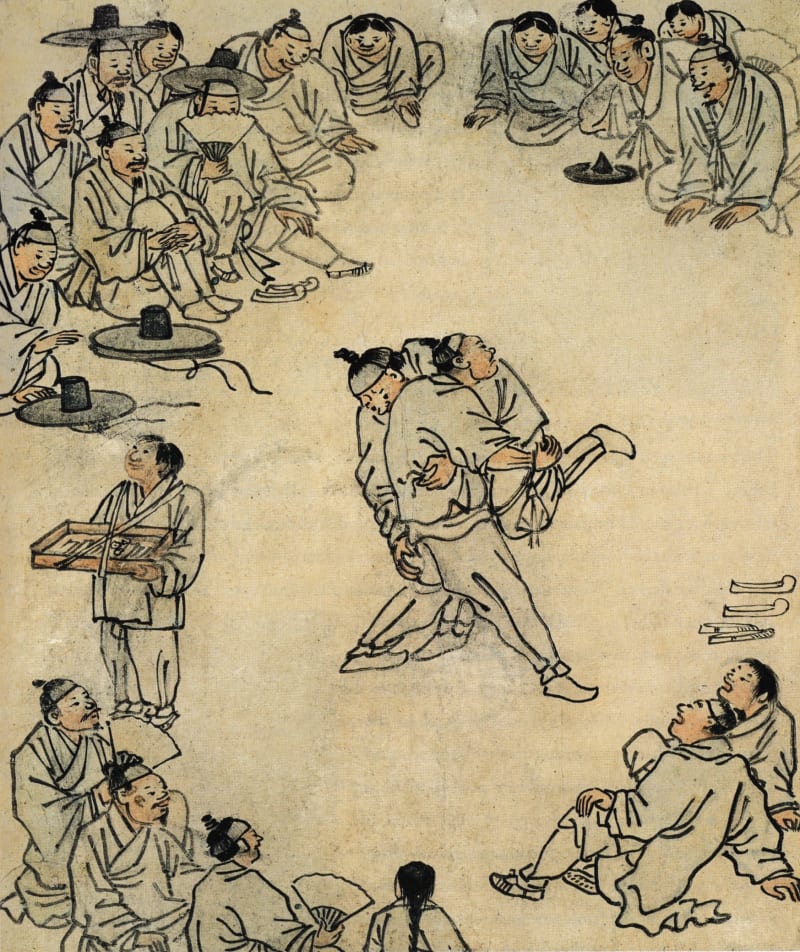
Ssireum (씨름) is Korea’s traditional wrestling art — one of the oldest sporting systems on the Korean Peninsula, reaching back to the 4th century CE. Its defining feature: both fighters grip each other’s Satba — a long fabric belt tied around the waist and thigh. From this grip all combat proceeds: lifting, throwing, pushing, pulling, sweeping — until a body part at knee height or higher touches the ground. Ssireum is contested in the Jangsa — a circular sand pit approximately 7 meters in diameter. The round arena, sand underfoot, and divided belts (red and blue) make Ssireum visually immediately recognizable. During the Joseon period (1392–1897), Ssireum was seasonal folk festival — at harvest and moon celebrations, men of all classes competed against each other, and the winner traditionally received an ox as prize. Today Ssireum is a national sport of Korea with a professional league and competition system similar to Japanese Sumo.
History
The earliest evidence for Ssireum comes from wall paintings of the Goguryeo period (~37 BCE–668 CE) — the same paintings that show Taekkyeon-like movements. In the Three Kingdoms era, Ssireum was both military training and community event.
In the Goryeo era (918–1392), Ssireum gained significance as a popular sport; King Chungsuk (r. 1308–1339) reportedly participated personally in competitions.
The Joseon period (1392–1897) was Ssireum’s golden age. On seasonal festivals (Dano in spring, Chuseok in autumn), competitions were held across Korea. The prize tradition — an ox for the strongest fighter — made Ssireum the most popular folk spectacle on the peninsula.
During the Japanese occupation (1910–1945), Ssireum like other Korean cultural practices was suppressed. After liberation it experienced institutional revival. Today the Korea Ssireum Association organizes professional competitions with national TV presence.
Technical Foundations
The entire Ssireum system begins and ends with the Satba (샅바) — the grip:
| Starting Position | Description |
|---|---|
| Baro Japki | Both kneeling, each holding opponent’s Satba |
| Rising | Both stand up while maintaining the grip |
| Contest | From the standing Satba-grip position |
The Satba enables immediate leverage: whoever better manipulates the belt grip controls the action.
Win condition: Any body part at knee height or higher touching the ground means defeat. No pinning, no choke — only taking down.
Core Techniques
Ssireum classifies techniques by body region and direction of effect:
Ahn Dari Gol (Inner leg throw) — similar to Uchigari in Judo, attack on the inner leg
Bakkat Dari Gol (Outer leg throw) — outer leg hook
Deul baet chigi (Lift and throw) — completely lifting the opponent from the ground and throwing
Eokkae Jechigi (Shoulder throw) — shoulder throw from the Satba grip
Ack Jji — leg and hip lever techniques for balance disruption
The Satba grip enables many techniques impossible without it — especially lifts.
Philosophy
Ssireum is folk art, not a philosophical martial art like Japanese Budo systems. Its value lies in community: Ssireum competitions were community events — not elite duels. Men of all social classes competed; the ox prize was achievable by anyone.
The fundamental principle of Ssireum: strength plus technique. Pure physical force alone is insufficient — Satba grip manipulation requires technique that outsmarts raw power.
“In Ssireum, it is not who is strongest that counts. It counts who recognizes the right moment.” — Korean Ssireum tradition
Connections to Other Martial Arts
- Sumo — structurally related: both are traditional wrestling forms with round arena, ritual elements, and long history; Sumo is Japanese-Shintoist, Ssireum Korean-folklorist
- Judo — many Ssireum techniques (leg throws, lifts) have parallels in Judo; both have Asian wrestling roots
- Taekkyeon — Ssireum and Taekkyeon were traditionally practiced at the same folk festivals; the striking system (Taekkyeon) and wrestling system (Ssireum) complemented each other
Today
Ssireum has a professional league in Korea with paid athletes and national TV broadcast — similar to Sumo in Japan. Competitions take place in enclosed arenas, no longer on open festival grounds.
The greatest Ssireum stars became national heroes in Korea — comparable to Sumo Yokozuna or wrestling champions.
Internationally, Ssireum is barely spread — it remains a deeply Korean martial art without significant global diaspora practice.
Related Articles
- Taekkyeon
- Hapkido
- Sumo
- Judo
- Subak — mentioned in the same annals — only this art actually survived
- Gungsul — archery as the other route into the official and military career
- From Folk Wrestling to Sport — the case documented negatively: suppressed 1910–1945, a national symbol afterwards
- Laamb — the same fall criterion and the same national symbolism, only without the commercial origin
- Thang-Ta — the same sequence: suppression by a colonial power, return after independence