Taekkyeon — Korea's Oldest Living Martial Art
Taekkyeon is Korea's oldest living martial art — rhythmic, dance-like, nearly wiped out by Japanese occupation, and in 2011 the first martial art awarded UNESCO Cultural Heritage status.
Lineage
Contents
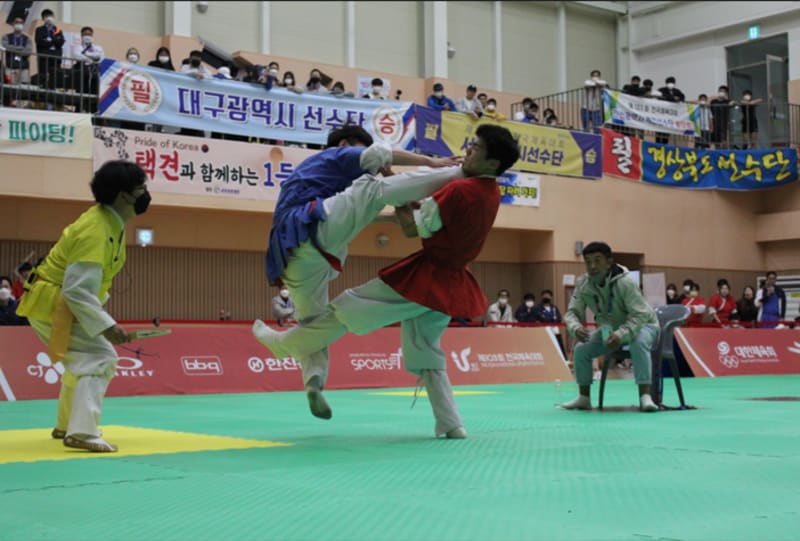
Taekkyeon (택견, also: Taekkyon) is Korea’s oldest and most distinctive martial art — a folk art that survived for centuries as seasonal communal sport, warrior training, and cultural practice. Taekkyeon differs fundamentally from modern combat sports: it is rhythmic, flowing, almost dance-like — movements are round and organic, never rigid. And yet it is highly effective: leg work dominates, trips and sweeps end fights faster than strikes, and the unpredictable movement structure makes Taekkyeon a difficult-to-pin-down martial art. Taekkyeon almost vanished under Japanese occupation (1910–1945). Song Duk-ki (1893–1987) was the only traditional master who rescued the art in its original form into the postwar era. In 2011 Taekkyeon became the first martial art inscribed on UNESCO’s Intangible Cultural Heritage of Humanity list.
History
The oldest depictions of Taekkyeon-like movements appear in Goguryeo wall paintings (~37 BCE–668 CE) — though direct continuity is contested.
In the Joseon period (1392–1897), Taekkyeon is clearly documented as a seasonal folk art: men competed in spring and summer contests — part of the agrarian community culture. Historical texts of the 18th century describe Taekkyeon as a widespread popular pastime.
During the Japanese colonial period (1910–1945), Korean martial arts and folk culture were systematically suppressed. Taekkyeon was not explicitly banned, but its social context was destroyed. After liberation in 1945, the art was nearly forgotten — only Song Duk-ki still possessed complete mastery.
In 1983 Song Duk-ki was designated as a holder of an Important Intangible Cultural Property (Important Intangible Cultural Asset No. 76) — the first official recognition of a Korean martial art. This began the institutional revival.
The claimed influence on Taekwondo — and what Choi Hong Hi said about it in 2001. It is widely taken for granted that the Taekwondo founders knew Taekkyeon and borrowed elements from it, and that the name “Taekwondo” picks up the “Taek” of Taekkyeon. The echo in the name is real. The borrowing is not documented, and the man behind it denied it himself.
Udo Moenig and Kim Minho assemble three points (Acta Koreana 19/2, 2016, pp. 146–147):
- Where the name actually comes from. In 1954, soldiers under Choi Hong Hi gave a tangsudo — that is, karate — demonstration before President Rhee Syngman. Rhee called what he had seen “t’aekkyŏn”, probably an offhand remark drawn from a vague childhood memory. For the emphatically anti-Japanese president a Korean pedigree was needed; a year later Choi coined the term “taekwondo”. What decided it was the similarity in sound, not in technique.
- Not a single Taekkyeon technique appears in the early manuals. Neither in Choi’s nor in those of the other pioneers; the few Taekkyeon elements in today’s Taekwondo were introduced much later.
- Choi Hong Hi (1918–2002) admitted it. In an interview in 2001, shortly before his death, he said he had never learned any Taekkyeon — in his youth he had played soccer, and later studied karate — and that he had invented the Taekkyeon narrative to give Taekwondo the legitimacy it lacked because of its Japanese karate roots (as cited in Han 2003: 193).
The Taekkyeon side has never claimed the connection. It came from the other direction, and out of a political need. This devalues neither Taekkyeon nor Taekwondo — it only assigns the story to its owner. The same process the article on Hwarangdo describes for the warrior code, thirty years later and with a witness who recanted.
Technical Foundations
Taekkyeon’s most characteristic feature is the Triangular Step (Pumbalkgi, 품밟기): the practitioner moves continuously in triangular, rhythmic steps — never standing still, always in motion. This fundamental gait makes Taekkyeon immediately recognizable.
| Concept | Meaning |
|---|---|
| Pumbalkgi | Triangular rhythm step — fundamental movement |
| Gyeolsaeng | Decisive finish — kick or sweep |
| Balgisul | Leg techniques — core of the system |
| Songi | Hand techniques — supplementary, not dominant |
Core Techniques
Leg work dominates Taekkyeon completely:
- Bitchigi — rotating leg techniques
- Chari — kicks of various types
- Georeo chagi — trips and sweeps at ground level
- Eokke milgi — shoulder push to destabilize
Hand techniques (Songi) are secondary, serving primarily to distract and open defenses — rarely as primary attack tools.
The goal in Taekkyeon contests: bring the opponent to the ground or force them out of the area. No point sparring — trips and sweeps are often more effective than kicks.
Philosophy and Community
Taekkyeon is a community art. In the Joseon period, the seasonal contests served not just sport but social bonding between village communities, physical cultivation, and the maintenance of regional identity.
The rhythmic, dance-like nature is not a weakness — it is strategic: an opponent who doesn’t know when a dance-like rhythm will transition into a lightning-fast sweep is always on the defensive.
“Taekkyeon is like a flowing river. No one fights a river — they get swept along.” — Korean tradition
Connections to Other Martial Arts
- Taekwondo — Taekkyeon influenced Taekwondo’s development; shared emphasis on leg work
- Ssireum — Korean wrestling; practiced alongside Taekkyeon as folk combat sport in the Joseon period
- Hapkido — all three form the core triangle of Korean martial arts
Today
Taekkyeon is actively taught in Korea and has been UNESCO World Heritage since 2011. The Korea Taekkyon Association coordinates training, competitions, and international dissemination.
Internationally, Taekkyeon remains little spread — in the shadow of Taekwondo. The art is slowly gaining interest, particularly among practitioners seeking authentic Korean martial arts.
Related Articles
- Taekwondo
- Hapkido
- Budo
- Subak — the older mention, for which — unlike here — no technique survives
- Gungsul — the third Korean art with unbroken practice
- Sibpalgi — the reverse case: a canon with a date but without a transmitter
- Footwork Compared — pumbalki set beside seven other answers to the same question