Bodhidharma — The Legend at the Origin of All Martial Arts
Bodhidharma (5th/6th c.) brought Chan Buddhism to China — whether he also taught the Shaolin martial arts is legend. But his cultural legacy is real and immense.
Contents
Overview
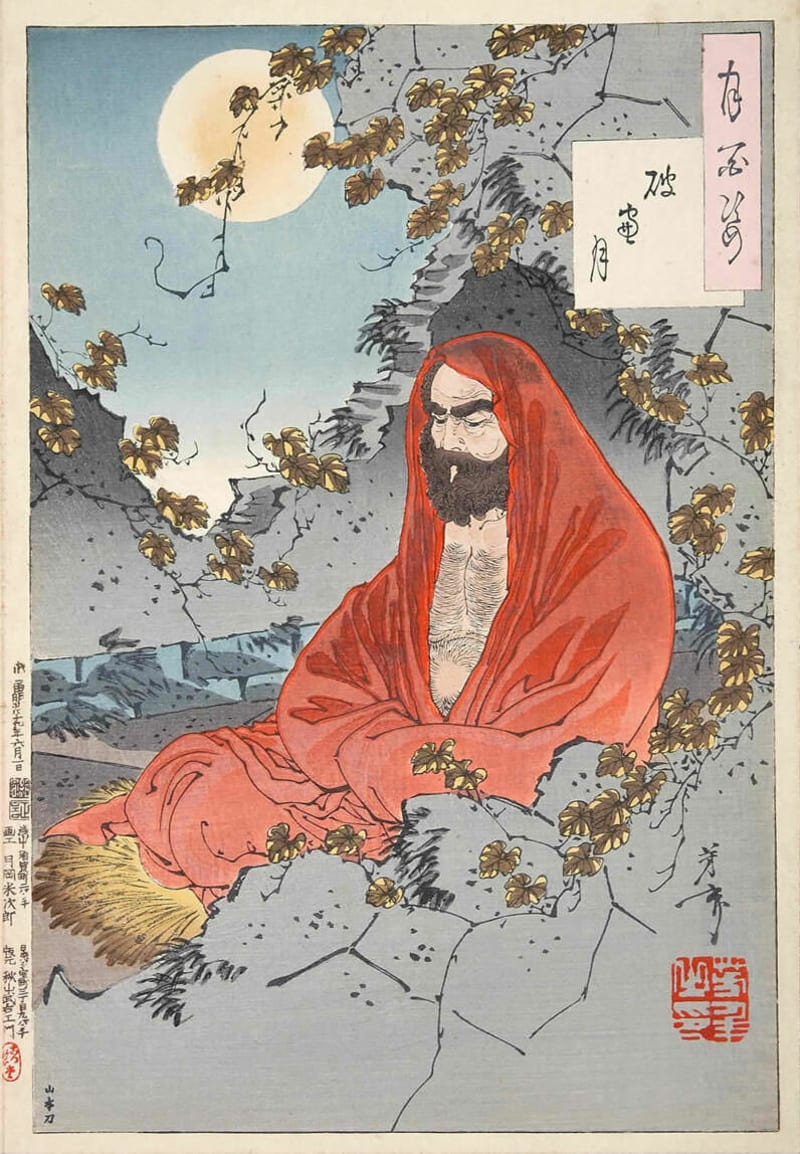
Bodhidharma — Daruma in Japan, Damo in China — is the most mythologized figure in Asian martial arts history. The Indian monk who traveled to China and meditated facing a cave wall for nine years is credited as the founder of Chan Buddhism (later Zen) and — according to popular legend — the originator of Shaolin martial arts. Historians cannot verify the second claim; the first is established fact. What Bodhidharma actually left behind is a philosophical foundation without which neither the Zen aesthetic nor the spiritual dimension of most East Asian martial arts would exist.
| Name | Bodhidharma (Sanskrit); Pútídámó (Chinese); Daruma (Japanese) |
| Lived | c. 5th–6th century CE |
| Origin | India (likely a South Indian kingdom) |
| Key site | Shaolin Temple, Henan, China |
| Key attribution | Yijin Jing (Sinew Transformation Classic) |
| Religious tradition | Chan Buddhism (1st Chinese Patriarch) |
The Historical Person
Bodhidharma is a semi-legendary figure. Chinese sources from the Tang Dynasty (618–907) describe him as a monk from the Western Regions — meaning either Central Asia or the Indian subcontinent. He is established as the first patriarch of Chan Buddhism in China.
What is historically certain: he taught a meditation practice (dhyana, Chinese chan) based on direct experience rather than scriptural scholarship — a radical approach in the Chinese Buddhist landscape of his time. His message: “Point directly at the human mind. See your nature and become Buddha.”
The Legend
The connection to Shaolin martial arts emerged centuries after his death. According to a 17th-century account, Bodhidharma found the Shaolin monks physically weakened and mentally sluggish. He allegedly gave them two texts: the Yijin Jing (Sinew Transformation Exercises) and the Xisui Jing (Marrow Washing Exercises) — physical practices that became the foundation of Shaolin martial arts.
Modern historians have identified this account as an apocryphal 17th-century construct — likely written to legitimize martial arts with religious authority. This does not diminish its cultural power.
Turning Points
Nine years of wall-gazing: The most famous story about Bodhidharma describes him staring at a rock wall for nine years — until his outline was supposedly carved into the stone. This endurance became the symbol for zazen (seated meditation) and the indomitability of the Zen spirit.
The Daruma figure in Japan — the round-faced, eyeless ceramic doll whose eyes you paint in when wishes come true — is Bodhidharma’s most popular cultural legacy. It stands for perseverance, rising after defeat, and determination.
Philosophy
Bodhidharma’s Chan teaching formulated a revolutionary paradox: the mind is already enlightened — enlightenment is not acquired but recognized. Meditation is the direct path to this recognition, without the detour of rituals or scriptures.
For martial arts this means: the perfect fighting mind is not the result of training, but the removal of obstacles — fear, greed, ego. Mushin (mind without mind) and Zanshin (alert awareness after combat) are philosophically rooted in Bodhidharma’s teaching.
Legacy in the Martial Arts
Whether Bodhidharma actually taught martial arts or not — his spiritual legacy permeates them all:
- Zen in Japanese martial arts: Kendo, Aikido, Kyudo — all emphasize mental cultivation
- Shaolin Temple: the center of Chinese Kung Fu is inseparable from his legend
- Breathing exercises (qigong, ki-training): trace to the physical practices attributed to him
- Daruma pedagogy: the idea that martial art is character building traces to what Bodhidharma symbolizes in China
Connections to Other Arts
Shaolin Kung Fu carries him as its mythical founder. The philosophical influence on Zen-Budo (Japanese martial arts with a meditative component) is direct. Wing Chun legends name a nun called Ng Mui as a student of a Shaolin monastery — and therefore indirect heir to Bodhidharma’s legacy.
Today
Bodhidharma is a fixed element of martial arts mythology even as historians correct his role. The Shaolin Temple actively uses his legend for tourism and cultural prestige. In films, manga, and video games, Daruma is a symbol of unbeatable determination. And his spiritual legacy — direct experience as the path to truth — lives in every serious martial art.
Related Articles
- Kung Fu / Wushu
- Zen in Budo
- Mushin — Mind Without Mind
- Shaolin Kung Fu — what the monastery actually documents — and when the attribution was added
- Shorinji Kempo — an art of 1947 that carries the temple in its name and gives the date itself
- Vasili Oshchepkov — the reverse case: a documented origin that was removed