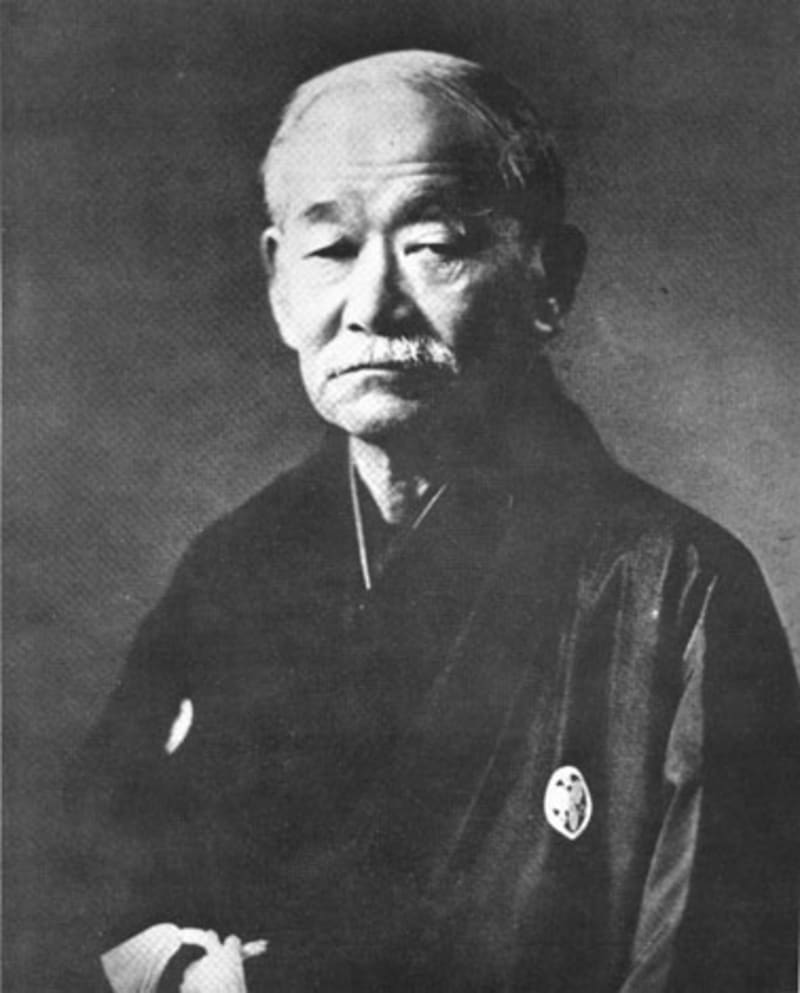
Jigoro Kano — The Father of Judo
Jigoro Kano (1860–1938) transformed brutal Jiu-Jitsu into Judo — the first modern martial art with an educational mission and an Olympic legacy.
Contents
Overview
Jigoro Kano is arguably the most influential martial arts reformer in history. He did not merely create Judo — he invented the concept of budo as an educational system. Teacher, diplomat, Olympic official, and thinker, he introduced randori (free practice), created the colored belt hierarchy, and brought Judo to the Olympic Games. His motto Seiryoku Zen’yo (maximum efficiency, minimum effort) remains one of the most widely known principles in the martial arts world.
| Birth name | Kanō Jigorō (嘉納治五郎) |
| Born | October 28, 1860, Mikage, Hyogo, Japan |
| Died | May 4, 1938, aboard the Hikawa Maru |
| Martial art | Judo (founder), Tenjin Shin’yo-ryu Jiu-Jitsu, Kito-ryu |
| Teachers | Fukuda Hachinosuke, Iso Masatomo, Iikubo Tsunetoshi |
| Notable students | Mitsuyo Maeda, Yoshiaki Yamashita |
Early Life and Training
Kano grew up as a physically weak boy in a sake-brewing family. Bullied at school, he began searching for Jiu-Jitsu instruction at 14 — but the old schools were in decline, marginalized by the Meiji modernization that had swept away samurai culture. He eventually found teachers and mastered two major traditions: Tenjin Shin’yo-ryu and Kito-ryu.
In May 1882, aged 21, he founded the Kodokan (Hall for the Study of the Way) in a Tokyo temple with nine students. Judo was born.
Turning Points
In 1886, the Tokyo Metropolitan Police organized a tournament between Kodokan Judo and the established Fusen-ryu Jiu-Jitsu school. Kano’s students won 13 of 15 bouts — a historic victory that secured government recognition and established Judo as Japan’s premier martial art.
In 1909, Kano became the first Asian inducted into the IOC (International Olympic Committee), paving Japan’s participation in the 1912 Olympics. He spent his final decades working to make Judo an Olympic event — a goal achieved in 1964, 26 years after his death.
Techniques and Principles
Kano eliminated the most dangerous Jiu-Jitsu techniques and developed a system that allowed intensive safe training:
| Category | Description |
|---|---|
| Nage-waza (throws) | 67 classical throws ordered by principle |
| Katame-waza (groundwork) | Holds, chokes, armlocks |
| Randori | Free practice — Kano’s pedagogical innovation |
| Kata | Formal exercises preserving classical techniques |
Philosophy
Kano’s two core principles structure his entire work:
Seiryoku Zen’yo (精力善用) — Maximum efficiency with minimum effort: technique and timing, not strength. A life philosophy as much as a martial principle.
Jita Kyōei (自他共栄) — Mutual welfare and benefit: not victory over others, but growth together. Randori is only possible because both partners challenge each other — and both become stronger.
Kano explicitly understood Judo as an educational instrument. He wrote: “The aim of Judo is to cultivate the body and mind and ultimately to serve society.”
Students and Legacy
- Mitsuyo Maeda traveled to Brazil and taught the Gracie family — the source of Brazilian Jiu-Jitsu
- Yoshiaki Yamashita brought Judo to the United States, teaching President Theodore Roosevelt
- Mifune Kyuzo was considered the most technically perfect judoka of his generation
The Kodokan in Tokyo still stands today as the world center of Judo.
Connections to Other Arts
Jiu-Jitsu is Judo’s direct ancestor. Brazilian Jiu-Jitsu traces directly to Kano’s student Mitsuyo Maeda. Philosophical parallels with Aikido exist in the centrality of jū (yielding) — both Kano and Ueshiba were reform-minded visionaries who knew and respected each other.
Today
Judo has been an Olympic sport since 1964 with over 40 million practitioners worldwide. Kano’s belt ranking system and the principle of free practice (randori) have influenced virtually every modern martial art. His pedagogical writings are foundational texts of modern Budo philosophy.
Related Articles
- Judo — The Gentle Art of Throwing
- Brazilian Jiu-Jitsu
- Budo — Philosophy of the Martial Way
- Keiko Fukuda — his student, and the granddaughter of his own first jūjutsu teacher
- Rusty Kanokogi — he set up the women’s section; she made the separation disappear