Morihei Ueshiba — The Creator of Aikido
Morihei Ueshiba (1883–1969) transformed the art of war into a philosophy of reconciliation — Aikido, the way of harmonious energy.
Contents
Overview
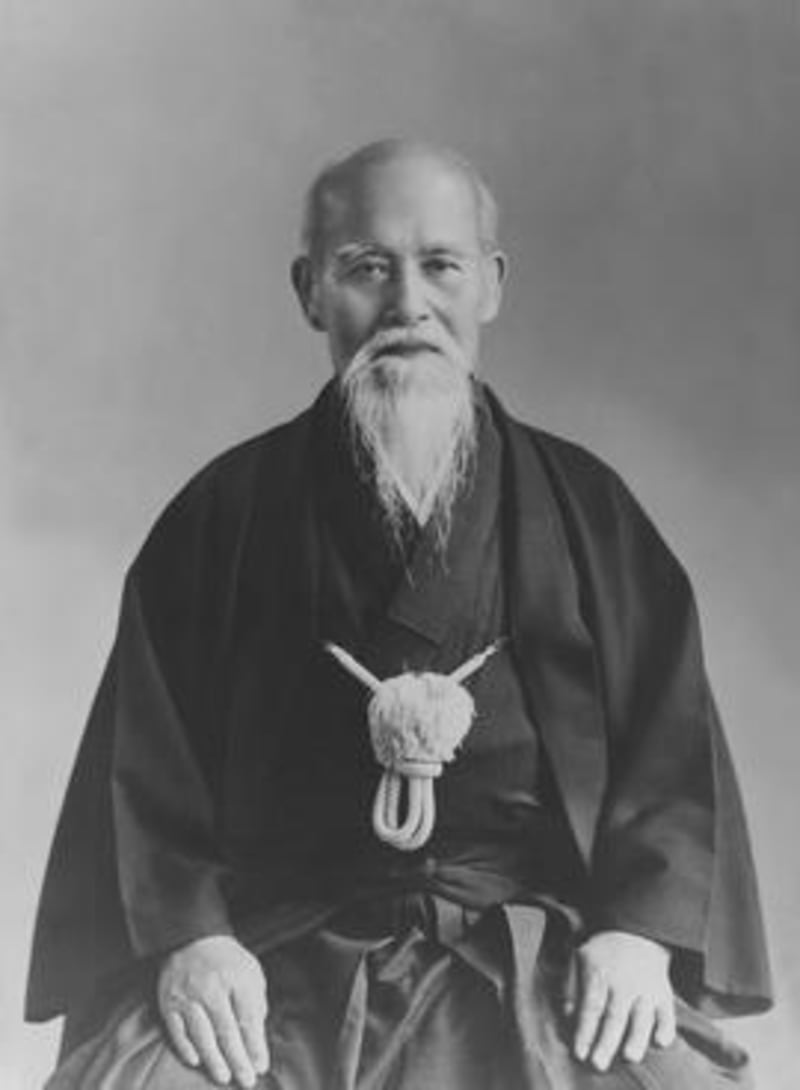
Morihei Ueshiba stands as one of the most profound martial artists of the 20th century. Known reverently as Ōsensei (Great Teacher), he created Aikido — a martial art rooted not in destruction but in harmony. He began as a soldier and fighter; he ended as a philosopher who believed love was the highest martial principle. His life is a story of spiritual transformation that shaped a practice for millions worldwide.
| Birth name | Morihei Ueshiba |
| Born | December 14, 1883, Tanabe, Japan |
| Died | April 26, 1969, Ayabe, Japan |
| Martial art | Aikido (founder), Daito-ryu Aiki-Jujutsu, Judo |
| Teachers | Takeda Sōkaku (Daito-ryu), Onisaburo Deguchi |
| Notable students | Koichi Tohei, Kisshomaru Ueshiba, Gozo Shioda |
Early Life and Training
Ueshiba was born a frail child into a merchant family. His father encouraged him toward sumo and swimming to build strength. He enlisted in 1903 and served in the Russo-Japanese War (1904–1905); in 1915 he settled in Hokkaido — where the pivotal encounter of his life took place.
There he met Takeda Sōkaku, the grandmaster of Daito-ryu Aiki-Jujutsu, and became his most devoted student, earning teaching credentials in record time. Simultaneously, he grew close to the Omoto-kyo spiritual movement under Onisaburo Deguchi — a relationship that would permanently alter his worldview.
Turning Points
In 1925, after a sparring encounter with a naval officer, Ueshiba experienced a moment of mystical clarity in his garden. He described golden light rising from the earth and an overwhelming understanding: true martial art is not victory over others, but victory over one’s own ego.
During World War II he withdrew from public life, rejecting the militarization of his art. In his final period at Iwama, he deepened Aikido’s spiritual dimensions into the form practiced today.
Techniques and Principles
| Category | Examples |
|---|---|
| Throwing techniques (nage-waza) | Irimi-nage, Tenchi-nage, Koshi-nage |
| Joint locks (kansetsu-waza) | Ikkyo through Yonkyo, Kote-gaeshi |
| Pinning (osae-waza) | Shiho-nage, Nikyo |
| Weapons | Bokken, Jo, knife defense |
Philosophy
Ueshiba’s teaching centers on masakatsu agatsu katsuhayabi — “true victory is self-victory, here and now.” He saw Aikido as budo in its truest sense: not a war art, but a path of self-perfection.
Central to his thought was musubi (connection): attacker and defender should merge into a harmonious flow rather than oppose each other. The opponent is not an enemy but a partner on the path to understanding. This stance made Aikido the first major martial art to explicitly ground itself in pacifism.
Students and Legacy
- Kisshomaru Ueshiba (son) continued the Aikikai Hombu Dojo in Tokyo
- Koichi Tohei founded Ki-Aikido with an emphasis on ki development
- Gozo Shioda developed Yoshinkan Aikido — a more martial style
- Morihiro Saito preserved the Iwama style with a strong weapons component
Connections to Other Arts
Aikido grew directly from Daito-ryu Aiki-Jujutsu and shares philosophical parallels with Judo in its emphasis on jū (yielding). Ueshiba corresponded with Jigoro Kano and sought dialogue with other Budo reformers.
Today
Aikido is practiced in over 140 countries. The ongoing debate about its combat effectiveness is, paradoxically, philosophically coherent: a system that explicitly avoids competition cannot be judged by competitive standards. Ueshiba’s legacy lives in dōjō across more than 140 countries and in his text Budo (1938).
Related Articles
- Aikido — The Way of Harmonious Energy
- Daito-ryu Aiki-Jujutsu
- Budo — Philosophy of the Martial Way
- Takeda Sōkaku — his teacher from 1915; the word aiki appears in his books only in 1922