Musō Gonnosuke — the Founder Who Barely Exists
Almost nothing about his life can be verified. The defeat by Musashi is attested several times — the victory his school rests on stands in a single scroll.
Contents
Overview
Musō Gonnosuke Katsuyoshi (夢想権之助勝吉) is held to be the founder of jōdō and of the Shintō Musō-ryū school, which arose around 1605. That makes him the originator of Japan’s oldest fully formulated jō system.
Almost nothing about his life can be verified.
That is not a shortcoming of this article but its subject. This encyclopedia’s stock contains in Kanbun Uechi a founder whose path can be documented year by year — city, date, teaching licence, duration of training. Musō Gonnosuke is the opposite case: a founder who left behind a school, a weapon and a story, but hardly a person.
And the story has a point where it grows especially thin — precisely the one everything rests on.
The story as it is told
Gonnosuke, a samurai of the early seventeenth century and by his own claim undefeated, challenged Miyamoto Musashi to a duel.
He lost. Musashi parried his attack with the bō — in one account with bare hands, in another with crossed swords.
Gonnosuke then withdrew. At the shrine on Mount Hōman he is said to have received a revelation whose core is a single sentence:
Know the solar plexus with a round stick.
From that revelation he developed the jō and a sequence of techniques aimed expressly at Musashi’s two-sword style. In a second duel, so the story goes, he won.
The withdrawal after defeat is at the same time the model case of shugyō — the deepening that follows from failure. As a narrative form the story is hard to beat.
What of it is documented — and what is not
Here the matter divides, and the dividing line runs unfavourably for the school.
| Source | Dating | What it attests |
|---|---|---|
| Kaijō Monogatari | 1629 or 1666, depending on the scholar | the first duel |
| Honchō Bugei Shōden | c. 1716 | the first duel |
| Niten-Ki | after Musashi’s death, compiled by his followers | the first duel |
| a single scroll at Tsukuba Shrine | — | the second duel |
The first duel is attested in several mutually independent works. Even the earliest of them, however, lies at least fifteen and possibly more than fifty years after the events; the duel itself is dated only vaguely to the period between 1596 and 1614.
The second duel stands in a single scroll, whose contents are doubted because no other source supports them. Outside the jōjutsu tradition there is no corroboration, and the sword schools deny on principle that Musashi ever lost.
And that is the actual finding
The defeat is comparatively well attested. The victory is not.
The founding story of Shintō Musō-ryū therefore rests on exactly the event nobody outside the school recorded. That does not make it false — but it makes it a statement by the school about itself.
About the person there is more to add: much of what has been written about Gonnosuke was embellished by later authors; part of the material portraying him as a colourful braggart arose long after his lifetime. Not even his birth and death years are secure — he is listed as “early seventeenth century”, and the tradition yields no more.
The twenty-eight centimetres
What can be checked, by contrast, is the weapon.
| Length | |
|---|---|
| jō | about 128 cm |
| katana, overall | about 100 cm |
The whole art rests on twenty-eight centimetres. The jō is long enough to land before the sword and short enough not to become a burden at close range.
That is exactly the trade the comparison of stick-fighting systems states as a general rule: length is a trade, not an advantage. A long staff is superior at range and a burden up close — and the legend of Musashi and Gonnosuke tells precisely that, since Gonnosuke lost with the bō and supposedly won with the shorter jō.
That makes the measurement the most interesting part of the tradition. The story may be embellished; the decision to go from the bō class above 150 cm down to 128 cm is a technical one, and it can be read off the weapon. The stick-fighting programme uses the same legend for the same reason: it is the clearest recorded case of somebody deliberately giving up length.
What actually endured
The school. Not the man.
The Kuroda clan asked Gonnosuke to teach selected warriors in Fukuoka the use of the jō. Out of that grew Shintō Musō-ryū — and that line is institutionally traceable, across centuries, in a named domain with named bearers.
This is the inversion of the pangai-noon case: there the Okinawan side of the tradition holds and the Chinese side dissolves. Here the institution holds and the founding story dissolves.
Taken together the two yield a rule of thumb for martial arts history that keeps proving useful in this stock: what was administered is verifiable. What was narrated rarely is.
The portrait
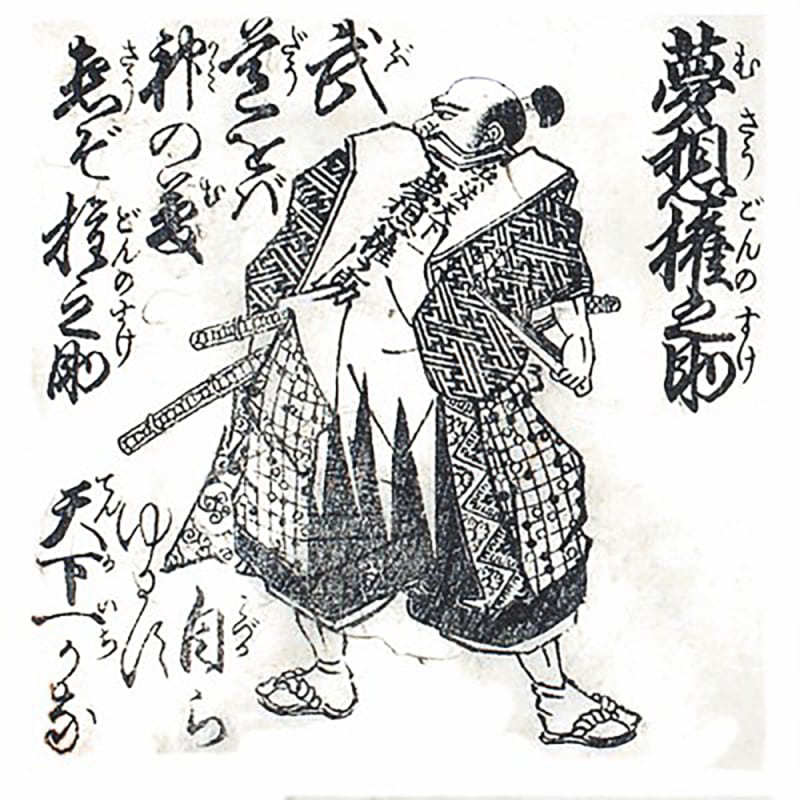
The image on this article is the only widely circulated depiction of Gonnosuke: an anonymous work, dated before 1800, held at the Musashi Shrine in Miyamoto, Okayama Prefecture.
That, too, belongs to the matter. The only face handed down of Musō Gonnosuke hangs in his opponent’s shrine.
Related Articles
- Jōdō — the art traced back to him, and Japan’s oldest fully formulated jō system
- Bōjutsu — the weapon he lost with, and the occasion for the switch to the shorter jō
- Miyamoto Musashi — the opponent in whose shrine his portrait is kept
- Stick Fighting Compared — where the rule stands that explains his 128 centimetres
- Stick Fighting Programme — uses the same legend as the clearest case of deliberately giving up length
- Kenjutsu — the art the jō was developed against
- Shugyō — withdrawal after defeat as the model case
- Kanbun Uechi — the opposite case: a founder whose path can be documented year by year
- Takeda Sōkaku — the model case for the rule stated there: what was administered is verifiable