Ogasawara Nagakiyo — the founder who was given etiquette afterwards
Bow, horse and manners in one school — this encyclopedia calls that strange. The resolution is that they only came together later.
Contents
Overview
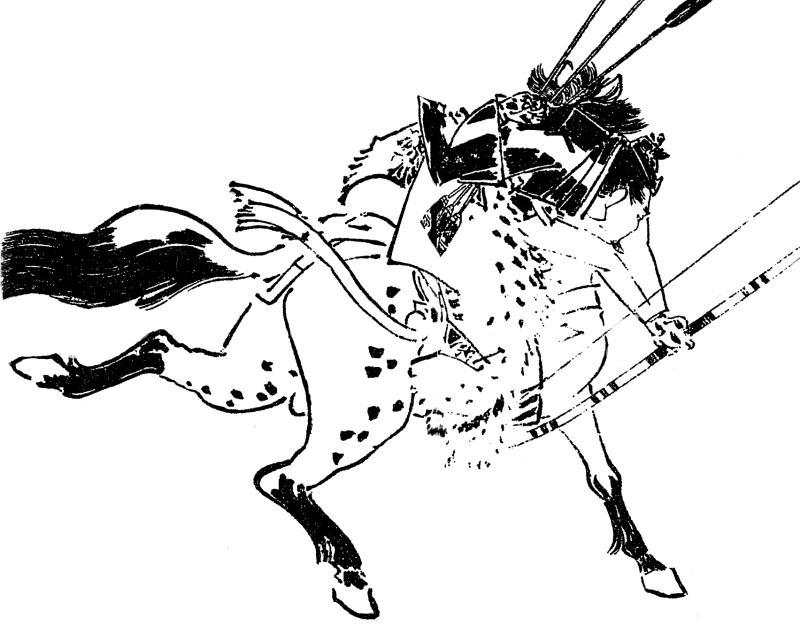
Ogasawara Nagakiyo (5 March 1162 – 15 July 1242) was a samurai of the late Heian and early Kamakura period and progenitor of the Ogasawara house. Minamoto no Yoritomo appointed him instructor of archery and horsemanship. The Ogasawara-ryū, which still exists, traces itself back to him.
The article on Reigi puts a question to this school and leaves it open: the Ogasawara-ryū unites three subjects that to Western eyes do not belong together — archery, mounted archery (yabusame) and reihō, the teaching of manners. Why does the same school teach how to hit a target and how to bow?
The answer is that originally it did not. Nagakiyo taught bow and horse. Etiquette arrived some hundred and thirty years after him, through a different man, on a different occasion — and was later backdated onto the founder.
What Nagakiyo actually taught
Yoritomo’s appointment concerned kyūba no michi, the “way of bow and horse” — the standing term for warrior training of the period. That is a military task: a Kamakura warrior fought mounted with the bow, and whoever mastered both at once was the army’s actual weapon.
Archery and mounted archery belong together within that without further ado. They are the same thing in two postures, and their connection needs no explanation. What needs explaining is the third subject alone.
How etiquette arrived
Sadamune, 1292–1347
Ogasawara Sadamune was a close ally of Ashikaga Takauji and was placed by him in charge of court etiquette. That is the key: it was not an archer who discovered manners, but an official responsible for ceremonial who happened to head an archery school.
Sadamune wrote the Shinden kyūhō shūshinron, regarded as a classic text of kyūjutsu, and through his teacher Seisetsu Shōhō brought Zen practice into the school — a trait that later made the connection of technique and bearing look all the more natural.
Nagahide, 1380
Three generations after Sadamune, Ogasawara Nagahide wrote the Sangi Ittō, the school’s first manual of courtly etiquette.
Do the arithmetic and the result is plain: between Nagakiyo’s death (1242) and the school’s first etiquette manual lie 138 years. The subject for which the Ogasawara-ryū is best known outside Japan today is younger than the founder it is attributed to.
The attribution, and what sets it apart from others
This encyclopedia records a series of backdated origins: Bodhidharma for Shaolin, Yue Fei for several Chinese styles at once, the Hwarang of the Silla kingdom for a twentieth-century art. The Ogasawara case belongs among them — but it is the mildest, and the difference is worth naming.
| Invented attribution | Ogasawara | |
|---|---|---|
| Did the person exist? | partly legendary (Bodhidharma), partly real but unconnected (Yue Fei) | real, dated, appointed as instructor on record |
| Did the line exist? | often unverifiable | continuous, by name, across generations |
| What was backdated? | the whole art | one subject that was added later |
The Ogasawara-ryū claims no descent it does not have. It has one, and it is well documented. What was backdated is not the school but the self-evidence of its scope — the impression that bow and bearing were one thing from the start.
It is precisely that impression which produces the question in the Reigi article. Anyone who knows that etiquette entered through a court office no longer finds the scope puzzling but explicable.
The second process: a warrior teaching becomes a school subject
For centuries the Ogasawara house supplied the etiquette instructors of the shoguns. In the Meiji era, etiquette was then taught in elementary schools — the manners of a warrior caste became teaching material for all children.
This process is not new in this encyclopedia. Ankō Itosu brought karate into the Okinawan schools in 1901, and the comparison of dō and jutsu describes what regularly happens then: the subject becomes more widely accessible and is at the same time changed in what it contains. What arrives in the school is the form; what does not arrive is the purpose the form once served.
With karate this can be shown in the techniques. With etiquette it is less conspicuous, but it is the same cut: a bow that once governed how two armed men faced each other becomes an instruction on how a child greets a teacher.
What is established and what is not
Established: Nagakiyo’s dates, his appointment by Yoritomo as instructor of bow and riding, Sadamune’s office under Takauji and his treatise, the Sangi Ittō of 1380, the house’s centuries-long standing as etiquette instructors to the shoguns, the elementary-school teaching of the Meiji era.
Not established: what Nagakiyo taught in detail. No teaching text survives from the twelfth century; what the school attributes to him is transmitted through later generations. The article therefore does not claim that Nagakiyo taught no manners — a warrior in Yoritomo’s service obviously had them. What is claimed is what can be shown: as a distinct, named, written subject, reihō appears only with Sadamune and Nagahide.
The difference between “he behaved well” and “he taught behaviour” is exactly where attributions are born.
Related Articles
- Reigi — the article that asks the question this one answers
- Kyūjutsu — the war craft of the bow, Nagakiyo’s actual subject
- Kyūdō — what became of it once the purpose fell away
- Bushidō — the code concept that encourages such attributions
- Ankō Itosu — the same process in Okinawa: a martial art becomes a school subject
- Dō and Jutsu Compared — what changes when a purpose becomes a way
- Zanshin — the alertness that has its clearest place in archery
- Shu-Ha-Ri — how schools order transmission, and what gets smoothed over