Bushido — The Way of the Warrior
Bushido is the samurai code of honour — a canon of courage, loyalty and honour that continues to shape Japanese culture, martial arts and aesthetics to this day.
Contents
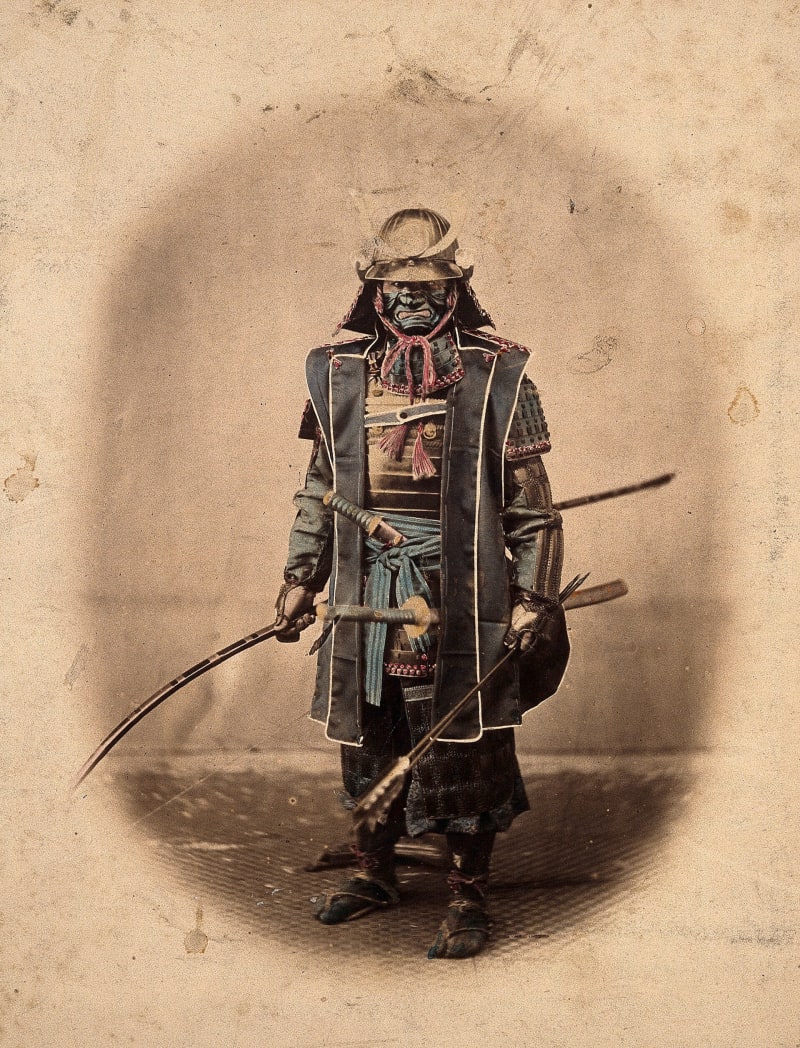
Bushido (武士道) — “the way of the warrior” — is the unwritten code of honour of the Japanese samurai. It draws on Confucianism, Zen Buddhism and Shinto to articulate the values that governed a warrior’s relationship to combat, death, service and humanity. Never codified as a formal rulebook, Bushido lived as cultural practice: in the way one wore the sword, served one’s lord, and faced death.
Its greatest influence on the Western world came through Inazo Nitobe’s book Bushido: The Soul of Japan (1900), which offered Western readers an accessible overview — though Nitobe significantly idealised the concept and wove in Christian values. The older, harsher counterpart is the Hagakure by Yamamoto Tsunetomo (c. 1716), which preserves the spirit of the early samurai without softening or compromise.
Today Bushido persists in the martial arts — in the bow, in respect for the opponent, in the discipline of daily training. It is not nostalgia but a living ethical system asking: how should a person live who looks death in the face?
Origins and History
Pre-samurai period: The term Bushi (武士, armed warrior) emerged in 10th-century Japan as the nobility cultivated warrior classes to enforce their authority. No formal code existed — loyalty and courage were taken as self-evident.
Kamakura period (1185–1333): With the first samurai government at Kamakura, a distinct warrior culture emerged. Zen Buddhism, introduced from China by the monk Eisai, gained influence: meditation, self-discipline, equanimity toward death — Zen values that aligned with the warrior ideal.
Edo period (1603–1868): The long peace of the Edo era confronted samurai with a paradox: they were warriors without wars. Reflection on the meaning of being a warrior deepened. Yamamoto Tsunetomo dictated the Hagakure to his student — a work later misread as a “samurai manual” but in reality a personal meditation on loyalty and death.
1900 — Nitobe: Diplomat and Christian, Inazo Nitobe wrote Bushido: The Soul of Japan in English to explain Japan to the West. He identified seven core principles and drew parallels with European chivalry. The book became a bestseller — and still shapes the Western image of the samurai.
Militarism and misuse: In the 20th century, Bushido was exploited by Japan’s military government to motivate soldiers to sacrifice themselves for the emperor. This perverted version has little to do with the classical code.
The Seven Virtues
| Virtue | Japanese | Meaning |
|---|---|---|
| Righteousness | 義 Gi | Ethical action, incorruptibility |
| Courage | 勇 Yū | Fearlessness, especially before death |
| Compassion | 仁 Jin | Kindness and humanity toward others |
| Respect | 礼 Rei | Courtesy, ceremony, dignity |
| Sincerity | 誠 Makoto | Truthfulness in word and deed |
| Honour | 名誉 Meiyo | Reputation as the highest good |
| Loyalty | 忠義 Chūgi | Unconditional service to one’s lord |
Some schools add Self-control (自制 Jisei) and Duty (義務 Gimu).
Core Principles
Death as constant companion: The most famous line of the Hagakure: Bushido to wa shinu koto to mitsuketari — “The way of the samurai is found in death.” This does not mean a longing for death, but complete presence: whoever has accepted death acts without hesitation, without calculation.
Chu — Loyalty: The samurai serves his lord (Han) absolutely. But this loyalty is not blind obedience — a samurai who accompanies his lord without honest counsel fails in his duty. True service includes speaking difficult truths.
Seppuku: Ritual suicide by abdominal incision was the ultimate means of restoring honour or escaping capture. It was not an act of weakness but of final control over one’s own fate.
Bunbu Ryodo — The dual path: Martial arts and literature as equally important education. A warrior who can only fight is a tool. One who reads, writes poetry and paints understands what he is fighting for.
Philosophical Influences
Confucianism: Hierarchy, duty, self-cultivation — the Confucian five-relations model (lord–vassal, parent–child, spouses, siblings, friends) structures the social foundation of Bushido.
Zen Buddhism: Meditative practice, presence in the moment, equanimity toward life and death. Sword and Zen united in the concept Ken Zen Ichi Nyo — “Sword and Zen are one.”
Shinto: Reverence for ancestors, nature, one’s bloodline. The samurai as a link in a chain of generations — his actions honour or shame those who came before.
Connections to the Martial Arts
Bushido is not a combat system — it is the spirit in which all Japanese Budo arts are practised:
- Kendo — The living sword school; kata and kata-ethics are direct embodiments of Bushido
- Judo — Kano’s “maximum efficiency, mutual welfare” carries Bushido values into the modern era
- Aikido — Ueshiba’s peace-Budo is a post-militaristic response to Bushido: the virtues remain, the violence yields
- Kyokushin — “Osu” as lived Bushido maxim: endure under pressure, without complaint
Today — Influence and Critique
Bushido is now a global cultural phenomenon — in martial arts, video games, corporate philosophy and motivational literature. This popularity has a price: the real, historically complex Bushido is frequently reduced to an empty motivational formula.
Critical perspectives: Historians such as Karl Friday argue that “Bushido” was largely an invention of the Meiji era and Western projection — most historical samurai acted opportunistically, not according to a fixed code. Yamamoto Tsunetomo himself spent his later years as a monk, never as a warrior.
What remains: Whatever the historical simplifications, Bushido contains a timeless ethical question: how does one maintain composure under extreme pressure? How does one combine strength with compassion? Every Budo practitioner asks these questions anew.
Related Articles
- Budo — The philosophy of the martial way as self-development
- Zen in Budo — How Zen shaped the warrior ethic
- Mushin — The mental state behind Bushido practice
- Aikido — Bushido reimagined as a philosophy of peace
- Reigi — where the forms actually come from: Ogasawara-ryū, not Zen
- Wu De — the Chinese counterpart term — and the same case of a modern form by a single author
- Hwarangdo — the model on which the Korean warrior code was built in the colonial period
Further Reading
As an Amazon Associate I earn from qualifying purchases. This costs you nothing extra.