Fudoshin — The Immovable Mind
Fudoshin is the immovable mind — the inner stability that is shaken neither by danger nor by praise, neither by pain nor by success, remaining centered through all circumstances.
Contents
Fudoshin (不動心, “immovable mind”) is the Budo concept of absolute inner stability — a mental state that cannot be shaken by any external circumstance. The kanji explains everything: 不 (Fu, “not”) + 動 (Do, “move”) + 心 (Shin, “heart-mind”) = “The heart that does not move.” Fudoshin is not indifference or emotionlessness — it is the deep inner rootedness that allows the practitioner to be fully present without being swept away by emotions. Neither fear nor arrogance, neither pain nor joy, neither the enemy’s threat nor the master’s praise should disturb this state. Fudoshin is thus the operational foundation of all other Budo concepts: without Fudoshin, Mushin (no-mind stillness) is impossible; without Fudoshin, Zanshin (remaining awareness) is brittle. Fudoshin is the rock-solid base upon which the other mental states of Budo are built.
The Kanji
| Kanji | Reading | Meaning |
|---|---|---|
| 不 | Fu | Not, no, un- |
| 動 | Do | Move, movement |
| 心 | Shin | Heart-mind, consciousness |
| 不動心 | Fudoshin | The immovable heart |
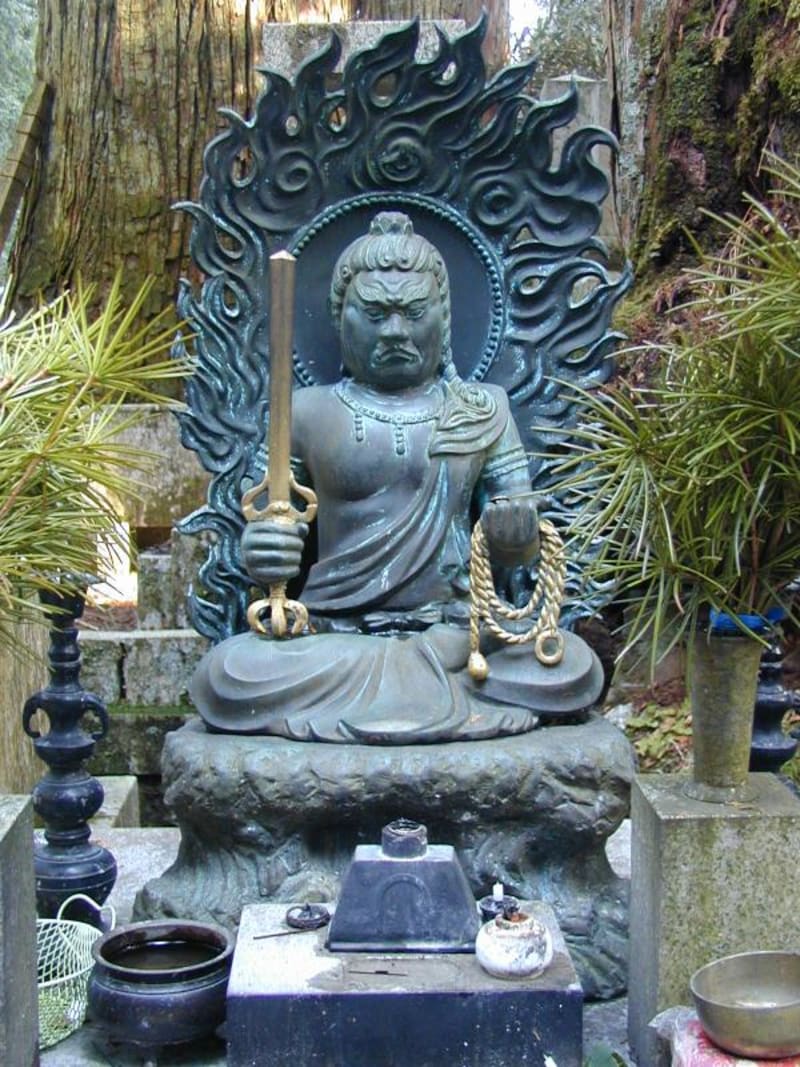
The concept is closely related to Fudō Myōō (不動明王) — the Buddhist deity of immovable will, depicted with a flaming sword that overcomes obstacles of the spiritual path. This deity sits on a rock — unmoving, while flames surround it.
Fudoshin vs. Indifference
An important distinction: Fudoshin is not emotionlessness, coldness, or apathy.
| Fudoshin | Indifference |
|---|---|
| Fully present | Absent |
| Moved stillness | Empty stillness |
| Clear perception of emotion | Suppression of emotion |
| Not controlled by emotion | No emotion |
| Responsive | Unresponsive |
The Fudoshin master feels fear — but is not controlled by it. They recognize pain — but don’t lose orientation. They experience joy — but are not swept away by it.
Fudoshin in Martial Arts Practice
Before combat: The opponent threatens, provokes, bluffs. The Fudoshin fighter observes calmly, without being intimidated or deceived.
In combat: Strikes land, pain arises. The Fudoshin fighter doesn’t lose tactics, technique, or direction.
After combat: Won or lost — both are accepted equanimously. No jubilation that complicates the next encounter; no resentment that poisons the next encounter.
Against emotional attacks: In the Dojo: a master who praises or criticizes. On the mat: an opponent who provokes or intimidates. Fudoshin lets both pass through evenly — neither accepted nor rejected.
Historical Foundations
Fudoshin as a term is deeply rooted in the Japanese Zen tradition. The Chan/Zen master Bodhidharma (Daruma, 5th–6th century) — the legendary transmitter of Chan Buddhism from India to China — reportedly meditated facing a wall for nine years without moving. This image of absolute equanimity is the primordial metaphor for Fudoshin.
In the Samurai context: Yamamoto Tsunetomo wrote in Hagakure (1716): “The Way of the Samurai is the Way of death. When one always thinks of death, the Way of the Samurai becomes clear.” This proximity to death — without fear, without distraction — is Fudoshin in its hardest form.
The Three Levels of Fudoshin
Physical Fudoshin: Stability under physical pressure. The body that still executes precise technique under pain and exhaustion.
Emotional Fudoshin: Stability under emotional pressure. The mind that still thinks clearly in fear, anger, or euphoria.
Spiritual Fudoshin: Stability in the existential dimension. The soul that remains calm in the face of death.
“Fudoshin is not the rock that withstands the storm. It is the water that remains calm no matter what is thrown into it.” — Zen Budo tradition
Fudoshin and Giri
In Japanese ethics, Fudoshin is closely connected with Giri (duty): who knows their duty needs no emotional stabilization through external circumstances. Duty itself is the calm center.
Morihei Ueshiba (Aikido founder) described Fudoshin as: “Connect with the universe, and you are immovable.” — Not through strength, but through harmony.