Kime — The Decided Moment
Kime means decision, not power. A decision became a muscular contraction — and it is exactly at this shift that the criticism begins.
Contents
Kime (決め) is the term with which karate describes the instant in which a technique reaches its target: the abrupt solidification of the whole body at the moment of impact, followed by immediate release. The usual translations are “focus”, “concentration of power”, or simply “snap”. The word, however, says something else. Kime is the noun form of kimeru (決める), and kimeru means to decide, to settle, to bring to a close. A kime is originally not a bodily state but a settled matter: the thing has been decided. That this became a muscular contraction in twentieth-century usage is the most interesting movement in the history of the term — and the point at which the loudest criticism to this day begins. For a decision requires a counterpart. A contraction does not: it can also be performed in empty air, and that is exactly what happens millions of times over in most dojos.
The word
| Character / form | Reading | Meaning |
|---|---|---|
| 決める | kimeru | to decide, to settle, to conclude |
| 決め | kime | the decision, the conclusion |
| 決め技 | kime-waza | the decisive technique, the one that ends the fight |
The original sense survives undisguised in judo to this day. The Kime-no-kata of the Kōdōkan, one of Jigorō Kanō’s classical forms, translates as “forms of decision” — meaning techniques that end an encounter. Muscular tension is nowhere mentioned. The same character therefore means “that which settles the matter” in one Japanese martial art and “briefly tense everything” in another. Anyone wanting to understand the term should start with the first meaning.
What happens in the body
The technical description as taught in Shōtōkan and the related Japanese styles is internally coherent and can be broken into four phases:
| Phase | State of the body | Purpose |
|---|---|---|
| 1. Initiation | maximally loose | Acceleration is possible only without opposing tension |
| 2. Chain | ground → hips → trunk → arm | Transfer of momentum from the large to the small muscle groups |
| 3. Kime | abrupt whole-body tension, centred on the tanden | Bring body mass behind the striking surface, secure the joints against recoil |
| 4. Release | immediate relaxation | Readiness for the next action |
The core is phase 3, and it is not biomechanically absurd. A strike transfers more momentum the greater the effective mass behind the striking surface. A loosely delivered arm strikes with the weight of an arm; an arm braced at the right moment against trunk and supporting leg strikes with a considerable share of the body’s weight. The brief co-contraction of flexors and extensors couples the chain of limbs rigidly, and electromyographic measurements of karate punches show exactly this pattern: joint activation of antagonistic muscles shortly before and around impact. The second, often overlooked purpose is self-protection — an extended but slack elbow joint absorbs the recoil with its ligaments rather than with muscle.
Up to this point kime is uncontroversial. The dispute begins one level higher.
The dispute: kime at the target or kime in the air
If kime is solidification at the instant of impact, then it presupposes an impact. In the training practice of most karate styles, however, it is predominantly practised without a target: the technique is thrown into empty air and braked and braced at its end point. The body inevitably learns something other than what the term means — namely to stop a movement, not to transfer a mass.
The objection runs accordingly: kime in the air is a training artefact. It arises because one practises a process whose decisive part — the resistance of the target — is missing from the training. The braking must then be supplied by the practitioner, and what is visibly trained is the braking.
Three observations support this objection:
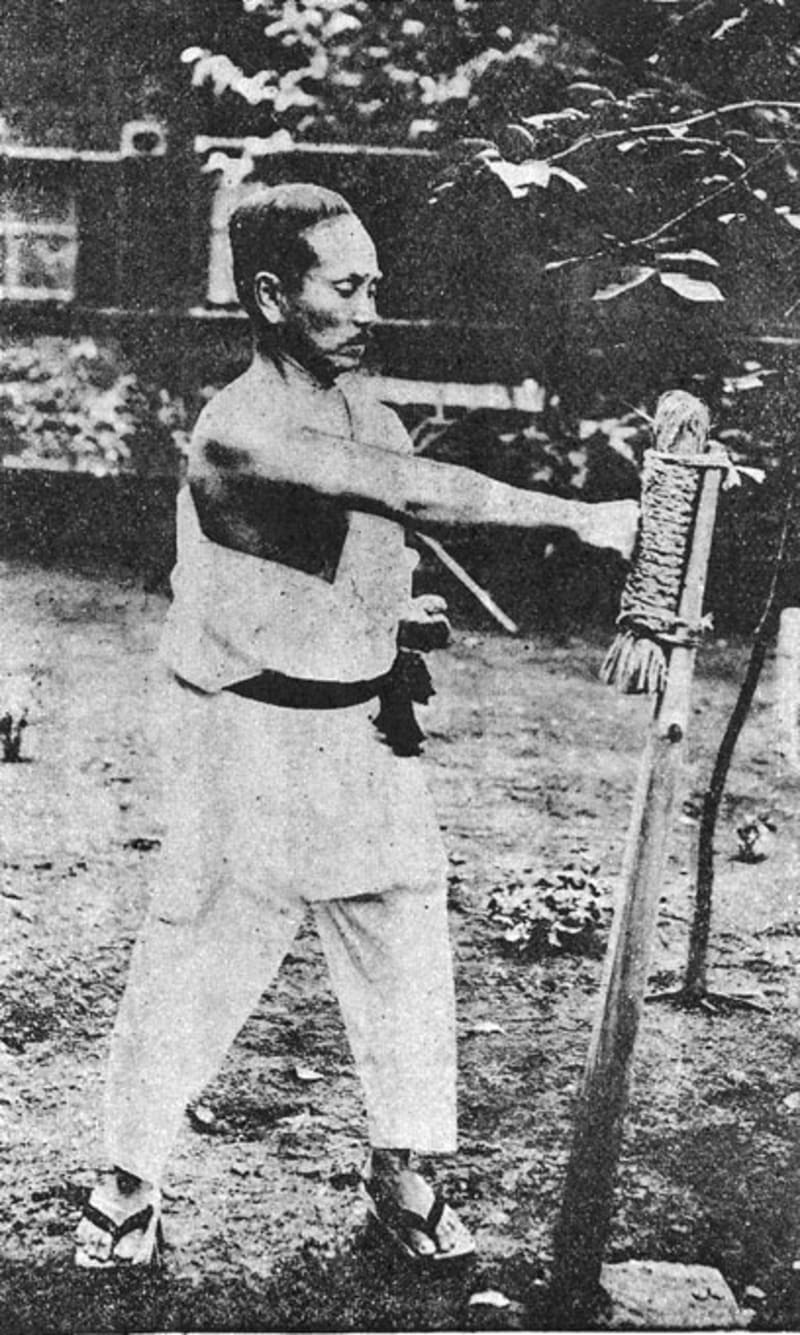
The makiwara solves the problem and is meanwhile becoming rare. At the striking post the target does the braking, and the tension arises where it belongs. This very device, standard equipment in Okinawan karate, has disappeared from many modern dojos — the tension stayed, the target fell away.
Other striking systems do not use terminal bracing. In boxing and Muay Thai one does not solidify at the end point but strikes through the target; the Muay Thai roundhouse kick is deliberately not stopped but swings on. These systems train almost exclusively on the heavy bag, on pads and on people — there the question of where a movement ends is already answered by the target. The comparison of roundhouse kicks shows the same dividing line in kicking mechanics.
The competition rules do not call for kime at all. It is often said that kime is one of the scoring criteria in karate kumite. It is not. The six criteria of the world federation WKF are: good form, sporting attitude, vigorous application, zanshin, good timing and correct distance. “Kime” does not appear among them — the scoring asks for zanshin, that is, for awareness after the technique, and for the distance from which it came. In kata competition, by contrast, kime very much is judged — but there as a visible quality of a form without an opponent, which tends to confirm the criticism rather than refute it.
Conversely, the argument must not be overextended. That training happens without a target does not make co-contraction pointless; anyone who never practises it in isolation cannot call it up when needed. The defensible conclusion is more modest: kime without regular verification against a target becomes something other than what it should be — and does not notice, because in the air every technique looks good.
Chinkuchi — the Okinawan answer
In Okinawa there is a separate word for the related matter: chinkuchi (筋骨 in Okinawan reading; roughly “sinew and bone”). It is readily translated as “the Okinawan kime”, and the translation misleads.
| Kime (Japanese) | Chinkuchi (Okinawan) | |
|---|---|---|
| Literally | Decision, conclusion | Sinew and bone |
| Reference point | A moment — the instant of impact | A state — the structure of the body |
| Describes | a brief, willed contraction | a lasting connection of ground, pelvis and striking surface |
| Related terms | tanden, kokyū | gamaku (pelvic control), muchimi (sticky heaviness) |
Chinkuchi aims not at an instant but at the connection: that at the moment of impact the body acts as one piece because it is structurally joined — not because it has briefly been clenched. The difference sounds subtle but is not: one term describes an action you perform, the other a property you have. Comparable notions are found in the Chinese systems under fajin (發勁, “issuing power”), for instance in taijiquan and xingyiquan, where power is expressly described as a wave through a connected body and not as bracing at its end.
What can be measured — and what cannot
Numerous individual studies of punches exist: kinematic analyses of joint velocities, EMG measurements of muscle activation, accelerometry on striking pads. They substantiate the basic mechanics — transfer of momentum from the large to the small segments, co-contraction around impact — and they show that trained karateka produce this pattern more reliably than untrained subjects.
What they do not substantiate is the most widespread claim: that kime increases striking power relative to other techniques. Cross-system force comparisons between karate, boxing and other striking systems remain methodologically unreliable to this day — different measuring devices, different targets, different instructions to subjects, small samples. The newton figures in circulation, with which individual styles document their superiority, largely reflect the measurement setup and not the technique. This is the same reservation set out at length in the comparison of hikite and the boxing guard, and it applies here unchanged.
Kime as a state of mind
That leaves the older, literal meaning — and it is the more interesting one. Kime as decision describes not a muscle but a stance: that a technique is executed without reservation. Not half, not on trial, not with a residue of hesitation.
Read this way, kime stands directly beside mushin, the mind without attachment. A hesitant attack is mechanically weaker because co-contraction sets in too early and brakes the acceleration — the indecision of the mind becomes measurable as opposing tension in the body. Both meanings of kime thus meet at one point: whoever has not decided tenses at the wrong time.
Miyamoto Musashi formulates the same thought without the term in the Gorin no Sho when he demands that every cut be delivered as though it were the only one. The error he describes — correcting the strike while it is already under way — is the error of a missing kime in the original sense of the word.
Today
The term is under pressure from two sides. From one, full-contact competition — Kyokushin, kickboxing, MMA — demands techniques that go through the target, and there terminal bracing is more hindrance than help. From the other, traditional kata training requires a visible, sharply marked form, since otherwise there would be nothing to judge.
The most usable resolution is not a choice between the two but a return to the meaning of the word. Kime is not the tension — the tension is merely what the body does when a technique really arrives. Practise it as the goal and you practise a symptom. Practise it against resistance and you get it for free.
Related Articles
- Mushin
- Zanshin
- Maai
- Karate
- Punch, Hikite and the Boxing Guard
- Roundhouse Kicks Compared
- Makiwara — the test case on which the dispute over terminal bracing hangs
- Breathing Methods Compared — breath as the clutch rather than the engine of punching force
- Punching Structure Programme — the decision to train the bracing only against resistance — and why