Reigi — The Form of Respect
The bow in the dojo is taken as an expression of respect. Historically it is courtly warrior etiquette — and practically it is a safety protocol.
Contents
Reigi (礼儀) denotes the manners of the ways of practice: the bow on entering the dojo, the greeting to one’s partner, the order in which the uniform is put on, the way a weapon is handed over. This is usually explained with a single word — respect — and there the explanation usually ends. That is unsatisfying, because it leaves two questions open, both of which can be answered. The first is historical: where do these forms come from? Not from Zen and not from timeless wisdom, but from the court etiquette of the warrior class, with a nameable origin in the twelfth century and a school that still teaches it today. The second question is practical: what does the bow accomplish? It establishes who may attack whom, and when. In a hall where people strike and throw each other with full intent, reigi is less a courtesy than a protocol — it marks beginning and end, responsibility and consent. Together the two answers explain why an art concerned with fighting takes such trouble over manners.
The words
| Characters | Reading | Meaning |
|---|---|---|
| 礼 | rei | Bow, courtesy, rite (Chinese 禮 lǐ) |
| 礼儀 | reigi | Manners, propriety — the attitude and its expression |
| 礼法 | reihō | The method of etiquette — the concrete forms as taught |
| 礼式 | reishiki | The prescribed ceremony, the set of rules |
The character 礼 derives from the Confucian 禮 (lǐ), one of the foundational terms of Chinese political philosophy: the ritual order through which a society makes its relationships visible. Lǐ is expressly not feeling but form — the notion that the right attitude arises from the right behaviour and not the other way round. This ordering is the core of the concept and the reason for its persistence: one does not bow because one feels respect; one acquires the attitude through repetition of the gesture.
Origin: Ogasawara-ryū
The Japanese forms have a surprisingly specific address. Ogasawara Nagakiyo was, towards the end of the twelfth century, instructor in mounted archery and in etiquette in the service of Minamoto no Yoritomo, founder of the Kamakura shogunate. The Ogasawara-ryū (小笠原流) he founded still unites three subjects that from a Western view do not belong together: archery, mounted archery (yabusame) and reihō, the teaching of manners.
That these three lie within one school is the real piece of information. For the warrior class, handling weapons and ceremonial conduct were not separate subjects but two sides of the same thing: the controlled behaviour of an armed person in the presence of other armed people. In the Muromachi period (1336–1573) these forms were codified as the binding standard of warrior etiquette and later became the official ceremonial of the shogunate. For the bow alone the school knows nine different executions, graded by occasion and difference in rank — a refinement that makes sense only if the gesture carries information.
In the Edo period (1603–1868) Ogasawara etiquette spread beyond the warrior class; it counted as refined and was taken up by well-off townspeople. A rule of estate thereby became a general item of education — and by this detour it entered the schools and the newly emerging training halls in the Meiji period.
Only in this period does the word dōjō (道場) acquire its present meaning. Originally it denotes the place of Buddhist practice; its use for a room in which martial arts are practised is an innovation of the late nineteenth century — contemporaneous with Jigorō Kanō’s Kōdōkan (1882) and the reshaping of the old arts of war into subjects of education. The etiquette of modern budō is therefore not the oldest but one of the younger elements inside an old wrapping: old forms, newly assembled for a new purpose.
The forms
| Form | Japanese | Execution | Occasion |
|---|---|---|---|
| Standing bow | Ritsurei (立礼) | Upper body from the hips, back straight; roughly 15° in passing, 30° to a partner, 45° formally | Entering and leaving, greeting a partner |
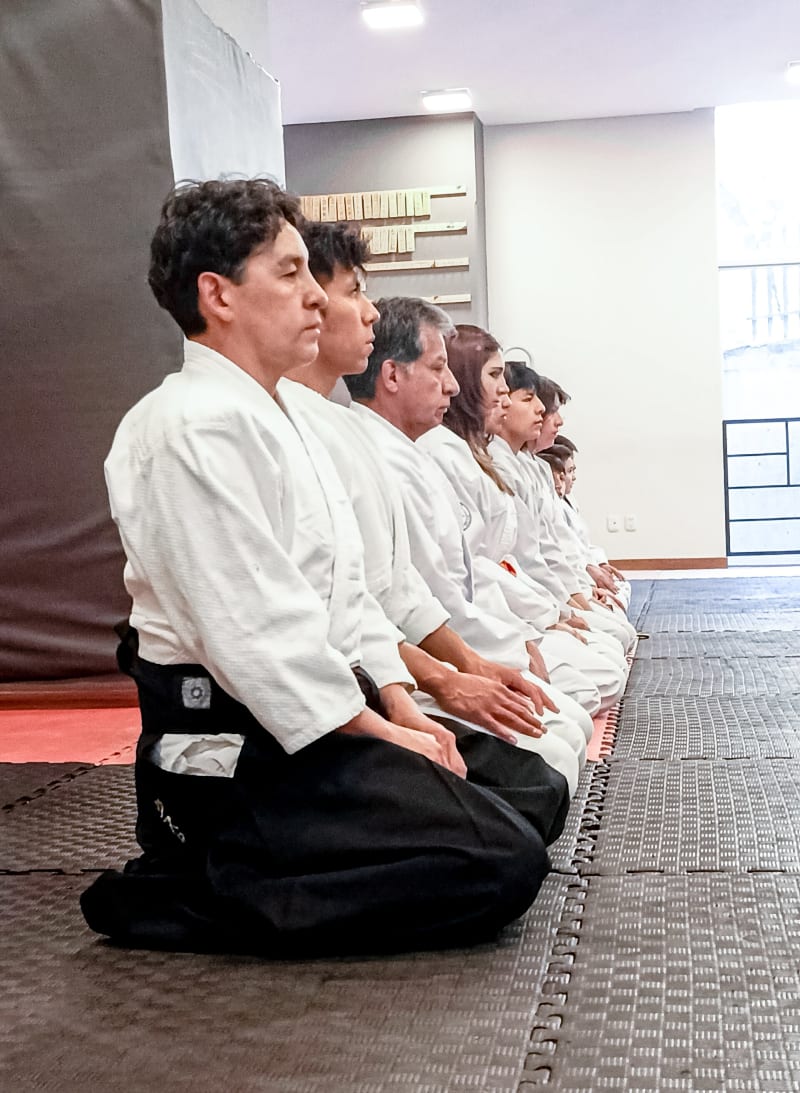
| Seated bow | Zarei (座礼) | From seiza; the hands are placed one after the other, left first, and lift in reverse order | Beginning and end of the session |
| Bow to the front | Shōmen ni rei (正面に礼) | Together, on command | Opening, closing |
| Bow to the teacher | Sensei ni rei (先生に礼) | Together, after the shōmen | Opening, closing |
| Bow to each other | Otagai ni rei (お互いに礼) | Together, in line | Opening, closing |
| Silent composure | Mokusō (黙想) | Seated, eyes closed or half lowered | Before and after the session |
The details are not arbitrary. That in zarei the left hand goes down first has a weapons-related origin: the right hand is the sword hand and is bound last and freed first. That the bow comes from the hips and the back stays straight keeps the head in a position from which a forward glance remains possible. How far that glance may go is disputed between the arts — in kendo the opponent is as a rule not lost from sight during the bow, whereas in the tea ceremony and in parts of aikido the complete lowering of the gaze is exactly the point: it is the statement that no attack is to be expected here. Both variants are consistent — they merely answer different questions.
Why it works: reigi as protocol
The soberest approach to reigi is the functional one. A budō training session consists of people attacking one another with considerable force and at close range. If that is not to end in injuries, several things must be unambiguously settled at all times:
- When does it begin and when is it over? The bow sets both marks. Between the bows a different regime applies than before and after.
- Who is my partner? The mutual bow closes a pair; it makes the pairing visible to everyone in the room.
- Do I consent? The bow is an agreement. Whoever does not bow does not train — which is why the gesture cannot be omitted without something essential going missing.
- Where is the front? The orientation towards the head of the room organises the space and with it the direction of gaze, the line-up, and the route one takes on entering.
Read this way, reigi is the counterpart to zanshin: zanshin is the alertness inside the frame of practice, reigi defines its boundaries. Systems with a high risk of injury and no protective equipment — iaidō, kyūdō, weapon arts generally — regularly have the most elaborate etiquette. That is not coincidence and not a question of venerability: where a mistake is expensive, the frame is made strict.
The greeting in other cultures
Comparison shows that the matter is universal and that the form reveals each system’s reading of combat.
| System | Greeting | Execution | What it says |
|---|---|---|---|
| Judo, karate, aikidō | Rei | Ritsurei / zarei | Beginning, end, consent |
| Taekwondo, hapkido | Kyeongnye (경례) | Standing, hands at the sides | Formally analogous, Korean in name |
| Kung fu, Wing Chun | Bàoquánlǐ (抱拳礼) | Right fist, left open hand laid over it | The weapon is covered: readiness without threat |
| Muay Thai | Wai khru ram muay | A danced circuit before the bout | Thanks to teacher and lineage; also warm-up and intimidation |
| Capoeira | Entering the roda | At the foot of the berimbau, on the rhythm | Consent to the game and to its tempo |
| Sumo | Shikiri, throwing salt | Ritual before setting up | Purification; also a strictly regulated preliminary |
| Boxing | Touching gloves | Before the first and last round | A remnant of the same idea, without ceremony |
The Chinese gesture is the most eloquent. In bàoquánlǐ the clenched right hand is covered by the open left — the weapon is present but veiled. A widespread reading holds that the four extended fingers of the left hand stand for the fellowship of all fighters while the bent thumb signals a refusal of arrogance; equally current is the reading that the combination of sun and moon points to the Ming dynasty and thus to anti-Manchu secret societies. Neither interpretation is documented; they are tradition, not source. What is uncontested is the basic statement of the gesture itself, and it is the same as that of the Japanese bow: I could, and I am not doing it.
Funakoshi’s first precept
The best-known formulation comes from the Nijū Kun, the twenty precepts of Gichin Funakoshi. The first reads:
空手道は礼に始まり礼に終る事を忘るな
“Do not forget that karate-dō begins with rei and ends with rei.”
The sentence is readily quoted as a call to politeness. More precisely, though, it says something else: that rei is not a part of the practice but its bracket. What happens outside that bracket is not karate — not because it would be impolite, but because it is then simply brawling. Funakoshi, who brought karate from Okinawa to Japan and in doing so deliberately transferred it into the outward appearance of the Japanese budō arts, had a very concrete reason for that bracket: without it his art could not have been taught in the schools and universities of 1920s Japan.
Criticism and open questions
The religious question. In many dojos the first bow is directed at the kamiza, a small shrine at the head of the room. For practitioners of monotheistic religions, bowing towards it is not unproblematic. The common solution is linguistic: outside Japan the command is usually shōmen ni rei — “bow to the front” — and is thus directed at a side of the room rather than at a sanctuary. The gesture remains, the address changes.
The authority problem. An etiquette that makes rank relations visible also makes them enforceable. The same forms that create safety can be used to treat dissent as a breach of the rules — a mechanism described repeatedly in the reckoning with abuse cases in competitive budō. Reigi is a tool and shares the fate of all tools.
The question of age. The frequent claim that dojo etiquette is centuries old and unchanged does not survive examination. The forms are old and well documented through the Ogasawara line; their present assembly — line-up by grade, mokusō, a three-part bow on command — belongs to the standardisation of budō in the twentieth century. This does not devalue them, but it demands precision: these forms were made, by nameable people, for a particular purpose.
Today
Reigi is the part of budō that holds on most stubbornly. Hardly any federation has loosened its etiquette, while technical rules are rewritten continually — and in modern competition formats the gesture reappears of its own accord without any tradition behind it: the handshake between MMA fighters before the first bell appears in no rulebook.
The turn in education policy is notable. When Japan made budō compulsory in lower secondary physical education in 2012, the official justification was neither self-defence nor fitness but the transmission of manners and of regard for one’s counterpart. The state, in other words, was interested in precisely the element that Western accounts usually treat as decorative trimming. Whether a bow builds character is thereby not proven — the claim is old, the evidence thin. What can be observed without difficulty is the concrete part: in a room where everyone knows when it begins, when it ends and who is training with whom, nobody gets injured by accident.
Related Articles
- Budo
- Bushido
- Shu-Ha-Ri
- Zanshin
- Gichin Funakoshi
- Kendo
- Wu De — the Chinese ethic that governs the same relationship from the side of admission
- Ogasawara Nagakiyo — why one school teaches bow and manners — etiquette arrived 138 years after him