Bare-Knuckle Boxing — 1867 Removed Two Things, Not One
The Queensberry rules took the bare hand and the wrestling out of prizefighting. Whether the first was a safety gain is still disputed.
Lineage
Derived
Contents
Bare-knuckle boxing is prizefighting without gloves, as contested in England from the eighteenth century until 1889. It is not the precursor of boxing in the sense of a cruder early form — it is the same discipline before two operations.
That is this article’s argument, and it sits in a single ruleset: the Marquess of Queensberry rules of 1867 took two things away from prizefighting, not one. They introduced the glove — and in the same stroke prohibited wrestling holds, throws and clinching. Modern boxing is prizefighting minus the bare hand minus the wrestling.
Both changes count as safety measures. For the second that is undisputed. For the first it is disputed to this day, and not at the margins but at the core.
The three rulesets
| Year | Ruleset | What it laid down |
|---|---|---|
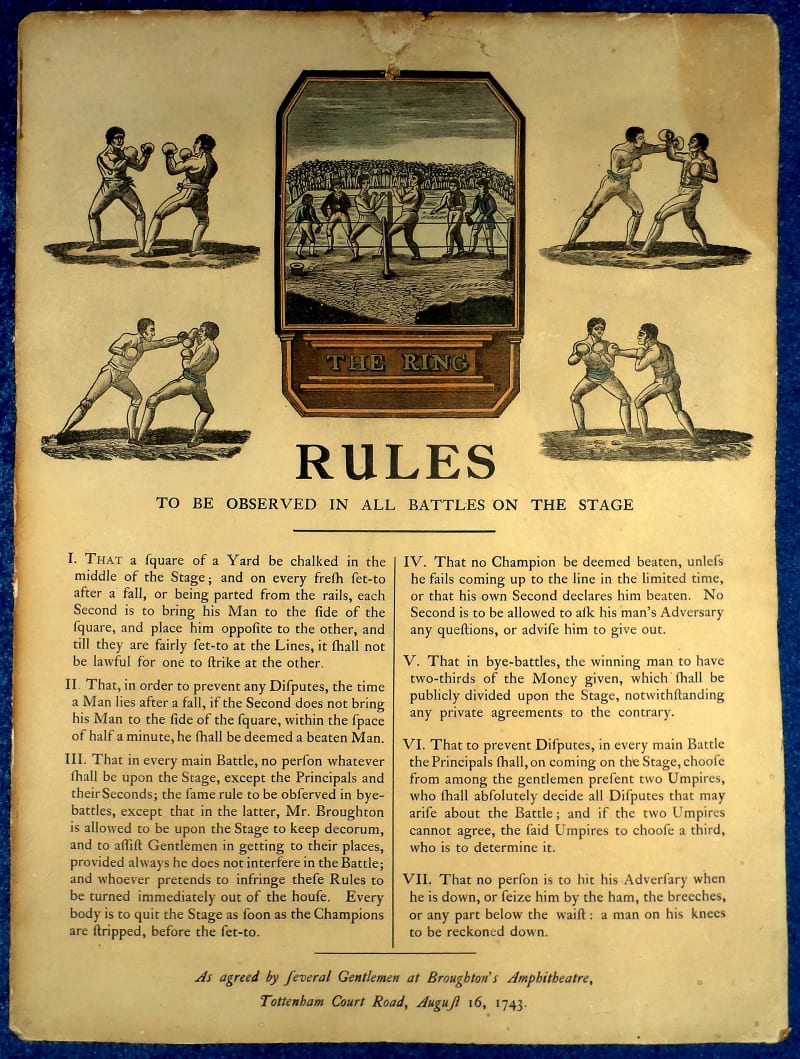
| 1743 | Broughton’s Rules | no striking a man who is down · no grip below the waist (rule VII) · only fighters and seconds in the ring · thirty seconds to get back up |
| 1838 | London Prize Ring Rules | superseded Broughton after almost a century · holds and throws permitted, the cross-buttock throw widely used · grabs below the waist prohibited |
| 1867 | Marquess of Queensberry Rules | drafted by John Graham Chambers, sponsored by John Sholto Douglas, 8th Marquess of Queensberry · gloves required · wrestling holds, throws and clinching prohibited |
The occasion for the first ruleset is well documented and unromantic. Jack Broughton fought George Stevenson on 17 February 1741 in a fairground booth on Tottenham Court Road; the fight lasted about 45 minutes, and Stevenson died a few days later. On 16 August 1743 Broughton set out the first written code — seven articles, printed as a broadside, “as agreed by several Gentlemen at Broughton’s Amphitheatre”.
That is a pattern this collection knows: a ruleset comes not from an idea but from an incident. At freestyle wrestling it was expulsion from the Olympic programme; here it was a death.
What 1867 removed: the wrestling
Under the London Prize Ring Rules, prizefighting was not a pure striking contest. Holds on the upper body and throws were allowed; the cross-buttock — a hip throw — was standard stock. Grabbing below the waist remained barred — a limit already written into Broughton’s rule VII and merely carried forward in 1838.
Anyone wanting to picture a fight under those rules should therefore not think of modern boxing without gloves, but of something closer to catch wrestling and, in part, to today’s MMA. Both grew up in the same decades and the same countries, and that is no coincidence.
In 1867 Queensberry separated the strike from the grip. What remained is boxing as everyone knows it — one of the very few martial arts in the world that works exclusively with the fists. That exclusivity is not a grown peculiarity. It is a deletion with a date.
What 1867 added: the glove
The glove counts as the advance by which boxing was civilised. The common picture is: padded fist, less damage.
The objection to that is mechanical, and it deserves to be taken seriously. In short: the glove protects the hand, not the head.
- Against a skull, the bare fist is the more fragile of the two. Anyone punching the head at full power and high frequency breaks his hand. That feedback acts as a brake: prizefighters struck the head less often and more cautiously, and worked more to the body.
- The glove removes that brake. What is protected is the puncher, not the man hit.
- And the cause of brain injury is not the skin wound but the acceleration and deceleration of the head. Padding on the fist does little against that, while the greater number and force of head punches counts directly.
This argument is not a fringe position: the British Medical Association has held that gloves do not reduce brain injuries and may even increase them — on precisely this reasoning.
What the figures give, and what they do not
Comparative figures circulate from the modern competitive scene, and the article lists them here expressly because they have to be read with their caveat:
| Bare-knuckle (BKFC analyses) | Gloved boxing | MMA | |
|---|---|---|---|
| Concussions | ~1.5 % | estimated 6–12 % | 14.7 % |
| Facial lacerations | 34.8 % of fighters, averaging 6.2 sutures | markedly rarer | — |
And now the caveat, without which the table misleads. The comparison is not controlled. Bare-knuckle bouts in today’s competitions are considerably shorter than championship boxing matches — fewer rounds, shorter rounds, and therefore far less time in which a head can be hit at all. A large part of the difference could come from that alone. Add different fields of competitors, different methods of collection, and the fact that the boxing figures are given as an estimated range.
What can be said solidly is therefore more modest than the table suggests:
- The mechanism is plausible and is argued from the medical side — the hand is the brake, the glove releases it.
- The kind of injury clearly differs, and in both directions: without gloves more cuts and hand fractures, with gloves more repeated loading of the head.
- The magnitude is not settled. A controlled study comparing the same fighters over the same time with and without gloves does not exist and, for obvious reasons, will not.
This is the same situation as at the makiwara and at ibuki in the breathing methods comparison: a good mechanism, thin measurement, and the temptation to take one for the other.
1889 and 2018
The last recognised bare-knuckle heavyweight title fight took place on 8 July 1889 at Richburg, Mississippi: John L. Sullivan against Jake Kilrain, 75 rounds, won by Sullivan. That ended the era, and boxing went over wholly to Queensberry.
On 2 June 2018 prizefighting returned legally in the United States: BKFC 1 in Cheyenne, Wyoming, under the Wyoming Combative Sports Commission — the first sanctioned bare-knuckle event in the USA since 1889.
129 years lie between those dates, during which prizefighting had not disappeared but had taken place outside sanction. Today’s competition is expressly not a revival of the London Prize Ring Rules: it is fought without gloves but without wrestling — that is, by one half of the old discipline and the other half of Queensberry.
Connections to other martial arts
- Boxing — the direct result of the deletions of 1867. Anyone wanting to know why boxing works only with the fists finds the answer not in a tradition but in a clause.
- Catch wrestling — the twin: what Queensberry removed from prizefighting survived there, in the same decades and the same countries.
- MMA — the reunion of strike and grip, a century after their separation. Seen this way, MMA is less an innovation than a reversal.
- Wrestling — the body of throws the cross-buttock comes from.
- Punch, hikite and the boxing guard — where it is set out what is not measured about punching force; this article supplies the matching case.
- Muay Thai — the counter-case from another tradition: there too the change from wrapped hands to gloves altered the technique.
Today
Bare-knuckle boxing is now a regulated niche sport with a growing following, carried by a handful of promoters and sanctioned in a number of US states and several countries. Its fighters come mostly from boxing and MMA.
Two notes for placing it. First: the sport is not harmless, and nobody seriously claims it is. The dispute is not about whether it is dangerous but about which danger weighs more: the visible, healing injury or the invisible, cumulative one. Second: anyone advertising with the comparative figures should quote the round count as well. Without it the juxtaposition is not an analysis but a selection.
The real value of the subject for this collection lies elsewhere. Bare-knuckle boxing is the rare case in which it can be shown that a safety measure may not have removed the injury but relocated it — out of the hand and the face and into the skull, and thereby out of the visible into the invisible. Whether that is so remains open. That it can be asked is the point.
Related articles
- Boxing
- Catch Wrestling
- MMA
- Wrestling
- Punch, Hikite and the Boxing Guard
- Muay Thai
- Pradal Serey — the same transition in Southeast Asia: ring, round and glove are imports there too
- Musangwe — Venda bare-fist fighting in South Africa: the same bare fist in a wholly different social frame
- Dambe — a bare fist, but only one — and a stopping criterion without a clock