Boxing — The Sweet Science
Boxing reduces combat to two fists and the space between them — the West's oldest organised striking art and the template for almost every modern ring sport.
Lineage
Contents
Boxing is the most radical restriction a martial art can impose on itself: two fists, an upper body as the target, no grabbing, no kicking. What looks impoverished on paper has developed extraordinary depth for exactly that reason. Because the toolkit is so narrow, everything shifts onto distance, timing and deception — the reasons eighteenth-century Englishmen spoke of the “sweet science of bruising”.
Boxing is also the organisationally oldest modern combat sport in the West. Its rules, its round structure, its weight classes and its squared ring have been adopted by almost every later full-contact sport — kickboxing, sanda and MMA all count in rounds and weight classes because boxing did it first. As a discipline in its own right it still produces the highest-grossing individual events in combat sport, and is simultaneously the one with the most unresolved medical questions.
History
Fist fighting is as old as the written record: reliefs from Mesopotamia and Egypt depict it, Homer describes it in the Iliad, and from 688 BCE pygmachia was an Olympic discipline. The Greeks wrapped the hands in leather thongs (himantes); the Romans hardened these into the caestus, sometimes with metal fittings — a spectacle with little in common with sporting competition. Related but broader in scope was the pankration, which combined striking and wrestling.
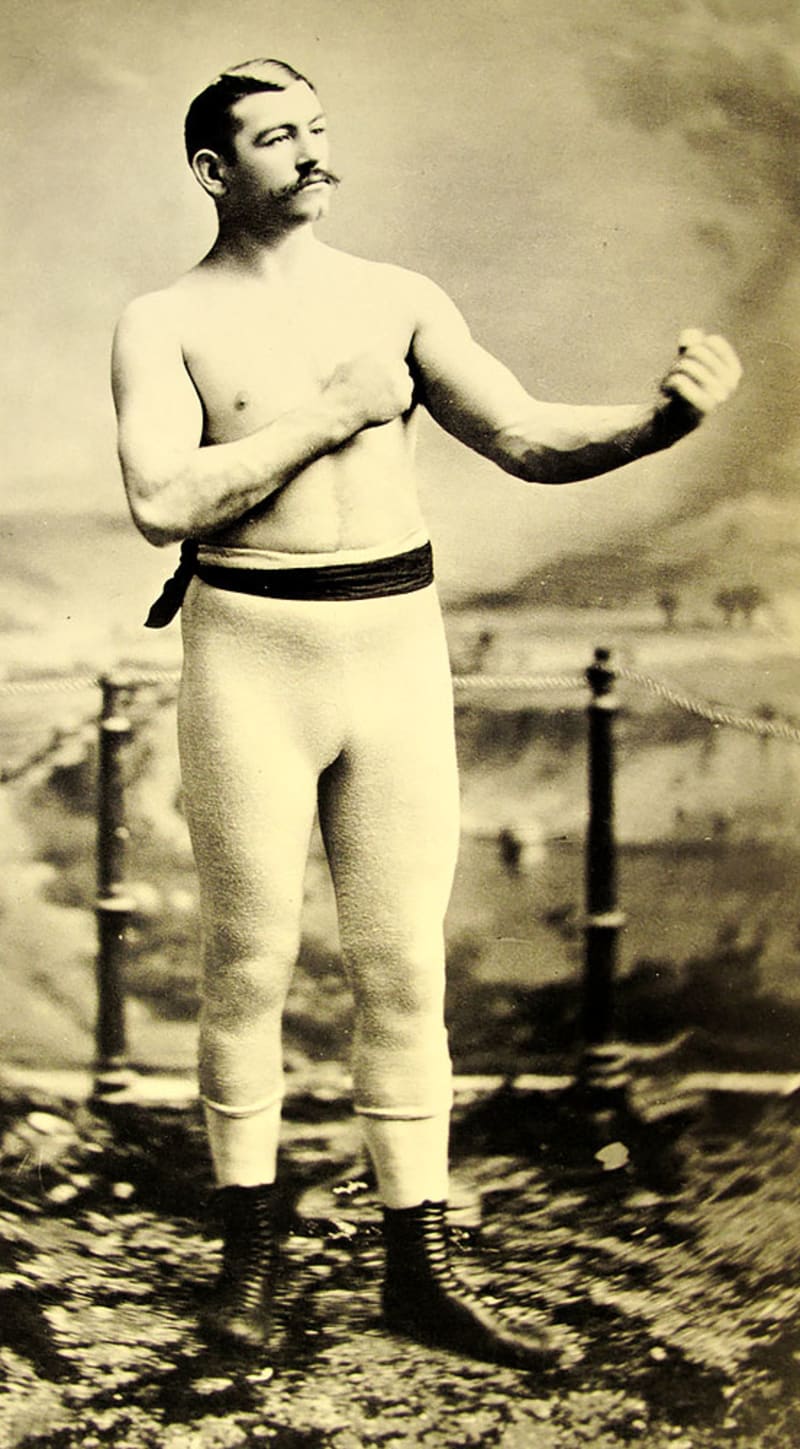
After antiquity, organised fist fighting disappears from the record for over a thousand years. It returned in early eighteenth-century England as prizefighting — bare fists, few rules, heavy wagering.
The history of the rules proceeds in three steps:
| Year | Ruleset | Innovation |
|---|---|---|
| 1743 | Broughton’s Rules | first injury protections; 30 seconds to resume; no striking a downed man |
| 1838 | London Prize Ring Rules | bounded ring, headbutts and low blows banned |
| 1867 | Queensberry Rules | gloves mandatory, 3-minute rounds, 1-minute rest, count of ten, wrestling banned |
The twelve Queensberry rules — written by John Graham Chambers and promoted under the name of the 9th Marquess of Queensberry — are the real break. Gloves and the count turned an open-ended war of attrition into a temporally structured sport that could be defended in public. That the gloves primarily protect the hands of the striker rather than the brain of the struck is an ambivalence that persists to this day.
In 1880 Britain’s Amateur Boxing Association became the first amateur governing body; in 1904 boxing became Olympic; in 1946 AIBA was founded as the world body for amateur boxing. In parallel, professional boxing developed with its competing sanctioning bodies — a split that still defines the sport.
Technical Foundations
Boxing has exactly four basic punches; everything else is a variation in angle, distance and timing.
| Punch | Motion | Function |
|---|---|---|
| Jab | lead hand, straight | range-finder, disruption, setup — the most important punch |
| Cross | rear hand, straight | principal power punch through the rear hip |
| Hook | horizontal arc | close range, jaw or liver |
| Uppercut | vertical, rising | against a low guard, chin or solar plexus |
Equally important is what is not thrown. Defence has five basic forms: blocking and parrying (contact), slipping and ducking (head movement), evasion (footwork). Footwork is the real difference between a novice and an advanced boxer — not punching power.
Rhythm is a training subject in its own right: combinations are deliberately set against the expected beat, and the most effective punch is usually the one whose timing the opponent misread.
Valid targets are the head and torso above the beltline, from the front and side only. Prohibited are, among others, strikes to the back of the head, kidney punches, low blows, striking with the open hand or the inside of the glove, and holding.
Core Techniques
- The jab — leads every combination, holds the opponent at range, conceals intent. “The jab wins fights” is not a platitude but a statistical observation.
- The one-two — jab followed by the cross; the base combination from which most others derive.
- Counterpunching — using the opponent’s punch: the cross over an extended jab, the hook onto the returning arm.
- Infighting — close-range work with short hooks and uppercuts, as shaped by Jack Dempsey and later Mike Tyson.
- The clinch — tying up to buy time or destroy the opponent’s range; tolerated by the rules, decisive in tactics.
Two stances are fundamental: orthodox (left hand forward, for right-handers) and southpaw (mirrored). The meeting of the two alters angles and the lead-hand battle so profoundly that it is treated as a discipline of its own.
Philosophy
Boxing has no textual tradition like Japanese budō and no dōjō-kun. Its ethic is practical and transmitted in sayings — but it exists.
“It ain’t about how hard you hit. It’s about how hard you can get hit and keep moving forward.” — a formula widely attributed to boxing and quoted in many variants
The central value is hardness towards oneself. Training camp, weight discipline, running before sunrise are ritualised forms of self-subjection that in function resemble the shugyō of the Japanese arts, though they were never named as such.
Socially, boxing has consistently been a sport of ascent: Irish and Jewish immigrants in the United States, later African American and Latin American fighters, today Eastern European and Central Asian ones. This grounding explains more of the sport’s culture than any technical analysis — and also part of its history of exploitation.
Styles and Schools
Instead of stylistic schools, boxing recognises fighter types:
| Type | Method | Examples |
|---|---|---|
| Out-boxer | long range, jab, footwork | Muhammad Ali, Wladimir Klitschko |
| Swarmer / infighter | pressure, close range, volume | Joe Frazier, Julio César Chávez |
| Slugger / puncher | single-punch power, less movement | George Foreman, Deontay Wilder |
| Boxer-puncher | hybrid, technical and powerful | Sugar Ray Robinson, Canelo Álvarez |
Institutionally the sport divides into two worlds. Amateur boxing (now usually “Olympic boxing”) is fought over three rounds, with headguards depending on category, and scores strikes by count and cleanness. Professional boxing is fought over up to twelve rounds without headguards and scored on the ten-point-must system. In the professional field, four major bodies — WBA, WBC, IBF and WBO — award titles in parallel, the principal reason “world champion” is an ambiguous term in boxing and undisputed champions are rare.
Connections to Other Martial Arts
- Kickboxing — adopted boxing’s ring, rounds, gloves and entire hand technique, and added kicks
- Muay Thai — took on gloves and the round system from boxing during the twentieth century; Thai hand technique is historically Western-influenced
- MMA — boxing technique is standard there but must be adapted: the deep boxing stance is vulnerable to takedowns and low kicks
- Savate — the French kicking art integrated English boxing in the nineteenth century, becoming the first European strike-and-kick synthesis
- Pankration — the ancient precursor, which had not yet separated striking from wrestling
- Lethwei — Burmese bare-knuckle boxing, preserving the pre-Victorian state without gloves
Today
How large boxing is economically cannot be quantified — and the reason is precisely its institutional fragmentation: no company and no federation reports revenue for the sport as a whole. Two things are documented. The highest-grossing individual events in combat sport are boxing matches — Mayweather against Pacquiao (2015) reached some 4.6 million pay-per-view buys, over $400 million in domestic pay-per-view revenue and over $70 million at the gate; the number of buys is listed by Guinness World Records as the record. The largest single company in combat sport, by contrast, is the UFC — its listed parent TKO Group Holdings reports UFC segment revenue of $1.502 billion for 2025, and boxing has no comparable figure because it is spread across competing promoters.
Olympic situation. The world body IBA (formerly AIBA) was suspended by the IOC in 2019 and in 2023 became the first international federation ever expelled from the Olympic movement, on grounds of governance, financial and refereeing problems. World Boxing was founded as a successor in 2023, received provisional IOC recognition in 2025, and secures the sport’s place at Los Angeles 2028. For national federations this means a forced switch: only athletes from World Boxing member federations will be eligible.
Health. Boxing is the sport in which chronic traumatic encephalopathy was first described — in 1928 as “punch drunk”, later dementia pugilistica. Unlike single injuries, the issue is the cumulative effect of repeated, including sub-concussive, head impacts. This is why medical associations in several countries have called for a ban on professional boxing for decades, and it is the strongest objection to the sport that its supporters must take seriously.
Structure. The four-body situation, the role of promoters and dependence on pay-per-view mean that the sporting most interesting fights often fail to materialise for years. At the same time the sport’s opening to women’s boxing — Olympic since London 2012 — has been one of the most dynamic developments in its recent history.
Related Articles
- Kickboxing
- Muay Thai
- MMA
- Savate
- Lethwei
- Pankration
- The Fist — Hikite Versus the Boxing Guard — why the guard sits at the chin and not at the hip
- Grading Systems Compared — why a ranking needs no examining board
- Bare-Knuckle Boxing — where the exclusivity of the fists comes from — a deletion of 1867
- Dambe — the counter-case to the mirrored guard: one hand strikes, the other grips
- Footwork Compared — the guiding question of footwork — and why the ban on crossing is only a coaching convention here