Dambe — One Hand Is the Spear, the Other the Shield
The Hausa fist fight divides the hands instead of mirroring them. One strikes, the other keeps the opponent at measured distance.
Contents
Overview
Dambe is the traditional fist fight of the Hausa in northern Nigeria, southern Niger and south-western Chad. The name comes from the Hausa word for “boxer”.
Its basic technical decision is unusual, and it is the reason this article exists: the two hands have different jobs. The strong fist is wrapped in cloth and cord and is called the spear. The other stays open, held out in front, and is called the shield — it does not strike; it measures distance, grips and lures.
Almost every other striking art in this stock mirrors the hands: in boxing both strike, in lethwei and musangwe likewise. Dambe does not — it builds the asymmetry into the rules.
The guild it comes from
Dambe is not the art of a people but of a trade: the Hausa butchers.
The connection is concrete. Butchers’ guilds travelled the trade routes of the Sahel, and at harvest time they formed teams from their own ranks — remembered as armies — that took on the local men in the villages. The festival paid, the guild supplied the fighters, and whoever won carried standing home for family and village.
That explains a good deal about the form. An itinerant trade needs a fight that requires no equipment, can happen on any cleared ground and is decided quickly. The ground is called the dandali, and nothing more than that is needed.
For the early period there is no dating. The origins lie, as the folklorist Thomas Green put it in 2005, “in antiquity”. The widespread claim of a line back to ancient Egyptian boxing rests on a resemblance in imagery — the single bound fist and the salute — that Edward Powe notes in his ethnography Combat Games of Northern Nigeria. A resemblance is not evidence of transmission; this stock holds the same standard for engolo and for subak.
Spear and shield
| Part | Hausa | Function |
|---|---|---|
| Striking hand | wrapped in kara, with zare knotted over it | the spear — the only weapon |
| Lead hand | open, palm towards the opponent | the shield — distance, grip, deception |
| Lead leg | historically wrapped with the akayau | kick and block |
| Ground | dandali | a cleared space |
| Dress | formerly the warki (loincloth), today shorts | — |
The kara is a strip of cloth over which a cord (zare) is knotted tight. It is not padding in the sense of a boxing glove but purchase: it holds the fist together and gives the striking surface an edge.
The akayau, a chain from ankle to knee, has been given up. The leg remains a weapon — kicks are more common today than they used to be, because the wrestling has gone and the fall is still the aim — but the chain belongs to the past.
A side form also existed: damben karfe, “iron boxing”, using a hand-held implement called the mazagi.
How a bout ends
Three rounds, no time limit. A round ends when nothing more is happening, when a fighter or an official stops it, when the hand binding comes loose — or when a fighter voluntarily breaks his fighting stance.
The winner is the one who “kills” the opponent. The word is the literal one used: a strike after which the opponent’s hand, knee or body touches the ground ends the bout. The single decisive blow is called kwab daya.
This is a rule set without judges. There is no time to manage and no score to accumulate. Set the stock beside it: the comparison of folk wrestling and sport shows that this very absence of a clock is the first thing to go in the transition to sport. In dambe it is still there.
The ritual apparatus
And here the matter thickens, because dambe is not merely a sport.
Fighters wear amulets: the laaya at the neck, the kambu on the arm, the guru at the waist. Their contents range from preparations and animal parts from sacrificial rites to verses of the Qur’an. Two kinds of specialist are responsible — the boka, who supplies protective or offensive charms, and the mallam, the Islamic scholar who supplies verses and instructions.
Preparation includes fasting, reciting verses, and acts at a grave: boxers dip the striking hand into a grave or spend the night beside one.
The most interesting observation concerns the ban. Amateur rules forbid visible amulets. The practice’s answer was not to give them up but to relocate them: ingestion instead of wearing, herbal preparations, smoke baths, acts that leave no physical trace.
That is an observation about rules, not about superstition. A ban aimed at visibility produces invisibility. The same mechanism sits behind much of what associations have regulated in the martial arts.
The ground-glass question
The best-known claim about dambe is that the cord is dipped in crushed glass.
What can be said: Powe alludes to a tradition of sometimes preparing the knotted cord that way, and Green states that a fist covering has been dipped in ground glass.
What cannot be said: that it was the rule. The report stands in the ethnography as an occasional practice, not as a standard, and today’s amateur rules expressly forbid injurious materials.
Anyone explaining dambe by the ground glass has the thing backwards. What makes the fight dangerous is not an additive on the cord but the absence of hand protection on a hand whose sole purpose is to strike — together with a stopping criterion that bites only once someone is on the ground.
What the asymmetry buys
The stock has a comparison of its own for hand position: the article on the fist, hikite and the boxing guard asks why different arts park the non-striking hand differently.
Dambe supplies the extreme case. The lead hand does not park, it works — open, extended, palm towards the opponent. It measures range, it grips, it deceives, and it can hold the opponent where the spear will land.
| Boxing | Musangwe | Dambe | |
|---|---|---|---|
| Striking hands | both | both | one |
| Lead hand | strikes and covers | strikes and covers | grips and measures |
| Hand protection | wrap plus glove | none | cloth and cord on one hand |
| End of the bout | points, KO, stoppage | submission or knockdown | touching the ground |
The arithmetic works once you read it from the ending backwards. Whoever wins by putting the opponent on the ground needs a hand that holds him where the blow arrives. Two equal striking hands would be worse for that.
What the 20th century changed
| Formerly | Today |
|---|---|
| head strikes allowed | forbidden in the amateur code, allowed in the professional one |
| akayau, the chain on the leg | given up |
| warki, the loincloth | shorts |
| the village dandali | enclosed stadiums |
| amulets visible | forbidden, and therefore relocated |
| training out of the guild | plus sports-science methods |
The split between amateur and professional is the real break — and it is the same split that the comparison of folk wrestling and sport describes in seven other cases: as soon as an association is in charge, a second, milder rule set grows up beside the old one, and both keep running.
Today
In January 2017 Anthony Okeleke and Chidi Anyina founded Dambe Warriors and put fights on YouTube. The audience came from everywhere — the Philippines, Thailand, Brazil, Indonesia, the United States.
Beside it stands the African Warriors Fighting Championship of Maxwell Kalu, which is taking the route to an international competition circuit. In April 2025 a partnership with the streaming service DAZN was announced; on 28 June 2025 the Dambe World Series opened in Abuja.
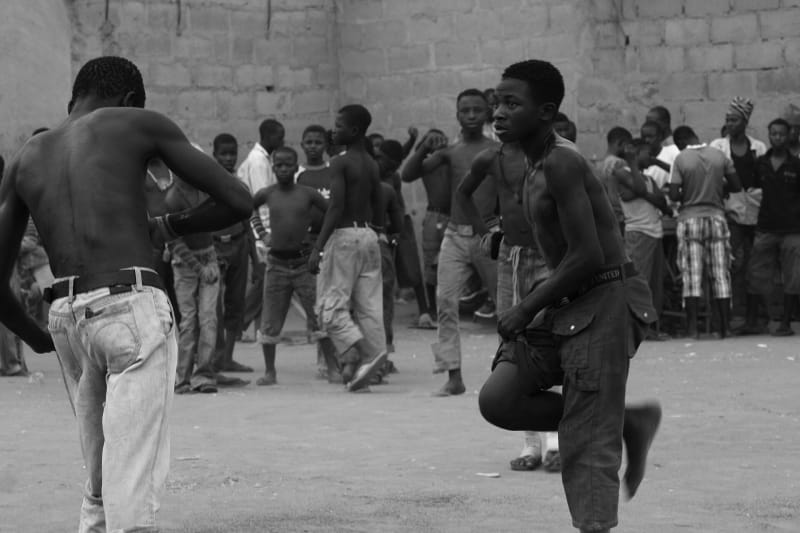
And the art has left its guild. In footage from Dei-Dei near Abuja it is by no means only Hausa in the circle; there are national championships.
The criticism is directed at the pay. Reports describe irregular payments controlled by local authorities. The traditional prizes — money, cattle, motorcycles — are not the same thing as a purse, and a streaming audience is not the same thing as a harvest festival.
Common fallacies
“Dambe is African boxing.” It is a fist fight, but not the African version of boxing. The difference is not the hand protection but the division of labour between the hands — and boxing has no such thing.
“The fists are dipped in glass.” The ethnography knows this as an occasional practice, not as a rule; today’s amateur codes forbid it. Anyone who starts there has not yet mentioned the essential thing.
“Dambe goes back to ancient Egypt.” The claim rests on a resemblance between images. Between a resemblance in imagery and a transmission lie several thousand years without a witness.
“It has no rules.” It has three rounds, four grounds for stopping, a clear criterion for victory and two separate codes for amateurs and professionals. What it does not have is a clock.
“The ritual part is folklore.” It is a component of preparation, it has specialists, and it responds to bans — which makes it a living part of the practice rather than its decoration.
Related Articles
- Musangwe — the second African fist fight in the stock, with mirrored hands
- Bare-Knuckle Boxing — what removing the hand protection changes about a fight
- Lethwei — the other major art that works without gloves and with a hard stopping criterion
- Boxing — the comparison case with two equal striking hands
- Engolo — an African combat game whose sources begin just as late
- Sisemba — a third African combat game, with the legs instead of the hands
- The Fist, Hikite and the Boxing Guard — where the non-striking hand belongs, and why
- From Folk Wrestling to Sport — the transition dambe is in the middle of right now
- Subak — the same standard applied to another art: resemblance is not transmission
- Laamb — the other West African case with a ritual apparatus and a professional circuit