Kickboxing — Fist and Foot in the Ring
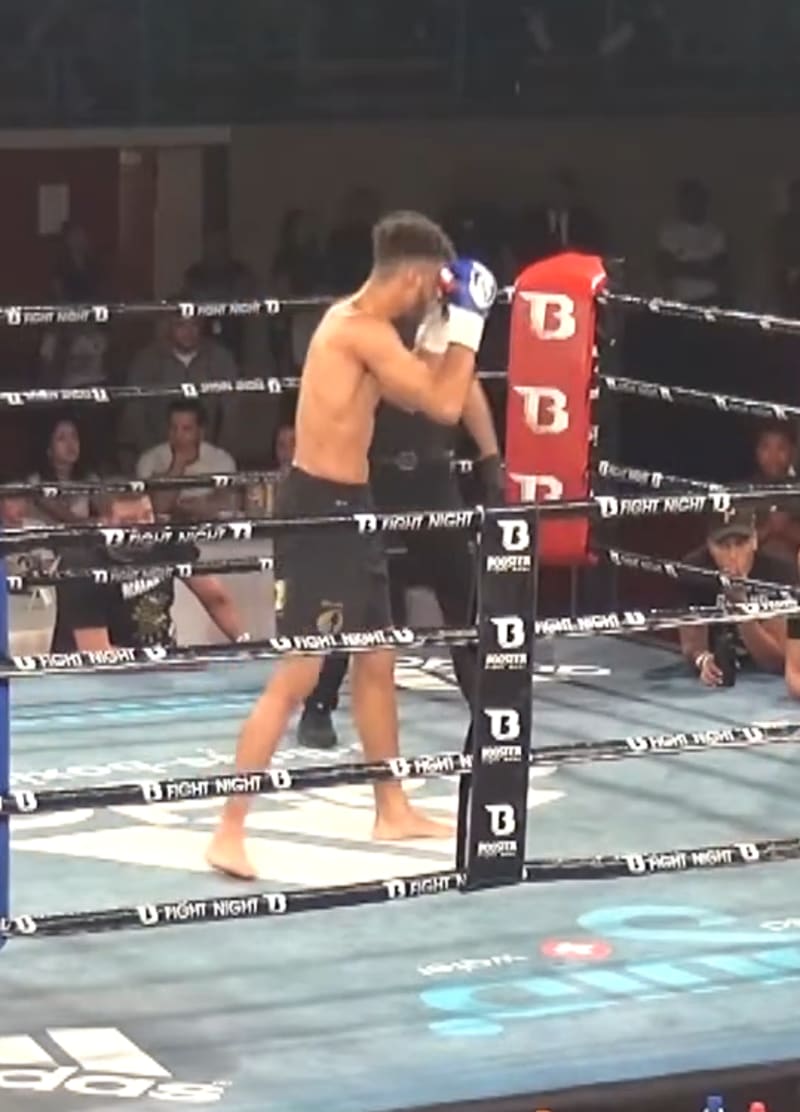
Kickboxing emerged in the 1960s from karateka's dissatisfaction with point fighting — boxing hands, karate kicks, and a ring instead of a mat.
Lineage
Origins
Derived
Contents
Kickboxing is a combat sport born out of an argument. Through the 1950s and 60s, dissatisfaction grew among Japanese karateka with the sundome principle — the rule requiring a strike to be halted just short of its target. Anyone who wanted to know whether their technique actually worked needed permission to follow through. Out of that question came a format that combined the hand technique of Western boxing with the kicks of karate, placed it in a boxing ring, and contested it over rounds.
Kickboxing is thus the first major hybrid sport in modern martial arts history: deliberately constructed rather than grown, assembled from named components, with a ruleset that explicitly defines what it does not want to be. That very logic of construction made it, thirty years later, the immediate precursor of MMA.
History
The initial impulse came from Tatsuo Yamada, founder of Nihon Kempo Karate-dō, who in 1959 proposed a format called karate-boxing: karate techniques at full contact, contested under boxing conditions. Yamada had studied Thai boxing and saw there the answer to a question Japanese karate could not resolve.
The idea became a sport through the promoter Osamu Noguchi. In 1966 he formulated a ruleset that deliberately kept its distance from muay thai — elbows and headbutts were banned, clinching severely limited — founded the Kickboxing Association, and coined the name. The first official bouts took place in Tokyo that same year. Also involved was Kenji Kurosaki, a Kyokushin karateka who had competed in Thailand and knew karate’s technical gaps from experience.
Success came quickly: by around 1970, kickboxing broadcasts ran weekly on three Japanese television channels, and Tadashi Sawamura became the sport’s first star. The collapse came just as quickly — by 1980 kickboxing had all but vanished from Japanese television.
In the United States a second strand developed in parallel and largely independently. American karateka founded the PKA in 1974 and established full-contact karate, in which kicks were permitted only above the waist — a rule that constrained the sport technically and later left it trailing formats that allowed low kicks. In the Netherlands, a third school grew out of the Kurosaki lineage via the Mejiro Gym, adopting muay thai elements more thoroughly and producing in the Dutch style what remains the most technically influential approach.
In 1993 K-1 launched in Japan and turned kickboxing into a mass phenomenon. Its tournament format — eight heavyweights, three fights in one night — and a ruleset without elbows and with limited clinching created the best-known kickboxing brand in history. After K-1’s economic collapse around 2011, Glory, ONE Championship and regional bodies took over.
Technical Foundations
Kickboxing has no unified global ruleset. The three principal formats differ precisely in how much muay thai they permit:
| Format | Low kicks | Knees | Elbows | Clinch |
|---|---|---|---|---|
| Full-contact / American | no | no | no | no |
| K-1 / Oriental rules | yes | yes, limited | no | very brief |
| Muay Thai | yes | yes | yes | yes |
For technical training this implies a fixed basic structure:
| Area | Techniques |
|---|---|
| Hands | jab, cross, hook, uppercut — taken from boxing |
| Kicks | low kick, mid-section roundhouse, high kick, front kick (teep), side kick |
| Knees | straight knee, jumping knee (format-dependent) |
| Defence | shin block (check), parry, slip, stance switching |
The decisive technical difference from boxing lies in stance. A deep, bladed boxing stance is unusable in kickboxing because it exposes the lead leg to low kicks. The kickboxing stance is more upright and more square — which in turn restricts head movement. This trade-off is one of the discipline’s core problems.
Core Techniques
- The low kick — a shin strike to the opponent’s thigh. The single most effective technique in the sport: it strips mobility over the rounds at low risk. The Dutch style made it the basis of a system.
- The boxing combination finished with a kick — the classic Dutch sequence: hands high to occupy the guard, then the roundhouse into the level thus opened.
- The check — blocking a low kick with the raised shin. Technically demanding, and the precondition for surviving against a good kicker at all.
- The teep — a straight front kick used as a range weapon, functionally the counterpart to the jab.
- The high kick — spectacular but risky: it opens the guard and is the most common cause of counter knockdowns.
Shin conditioning through repeated kicking of pads and heavy bags is a standard part of training; the once-common practice of working the shins with bottles or rods is now considered obsolete in sports medicine.
Philosophy
Kickboxing was conceived from the outset as a sport, not a way. There is no dōjō-kun, no kata, no code of etiquette — and that renunciation was the point. Those who left karate for kickboxing did so precisely because they placed the question of effectiveness above the question of form.
What takes its place is an empirical self-understanding: a technique counts if it works under competitive conditions. This is the same attitude Bruce Lee had formulated two decades earlier in Jeet Kune Do, and the same one that later produced MMA. Its strength is honesty about testable results; its weakness is that “competitive conditions” themselves presuppose a ruleset — and every ruleset privileges particular techniques.
Proximity to the Thai origin has nonetheless brought some elements back: in gyms with a muay thai grounding, expressions of respect towards the trainer and ritual forms are entirely common.
Styles and Schools
| School | Origin | Character |
|---|---|---|
| Japanese kickboxing | Noguchi/Kurosaki, from 1966 | karate base, early muay thai influence |
| American full-contact | PKA, from 1974 | no low kicks, high hand activity, minimum kicks per round |
| Dutch style | Mejiro Gym, from the 1970s | boxing combinations plus low kicks, high volume, globally dominant |
| K-1 rules | Japan, from 1993 | compromise format: low kicks and knees, no elbows, no sustained clinch |
| Sanda | China | independent parallel development permitting throws |
The Dutch style deserves separate mention: through gyms such as Mejiro, Chakuriki and later Golden Glory it produced a generation of fighters who dominated K-1 for years. Its hallmark is high work volume — long combinations rather than single power shots — and the systematic linking of hand work and low kicks.
Connections to Other Martial Arts
- Karate — the starting point; the early Japanese kickboxers were karateka throughout, many from Kyokushin
- Boxing — supplied the ring, rounds, gloves and the complete hand technique
- Muay Thai — technical godparent and simultaneously the thing kickboxing defines itself against by rule; the boundary between them is now fluid
- Sanda — the Chinese variant, which additionally permits throws and thus gives a third answer to the same question
- Savate — the older French synthesis of kicking and boxing, developed independently
- MMA — kickboxing is the standard basis of stand-up fighting there, though it must be adapted against takedowns
Today
Kickboxing is established worldwide as a participation and fitness sport and is administered by several competing bodies — WAKO as the largest amateur federation, alongside professional organisations such as Glory and ONE Championship. WAKO has held provisional IOC recognition since 2021; the sport is not Olympic.
The picture is mixed. As a fitness offering kickboxing is extraordinarily successful; non-contact “cardio kickboxing” has little to do with the competitive sport, however, and is viewed critically within the scene. As a competitive sport, kickboxing is under double pressure: MMA has drawn away much of its attention and many of its best athletes, and fragmentation into competing bodies with their own titles makes undisputed rankings hard to establish — a problem it shares with professional boxing.
Technically, by contrast, development has plainly continued: the fusion of Dutch hand work, Thai kicking and modern athletic preparation has produced a standard well above that of the early K-1 years. And the health questions that apply to boxing apply here just as much: repeated head impacts are cumulatively damaging even when a fight lasts only three rounds.
Related Articles
- Boxing
- Muay Thai
- Karate
- Kyokushin Karate
- Sanda
- Savate
- MMA
- Pradal Serey — the same techniques without a national attribution — and the dispute disappears