Lethwei — Burmese Boxing with Nine Weapons
Lethwei is Myanmar's ancient combat art — bareknuckle, with headbutt as the ninth weapon, no points scoring, and victories only by KO or submission.
Contents
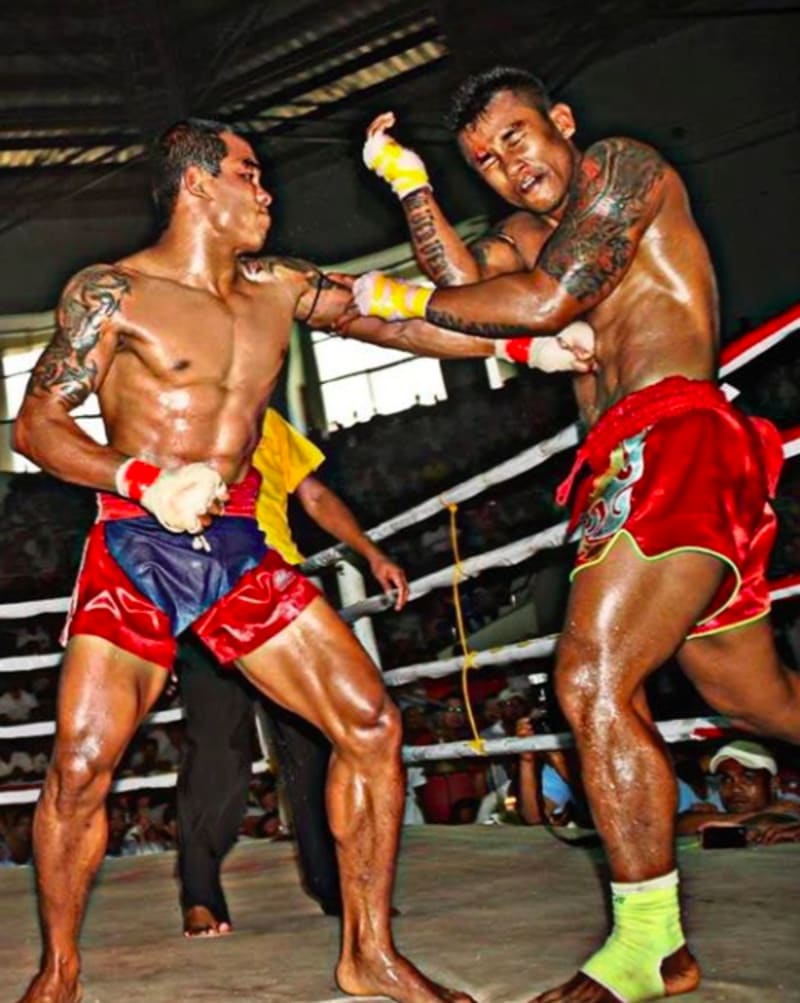
Lethwei (လက်ဝှေ့, pronounced “Let-way”) is Myanmar’s ancient combat art — one of the most brutal and honest combat sports in the world. Lethwei fights bareknuckle: hands are wrapped only in gauze and tape, no boxing gloves. The headbutt is one of the central weapons — which is why Lethwei is called the “art of nine limbs” (both fists, elbows, knees, shins, and the head). There is no points system — victories come only by KO, technical KO, or submission. A draw is only possible if neither fighter knocks out the other. Lethwei has no weight classes in its most traditional form. This radicalism makes Lethwei the hardest striking combat sport in the world — and simultaneously the cultural heart of Myanmar.
History
The first historical mention of Lethwei dates from the Pyu Empire (2nd century BCE–mid-11th century CE) — one of the first great kingdoms in modern Myanmar’s territory. Lethwei was used alongside other Burmese martial arts (Bando for unarmed combat, Banshay for weapons combat) by armies to keep soldiers fit and as a rite of passage for young men.
In towns and villages, Lethwei was folk festival spectacle — fighters from different communities competed against each other, accompanied by traditional music (Saing ensemble) and ceremonies.
Kyar Ba Nyein, who participated in boxing for Myanmar at the 1952 Summer Olympics, modernized Lethwei after World War II: he established rules, training structures, and international standards without losing the original rawness.
In the modern era, combat professional Dave Leduc (Canada) brought Lethwei international attention: as a non-Burmese world champion and promoter, he made Lethwei globally known.
Technical Foundations
The nine weapons:
| Weapon | Application |
|---|---|
| Both fists | Jabs, straight punches, hooks |
| Both elbows | Horizontal, diagonal, upward elbows |
| Both knees | Knees in clinch, jumping knees |
| Both shins | Low kicks, body kicks |
| Head | Direct headbutt — the ninth weapon |
Bareknuckle dimension: Without gloves, strikes are sharper and more accurate — but hands are more injury-prone. Lethwei fighters condition hands through intensive striking training.
Clinch work: In the clinch, knees and elbows are deployed — similar to Muay Thai, but without the same clinch restrictions.
The Hnaung Rule — Unique Element
In traditional Lethwei fights, a KO’d fighter may continue fighting after a 2-minute pause. His trainer can use this pause to tend to him and ask if he wants to continue. If the fighter wishes to continue, the fight goes on — without point deduction. This element makes Lethwei an incredibly dramatic combat art: the fight is never over until no one can or will stand up anymore.
Philosophy
Lethwei is deeply connected to Myanmar’s cultural identity. It is not a sport in the Western sense — it is a test of spirit. The Lethwei fighter should:
- Demonstrate physical superiority
- Show mental strength — continuing when others would stop
- Honor the tradition — combat as a gesture of respect toward the opponent and audience
“A Lethwei fighter does not fight against his opponent. He fights against himself.” — Burmese fighting tradition
Connections to Other Martial Arts
- Muay Thai — closest relative; both combat systems use the same limb systems, but Lethwei permits headbutt and fights bareknuckle
- Muay Boran — historically connected: both arise from warrior combat systems of Southeast Asia
- Savate — both are striking systems with strong cultural identity
Today
Lethwei is experiencing a global surge through international marketing (WLC — World Lethwei Championship). Fighters from Thailand, Japan, the USA, and Europe compete against Burmese champions. In Myanmar it is a national sport.
Related Articles
- Muay Thai
- Muay Boran
- Savate
- Pradal Serey — the third neighbour, at which the question of origin is visibly ill-posed
- Dambe — the second major gloveless art, with a wholly different division of labour between the hands