Pradal Serey — the Dispute Is About the Name, Not the Technique
Cambodia and Thailand argue over who owns this combat sport. Both claim something younger than the claim itself.
Contents
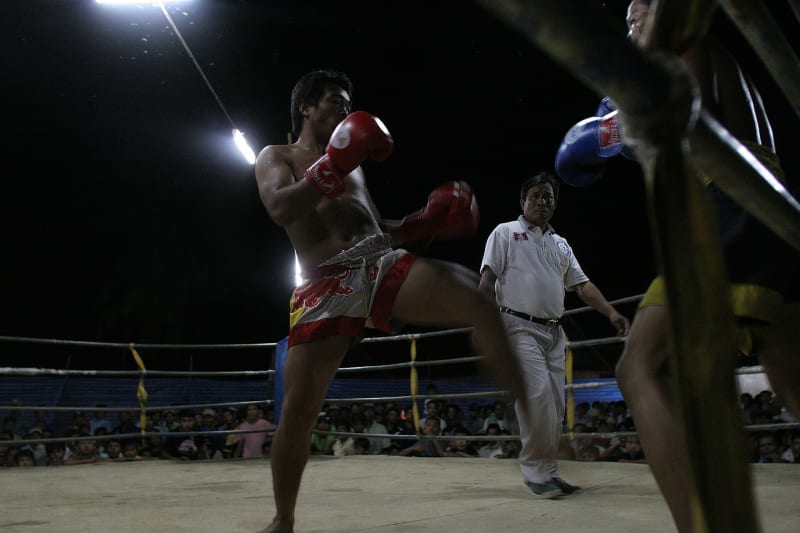
Pradal Serey (ប្រដាល់សេរី, “free fighting”), today usually called Kun Khmer, is the Cambodian ring sport fought with fists, elbows, knees and kicks. It is the closest relative of muay thai, lethwei and Lao muay lao — and the subject of a dispute that produced a boycott at the 2023 Southeast Asian Games.
That dispute is why the article is here, and the argument runs: it cannot be settled, because both sides claim something younger than the claim. The reliefs at Angkor are real. What they do not show is a named system or a lineage. And the modern competitive forms on both sides of the border were assembled in the twentieth century from the same components — ring, rounds, boxing gloves, points scoring.
And the Cambodian side carries an objection to its own continuity that weighs more than anything coming from Thailand. It appears below.
What the reliefs show — and what they do not
The appeal to the Khmer Empire (802–1431) rests on stone reliefs at Angkor Wat and the Bayon, the latter built around 1200–1230 under Jayavarman VII. The reliefs show unarmed fighters, and the actions depicted are clear enough: punches, elbows, knees and clinch holds.
That is a good finding, and better than much of what passes for “old” in this collection. But it has a clear limit, and the specialist wording names it: the scenes are interpreted as precursors by Cambodian practitioners. An interpretation is not a transmission.
What the reliefs do not supply:
- no name. No system is written beside them, neither Pradal Serey nor anything else.
- no lineage. Between the thirteenth and the twentieth century there is no continuous, named chain of teaching.
- no distinction. Elbows, knees and the clinch are attested across mainland Southeast Asia. A relief showing an elbow does not separate Cambodia from its neighbours — it shows that the region knew the technique.
This is exactly the situation the collection describes at subak: the testimony is genuine, the line to present practice is not.
1975 to 1979
The heaviest objection to an unbroken Cambodian line comes not from Thailand but from Cambodia’s own history.
Under the rule of the Khmer Rouge from 1975 to 1979 the traditional arts were suppressed and those who carried them were persecuted. Masters and practitioners were killed or sent to camps; the transmission came close to ending. A figure in circulation, given here expressly as an estimate, puts the loss at around 90 per cent of the specialists active before 1975.
What followed was a rebuilding by survivors. Through the 1980s practice continued in remote areas such as Kampot province — and, this being the detail that carries this article, in refugee camps on the Thai border.
That leaves the nationality dispute on unstable ground. Part of what is now marshalled as Cambodian heritage against Thailand was preserved in the 1980s at that very border, by people who had fled a genocide to get there. The rupture that puts continuity in question is also the reason the two sides are so hard to separate.
What both modern forms have in common
Set today’s competitive forms side by side and you find not two separately grown traditions but two versions of the same blueprint:
| Component | Origin |
|---|---|
| Square roped ring | Western boxing |
| Rounds and a fixed bout length | Western boxing |
| Boxing gloves instead of wrapped hands | Western boxing, 20th c. |
| Scoring by judges | Western boxing |
| Weight classes | Western amateur sport |
| Elbows, knees, clinch | regional, mainland Southeast Asian |
| Pre-fight dance and music | regional, named differently in each country |
Of those seven rows, five were adopted in the twentieth century, and on both sides of the border. The article on bare-knuckle boxing describes exactly the same transition for England: the glove and the round are not a tradition but a decision about rules.
What has stayed regional is the stock of elbows, knees and clinch — and that is older than both nation states and belongs to neither alone.
2023: the dispute in Phnom Penh
The dispute is concrete and dated. When Cambodia hosted the 2023 Southeast Asian Games, it staged the competition under the name Kun Khmer, not “muay thai”. Vath Chamroeun, secretary-general of the Cambodian organising committee, justified this by the host’s prerogative.
The response was blunt. The International Federation of Muaythai Associations (IFMA) announced it would send no athletes, and threatened other countries with bans and fines if they took part. Thailand stayed away from the events.
What is remarkable is what was actually at stake. It was not rules, technique or safety — those could have been settled in an afternoon. It was the designation, and thus the question of which country the sport is credited to. That is not a sporting dispute but a cultural-political one, conducted with a federation’s instruments.
The collection knows the pattern: at qigong, at changquan and at freestyle wrestling an institution shaped the subject to its own needs each time. What is new here is only that two institutions are contesting the same subject.
Technical foundations
| Feature | Form |
|---|---|
| Permitted | fist, elbow, knee, kick, limited clinch |
| Emphasis | the elbow is traditionally given more room than in the Thai competitive form |
| Pre-fight | ritual dance with musical accompaniment (kun kru) |
| Equipment | boxing gloves, ring, rounds |
| Decision | points or knockout |
Honesty requires saying how small the technical differences are. The greater emphasis on the elbow is often cited, but it is a matter of weighting and scoring practice, not of repertoire: both disciplines know the same tools. Watch a bout without knowing the label and you will not reliably place it — which is the best comment there is on the argument over which produced which.
Connections to other martial arts
- Muay thai — the object of the dispute, and technically the closest relative. Both belong to a regional body of material that no border divides cleanly.
- Lethwei — the Burmese version, and the most useful third point: once three neighbours are set side by side, the question “which came first” is visibly ill-posed.
- Muay boran — the pre-modern Thai form, where the same question about transmission versus reconstruction arises.
- Kickboxing — what happens when the same techniques are cast into a ruleset without a national attribution.
- Bare-knuckle boxing — where it is set out what the glove and the round do to a combat sport; here it is the unnamed component on both sides.
Today
Kun Khmer is mass sport and television entertainment in Cambodia, with regular fight nights, several broadcasters and a growing number of gyms; for many fighters it is a profession with modest purses. Internationally its visibility is far lower than muay thai’s, which has less to do with the sport than with the size of the market and the head start of Thai promotion.
Two notes for placing it. First: read claims of age with care. “Since the ninth century” refers to the Khmer Empire, not to a transmitted system of instruction. What is documented are reliefs, not a line. Second: the naming question is not a technical question. Anyone treating it as one has adopted one side’s position without checking.
The value of this case for the collection lies in the opposite of what is being argued over. Pradal Serey shows more clearly than anything else here that martial arts do not respect state borders — the techniques are regional, the competitive form is imported, and the only genuinely national component is the name. That the rebuilding after 1979 partly took place at the border itself does not weaken that point but sharpens it.
Related articles
- Muay Thai
- Lethwei
- Muay Boran
- Kickboxing
- Bare-Knuckle Boxing
- Bokator — the older Cambodian branch, whose relation to the modern ring sport is disputed