Kata and Kumite — Why One Is Not the Application of the Other
Kumite is said to be the application of kata. Historically it is the other way round: free kumite was added in the 1930s, from kendō.
Contents
Overview
In almost every karate dojo the matter is explained like this: the kata is the form in which the techniques are preserved, and the kumite is their application. First you learn the movements alone, then you apply them on a partner. Kata is the theory, kumite the practice.
That explanation is widespread, plausible — and historically back to front.
Free kumite did not emerge out of the kata. It was added in the 1930s as a training form in its own right, modelled on kendō and judo, by a generation that felt precisely this to be missing from kata. It is therefore some fifty years younger than the spread of karate in Japan, and many centuries younger than the kata.
From this follows the thesis of this article:
Kata and kumite are not theory and practice of the same thing but two answers to two different questions. Kata asks: what has been handed down? Kumite asks: who wins under these rules? The bridge between them is called bunkai — and it had largely to be reconstructed.
The chronology
The sequence is well documented and it contradicts the usual account.
Kata is the older vehicle of transmission. On Okinawa it was the teaching system: a teacher passed a few forms to a few students, often a single one over years. It was not preparation for something else but the procedure itself — the store in which the techniques were kept.
Free sparring did not exist there. What existed were prearranged partner drills and, outside instruction, kakedameshi, the informal challenge match. A training format with rules, rounds and free choice of technique did not exist.
It arose in Tokyo, in the 1930s. The decisive figure is Gigō (Yoshitaka) Funakoshi (1906–1945), son of Gichin Funakoshi. He developed partner training in stages:
- Gohon kumite — five predetermined advancing attacks, recognisably built on the kendō model
- Kihon ippon kumite — one-step sparring, 1933
- Jiyū ippon kumite and finally free kumite, around 1935
The kendō connection is not conjecture: Gigō practised kendō himself, among others under Nakayama Hakudō. Judo elements are recognisable too, such as foot sweeps. The deep stances and long attacking lines that mark Shōtōkan to this day come from the same development.
His father continued to place the emphasis on kata. The generational difference within the same dojo is therefore unusually well documented.
What each of them answers
| Kata | Kumite (competition) | |
|---|---|---|
| Age | centuries | since the 1930s |
| Opponent | imagined | present |
| Resistance | none | full, uncooperative |
| Time pressure | self-chosen | set by the opponent |
| Range of technique | grabs, throws, locks, strikes to any target | whatever the rules permit |
| Feedback | none immediate | instant and unambiguous |
| What it tests | memory and execution | decision under pressure |
| What it stores | a repertoire | nothing |
The last line is the core. Kata stores; kumite tests. A competition leaves behind no knowledge that could be transmitted without it; a form carries content across generations even when nobody currently understands it. Both are necessary, and neither can do the other’s job.
Why the translation does not work
The strongest objection to “kumite is the application of kata” is not historical but very practical: kata consists largely of techniques the kumite rules forbid.
The transmitted forms contain grips on clothing and limbs, locks against wrist and elbow, throws, strikes to throat, neck and nape, attacks on the knee, hair-pulling. In competition kumite almost none of this is permitted — what is scored are controlled punches and kicks to designated target areas.
If kumite were the application of kata, it would therefore have to apply precisely what it excludes. This is no detail: it means that a large majority of kata content cannot appear in competition kumite at all. Practise only kata and competition kumite, and you are practising two things that barely touch.
Bunkai — the actual bridge
The gap between the two is closed by bunkai (分解, “disassembly”) — the reading of kata movements as concrete applications, drilled with a partner who actually grabs, strikes or pushes.
Bunkai is where kata content becomes accessible again: a sequence that looks in isolation like a block turns out to be a release from a grip, a lock, or the entry to a throw. Only here is kata more than a sequence of movements.
And precisely here lies the real problem of 20th-century karate history. When karate entered school instruction and the universities, it was simplified for mass teaching; the application layer was not transmitted along with it in many lines. What is taught as bunkai today is therefore to a considerable extent reconstruction — plausible, often convincing, but not continuously handed down.
That is the honest finding, and it is uncomfortable for both camps: for those who hold kata to be useless gymnastics, and for those who present every reading as ancient secret knowledge.
The institutional split
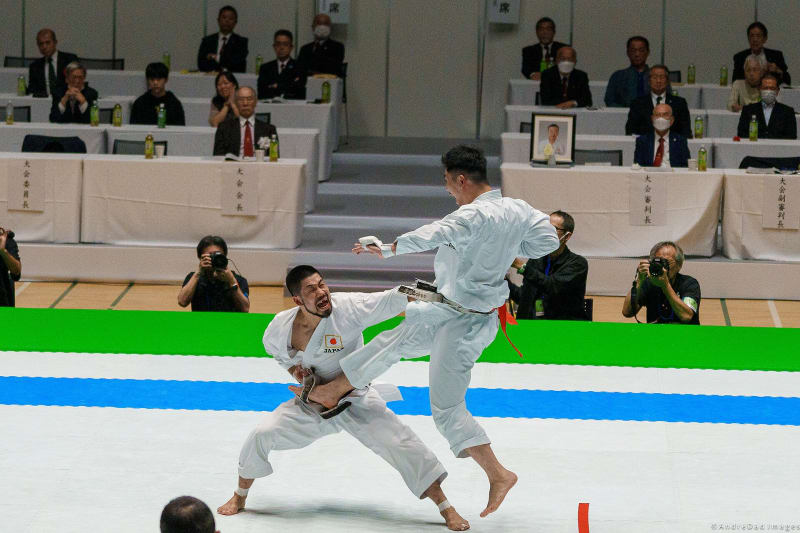
What began as a question of method is today formally fixed. At international competitions kata and kumite are separate disciplines, with separate scoring, separate titles and largely separate athletes. A kata specialist does not enter the kumite and vice versa.
With that the break is complete: two training forms of the same subject have become two sports sharing a name. It is the logical continuation of a development that began in 1935 — and it explains why the question “kata or kumite” is argued so hotly. It has long ceased to be a training question and has become a question of belonging.
Anyone wanting to follow that mechanism more generally: the same movement can be observed in grading systems — a question of practice becomes a question of federation as soon as a federation decides it.
Common false conclusions
“Kata is shadow-boxing for karateka.” Shadow-boxing freely reproduces one’s own fighting style; kata prescribes a fixed sequence that is passed on even when nobody can currently interpret it. That is the difference between improvisation and archive.
“Kata is useless because it does not teach you to fight.” It is true that kata alone does not teach you to fight. It does not follow that it is useless — it performs a different task. A sheet of music makes nobody a musician either, and is not worthless for that.
“Competition kumite is watered-down karate.” It is a sport with its own rules and its own demands, which it meets very seriously. All that is false is the claim that it is the application of kata — a claim the rule book itself does not make.
“The old masters needed no sparring.” They had kakedameshi and the informal challenge match. What was missing was a safe, repeatable format for it — and that is exactly what was built in the 1930s.
“Bunkai is the secret true meaning of kata.” For some readings there are good arguments from old sources. Others are modern reconstruction. Naming both side by side is more honest than declaring everything to be secret knowledge.
What this means for your own training
Three things, not two. Kata, bunkai with a resisting partner, free kumite. Leave out the middle stage and you really do have two unconnected exercises — thereby confirming the very charge you mean to reject.
Resistance is the test. An application that only works if the partner leaves his arm extended has not been tested. The transition from prearranged to resisting is the actual work.
Keep the rule book in mind. If you compete, you train for its demands — which is legitimate, and should simply not be confused with kata content.
Ask which layer is being taught. A good school will say whether it presents a reading as transmitted or as its own reconstruction. That a reading is new does not make it worse — that it is passed off as old makes it uncheckable.
How far this comparison holds
Well documented is the chronology: Gigō Funakoshi’s development of partner training in the early 1930s, kihon ippon kumite in 1933, free kumite around 1935, his own kendō training, the adoption of elements from kendō and judo. So is today’s separation of kata and kumite competitions.
An assessment rather than a citation is the contrast set out in the table. It follows from rule books and training practice but has not been surveyed.
Disputed is the extent of bunkai transmission. How much application knowledge was lost in the shift to mass instruction and how much ran on in individual lines cannot be settled — the evidence differs greatly from school to school. Anyone quoting a figure here is estimating.
Not investigated is the obvious question: whether practitioners who train kata with bunkai perform better in free fighting than those who train only kumite. No such study exists, and without it the debate remains one about plausibility.
Related Articles
- Karate
- Shōtōkan
- Gōjū-ryū
- Kime
- Makiwara
- Grading Systems Compared
- Breathing Methods Compared — two kinds of breath repeating the same split as kata and kumite
- Okinawan Karate — 1901: the moment the application layer was lost
- Kata and Bunkai Programme — the bridge as a procedure — with a logbook against retrospective adjustment
- Kenwa Mabuni — his decision to preserve everything is the origin of this dispute
- Chōki Motobu — the historical counter-position in person — in 1926 he wrote the oldest book on kumite