Sport Fencing — the Line That Held, Because It Became a Sport
The European fencing line never broke. The price: almost every rule preserves a condition that no longer exists.
Lineage
Contents
- Three weapons, three rulesets
- Right of way is a fossil
- The sabre target area — and a widespread wrong explanation
- Two inventions that changed more than any master’s lineage
- 2004: the rule against a technique the measuring apparatus had created
- The institution
- The European triad
- Connections to other martial arts
- Today
- Related articles
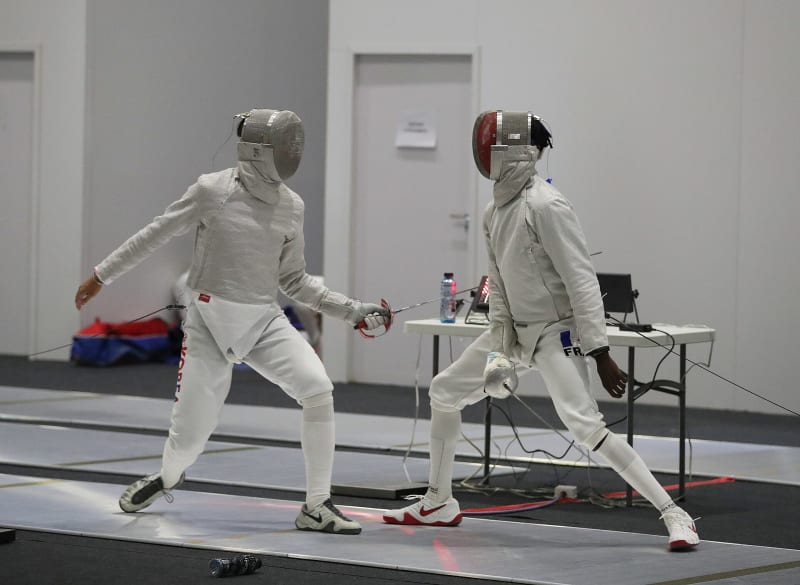
Sport fencing is the only European weapon art whose transmission never broke. It has been contested at every Olympic Games since 1896 — one of very few disciplines of which that is true — and the world federation, the FIE, has existed since 29 November 1913.
That makes it the counterpart to the other two European articles in this collection. HEMA has a broken line and retrieves it from texts. Bartitsu failed as a whole, and only its parts carried on. Fencing has what both lack: an unbroken chain of teachers, schools and federations from the eighteenth century to the present.
And that is exactly why it is the most instructive of the three. The price of continuity was conversion. Look at the rules of present-day fencing and you find, almost everywhere, a provision preserving a condition that has long since vanished — and alongside them techniques that exist only because for some decades a machine has counted the hits. It was not the lineage that shaped fencing, but two inventions and a ruleset.
Three weapons, three rulesets
The most important and most overlooked point: foil, épée and sabre are not three variants of the same thing but three different sports with different ancestries.
| Foil | Épée | Sabre | |
|---|---|---|---|
| Target area | torso | the whole body | above the waist, hands excluded |
| Right of way (priority) | yes | no | yes |
| Type of hit | thrust | thrust | cut and thrust |
| Ancestry | training weapon for the smallsword | the duelling weapon itself | cavalry sabre, via the Hungarian-Polish cutting school |
| What the ruleset models | the etiquette of the duel | the duel itself | mounted combat |
The épée is the most honest of the three: the whole body, no priority, and a double hit scores for both. That is not a gap in the rules but a depiction of what could actually happen in a duel — both hit, both are hit.
Right of way is a fossil
The hardest rule of fencing for outsiders is right of way: when both hit simultaneously, the point goes not to the faster fencer but to the one who by convention was “in the right” — whoever attacked first, or whoever had parried the attacker’s blade.
This rule is not a statement about physics and describes nothing measurable. It is a convention, and it encodes a lesson from a time when the subject was lethal: anyone who thrusts without troubling about the other’s blade may win the exchange and die anyway. Right of way penalises exactly that.
The remarkable thing is that the rule has survived although its reason has gone. In foil and sabre an etiquette still decides who owns a hit that technically both fencers landed. Fencing is therefore the only Olympic combat sport in which a substantial share of the points is awarded by convention rather than by what happened — and fencers say so openly.
The sabre target area — and a widespread wrong explanation
In sabre only above the waist counts. The explanation one reads almost everywhere: the sabre comes from the cavalryman, and a rider’s legs were shielded by the horse and therefore not a target.
In the specialist literature this explanation is treated as a common misconception — and the article records it here because it is passed on so persistently. The fencing rationale is different and better: attacking the leg puts the attacker into the low line, where he has less reach. The opponent withdraws the leg and, along the longer line above, hits the now uncovered arm or head. The legs are not excluded because a horse stood in front of them, but because attacking them does not pay.
Whether that finally disposes of the cavalry explanation this article does not say — the weapon’s descent from mounted combat is not in dispute, only the derivation of the rule from it. What is certain: anyone passing it on as established fact is passing on something long contested.
Two inventions that changed more than any master’s lineage
Here lies this article’s real finding. The decisive changes in fencing came not from masters but from the workshop.
The mask. The wire mask is credited to the French fencing master Texier de la Boëssière; dates given range from about 1750 to 1780. Its effect was immediate and far-reaching: only with it did free play against a real opponent become safe enough to become fast. Before the mask every exercise had to spare the partner’s face; afterwards one could push tempo, precision and deception to the limit. The mask made fencing faster — not a master, but a piece of wire mesh.
Electrical scoring. It arrived in three steps, decades apart:
| Weapon | electrical from |
|---|---|
| Épée | 1933 |
| Foil | 1956 |
| Sabre | 1988 |
With that the referee’s eye became replaceable — and the moment a machine measures, what counts is no longer what looks like a hit but what triggers the contact. Precisely from that came a technique that had not existed before.
2004: the rule against a technique the measuring apparatus had created
The flick (also coup de fouet) is a whipping action with the flexible blade that snaps around the guard onto the back or flank. By hand it would be no hit in the old sense — with a duelling weapon it would have done nothing. To the scoring electronics it was one.
After the 2004 Olympic Games the FIE responded with two figures, and they are the most precise evidence for a pattern this collection describes repeatedly:
- Foil lockout time was reduced from 750 ± 50 ms to 300 ± 25 ms.
- The required contact time was raised from 3 ± 2 ms to 15 ± 1 ms.
The outcome is documented and honest: flicks did not become impossible, but distinctly harder — glancing hits no longer register, and the point must arrive more or less square-on.
With that the circle closes, and it closes in milliseconds. A ruleset generates a technique; the same body changes the ruleset to be rid of the technique again. The throwing principles comparison makes that argument, kosen judo and freestyle wrestling evidence it through rules — here it can be read off to two pairs of numbers. The three cases complement rather than outbid one another: freestyle wrestling supplies the control group (two disciplines, one rule apart), kosen judo the evidence from inside a single art, and fencing the only one in which the body reverses its own rule — with figures attached.
The institution
- 1896: fencing is present at the first modern Games and has been at every one since.
- 29 November 1913: the FIE is founded in Paris with eight members — Belgium, Bohemia, France, Great Britain, Hungary, Italy, the Netherlands and Norway.
- Women: individual foil Olympic in 1924, team 1960 · épée 1996 · individual sabre 2004, team 2008.
The women’s chronology deserves a second look, because nothing technical explains it. Eighty-four years separate the first women’s Olympic event from the last — and the sabre, the weapon with the reputation for harshness, came last. That is the same mechanism the grading systems comparison describes: what an institution permits says more about the institution than about the subject.
The European triad
Only read side by side do this collection’s three European articles make a statement:
| Line | What became of it | |
|---|---|---|
| HEMA | broke | reconstructed from dated texts, the boundary to interpretation declared |
| Bartitsu | failed after three years | the parts carried on through the teachers |
| Sport fencing | held throughout | converted into a sport; the rules are fossils |
From that follows something running against the common expectation: an unbroken line does not protect a martial art from becoming something else. It merely ensures that nobody notices the conversion, because it happens in small steps and each step is decided by the same people who also administer the tradition.
Connections to other martial arts
- HEMA — the same root, the opposite route. HEMA goes back to the sources before this development; sport fencing is its result.
- Bartitsu — the third European model, and connected to fencing through people: Pierre Vigny was a master-at-arms before he taught stick and savate in London.
- Kendō — the Japanese parallel, and it is strikingly exact: likewise protective equipment as the precondition of free practice, likewise competition rules determining which hit counts. Anyone wanting to understand what a ruleset does to a sword art has two independent attempts on the same problem here.
- Iaidō — the opposite direction: no opponent, no ruleset, no reshaping by competition, but no test either.
- Jeet Kune Do — fencing’s most surprising effect outside Europe. Bruce Lee’s brother Peter was a fencer and taught him épée and foil; the stop hit and the strong hand leading are taken directly from there.
- Canne de combat — the French neighbour that went the same way and likewise became a sport.
Today
Fencing is broadly organised in Europe, East Asia and North America, with clubs, leagues and university teams; the strongholds are Italy, France, Hungary, Russia, South Korea, China and the USA. Getting started is easier than the reputation suggests: most clubs lend equipment at first, and the injury rate is remarkably low for a weapon sport — the result of two and a half centuries of work on protective gear.
Two notes for placing it. First: which weapon? That choice matters more than the club. Anyone who dislikes the convention goes to épée; anyone who wants the tactical game around priority goes to foil or sabre. Second: what is being promised? Sport fencing is not swordfighting and makes no effort to pretend otherwise. Anyone after historical technique wants HEMA; anyone after the fastest duelling sport in the world wants this.
And that is not a disparagement but the point. Sport fencing is the one European weapon art that lasted — not despite transforming itself but because it did. The price is written in its rulebook, and it can be read there.
Related articles
- HEMA
- Bartitsu
- Kendō
- Iaidō
- Jeet Kune Do
- Canne de Combat
- Footwork Compared — the controlled experiment: sabre forbids the crossover step, foil and épée do not