Gatka — The Weapon Tradition of the Sikhs
Gatka is the traditional martial art of the Sikhs — with wooden staves, swords, and shields, deeply rooted in the Sikh philosophy of Miri-Piri and alive at every Sikh festival.
Lineage
Origins
Contents
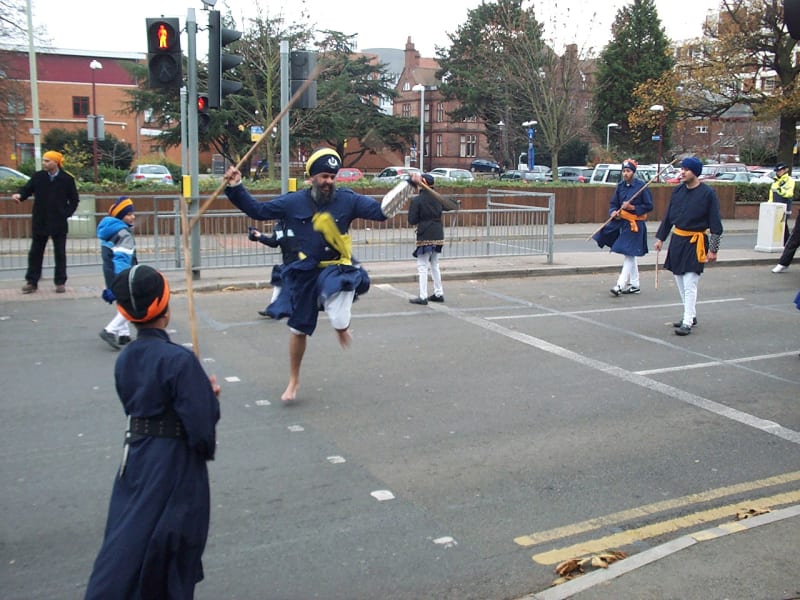
Gatka (ਗਤਕਾ) is the traditional martial art of the Sikhs — a weapons system from the Punjab, India, combining staff fighting, sword fighting, shield fighting, and unarmed techniques. Gatka is not merely sport or martial art — it is a spiritual expression of the Sikh faith. The central concept: Miri-Piri (मिरी-पिरी) — the inseparable unity of worldly power (Miri) and spiritual authority (Piri). The Sikh warrior carries two swords — one for the physical world, one for the spiritual. Gatka emerged as part of the broader Shastar Vidya (Sword-Science) — the comprehensive Indian weapons system of the warrior castes. Under British colonial rule real swords were banned; Gatka masters developed wooden staves as substitute. This adaptation saved the art. Today Gatka is alive at every Sikh festival (Gurpurab, Vaisakhi) — a spectacular sword-dance-martial art ritual drawing tens of thousands. The International Gatka Federation was founded in 1982 and formalized in 1987.
History
Sikh Founding and the Warrior Tradition (15th–17th century)
Sikhism arose in the early 15th century through Guru Nanak (1469–1539). The first Sikh communities were peaceful and spiritually oriented. This changed under Guru Hargobind (1595–1644) — the sixth and first warrior Guru:
Guru Hargobind wore two swords — the symbolic Miri-Piri principle. He built the first Sikh army and made weapons training a religious duty. Gatka became the spiritual and military training of Sikh warriors (Singhs).
Guru Gobind Singh and the Khalsa (1699)
Guru Gobind Singh (1666–1708) — the tenth and last human Guru — formed the Khalsa (pure community of Sikh warriors) in 1699. Every Khalsa Sikh had to be armed and master Gatka.
Guru Gobind Singh codified the Five K’s (Kakars) — including Kirpan (the sword) as a sacred object. Gatka became the art of wielding this weapon.
Sikh Wars and British Colonial Period
The Sikh Wars (1845–1849) against the British East India Company were the hardest tests for Gatka-trained warriors. The British recognized the danger of the system and banned weapons after the defeat of the Sikh kingdoms.
Gatka masters responded with wooden staves as substitute — legal, but technically equivalent.
Technical Foundations
Gatka uses a broad weapons palette:
| Weapon | Term | Type |
|---|---|---|
| Gatka | ਗਤਕਾ | Wooden staff (training) |
| Kirpan | ਕਿਰਪਾਨ | Sword (sacred) |
| Khanda | ਖੰਡਾ | Double-edged sword |
| Talwar | ਤਲਵਾਰ | Curved sword |
| Chakram | ਚੱਕਰਮ | Throwing ring |
| Barcha | ਬਰਛਾ | Spear |
| Bagh Nakh | ਬਾਘ ਨਖ | Tiger claw (metal blade) |
| Dhal | ਢਾਲ | Shield |
Training sequence: Gatka begins with staff exercises, develops into sword-shield combination, and concludes with multi-sword sequences.
Philosophy — Miri-Piri
The deepest concept in Gatka is Miri-Piri:
- Miri (मिरी) — worldly power: the body, the weapon, the deed
- Piri (पिरी) — spiritual power: the mind, the devotion, the ethics
Gatka is incomplete without both. A fighter without spirituality is a mercenary. A spiritual person without combat capability is defenseless. The complete Sikh warrior unites both.
“The Kris (warrior) protects the weak. The Sadhu (holy man) illuminates the soul. In one Sikh, both are united.” — Sikh warrior tradition
Connections to Other Martial Arts
- Escrima/Arnis — both are staff/blade-based systems; Gatka is spiritually anchored, Escrima pragmatically martial
- Kenjutsu — both are sword martial arts with deep cultural anchoring; Japan’s Bushido and Sikh’s Miri-Piri are structurally similar warrior ethics
- Silambam — Indian sister staff art from the Tamil region
Today
Gatka is practiced worldwide in the Sikh diaspora — in India, Canada, USA, UK. At every Vaisakhi festival (Sikh New Year), Gatka demonstrations are mandatory. The International Gatka Federation coordinates worldwide competitions.
Related Articles
- Escrima / Arnis / Kali
- Kenjutsu
- Silambam
- Stick Fighting in Eight Systems — the hand guard on the soti — the best evidence in the whole comparison
- Thang-Ta — the same build of stick and small shield, but without blade logic