Jogo do Pau — the Staff Built for Several Opponents
Portugal's stick fighting has two schools — one for a single opponent, one for several. They differ in everything that follows from that.
Contents
Overview
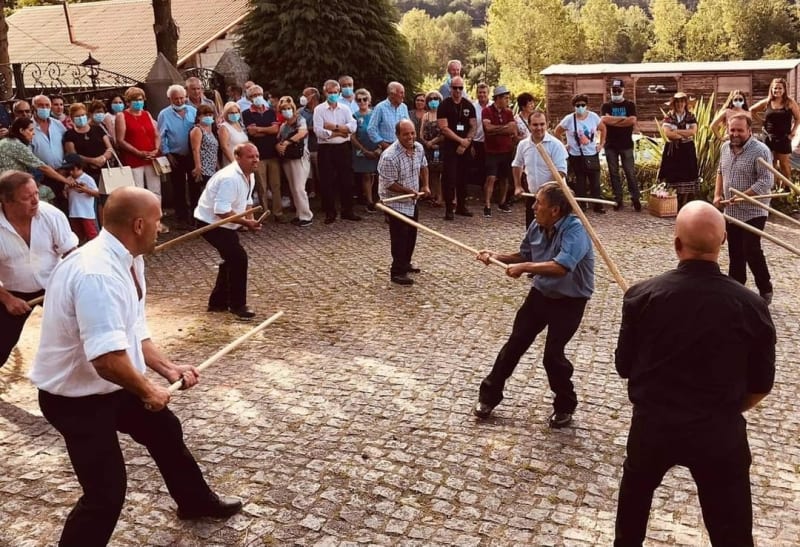
Jogo do pau — “the game of the stick” — is Portuguese stick fighting. It comes from the mountains of the north, from Minho, Alto Douro and Trás-os-Montes, and reaches across the border into Galicia.
The stock carries in Stick Fighting in Eight Systems a comparison that orders the stick arts by whether the stick stands in for a blade or is itself the weapon, and that names three variables: length, weight, second hand.
Jogo do pau is the ninth case — and it brings a fourth variable that is missing there: the number of opponents.
Because this art has two schools. One is built for one opponent, the other for several. And the difference does not stop at intent: it changes the grip, the arcs, the footwork and even whether a hand stays free.
The varapau
The weapon is called the varapau, and its dimensions are unusually well argued.
| Length | 1.60 m |
| Weight | around 600 g |
| Woods | medlar, ash, oak, chestnut, yew |
| Shape | one end thinner — that is where it is held; the thicker end strikes |
The 1.60 m is an upper limit, and the Portuguese practical literature gives the reason: a longer staff strikes the ground when twirled.
That is the most interesting sentence this article contributes to the comparison. The stick fighting comparison observes a threshold at around 150 cm: above it two-handed with wide arcs, below it one-handed. It observes the threshold — but does not explain it.
Jogo do pau explains it. Whoever circles the staff around the body traces with the tip a circle whose radius is half the staff plus the length of the arm. Past a certain total length that circle meets the ground. The threshold is not a convention but geometry.
And the 600 g places the varapau. The comparison knows three weight classes: around 100 g (the canne, a scored hit without effect), a few hundred grams (rattan, soti), close to a kilo (bō, ubhoko, breaking and stunning). The varapau sits in the middle — heavy enough to have effect, light enough to keep circling for a long time. Which is exactly what a fight against several demands.
Where it comes from
The staff was there because the herders carried it anyway. It served for self-defence on the road and for settling disputes — between individuals, families, villages. The occasion was often the romaria, the pilgrimage festival, where several villages met.
That makes the starting position different from almost every other system in the comparison. Whoever has to hold his own in a quarrel between villages does not face one man. He faces a group — and the art is built on that.
The 1830s: when the sword was forbidden
There is a datable push, and it is a parallel to France.
In the political conflict of the 1830s liberals were barred from carrying swords. They took up the staff — and thereby carried stick fighting beyond the north into the whole country. Earlier still, its use by guerrillas against Napoleonic troops in the Peninsular War is recorded.
The canne de combat did the same thing in the same century, only with a different object: there the citizen’s walking stick took the weapon’s place, here the herder’s staff. Where blades become forbidden or unseemly, the wood one is carrying anyway takes over.
The two schools
| Escola do Norte | Escola de Lisboa | |
|---|---|---|
| Opponents | several | one |
| Origin | rural, mountain regions | 19th c., northern masters in the capital |
| Character | earnest, feud, honour | sporting, contra-jogo |
| Formative influence | — | merged with sabre technique |
| Hands on the staff | both | also one |
| Codified by | no single person | Frederico Hopffer, early 20th c. |
The Lisbon branch is the reason jogo do pau stands in two places in the comparison at once. It took up sabre technique — and with it blade logic, into a system whose northern branch handles the stick as a stick.
That makes jogo do pau the European counterpart to krabi-krabong: there an art carries the dividing line between blade-substitute and weapon-in-itself inside itself, because the same people handle sword and staff. Here it carries the same line inside itself because the same art learned to fence in the city and did not in the country.
What the number of opponents changes
And here is the actual yield.
Against one opponent you may commit. You can enter, bind, drive him into a corner, seek the exchange. Time is not working against you.
Against several you may not. Every second spent on one opponent belongs to the others. From that follow technical constraints that are not a matter of style:
| Requirement | Technical consequence |
|---|---|
| Let no one get behind you | constant relocation; circling rather than advancing |
| Never stand still for a second | the staff runs on, every blow flows into the next |
| Reach above all | two-handed, wide arcs, keeping distance |
| No wrestling, no binding | hit and move on, no control on the opponent |
| Overview instead of precision | broad targets, no strikes to the hand |
The comparison already has an explanation for the circular movement — a stick that stops has to be accelerated again. Jogo do pau adds a second: the circling staff occupies an area. Against one opponent that is re-acceleration; against three it is control of space.
And the length follows the same arithmetic. 1.60 m is the limit at which the circling staff just runs free. Shorter would be less area, longer would be no circling at all.
Hopffer and the single hand
Frederico Hopffer, a master in early-20th-century Lisbon, codified the Lisbon school — and with him came the advantage of handling the staff one-handed.
That is not a quirk but the logical consequence of the change of opponent. Whoever has only one opponent can free a hand, trade reach for mobility and fence with the tip. Whoever has three needs both hands on the staff.
So jogo do pau answers the comparison’s third variable — what the second hand does — twice over, and the difference hangs on the number of opponents. None of the eight systems shows that as cleanly, because none of them carries both answers within the same art.
The later master Pedro Ferreira (26 March 1915 – 24 September 1996) brought the two schools back together.
Decline and revival
The generation born between 1910 and 1930 was the last to see the art thriving. After that it collapsed, for two reasons that reinforced each other: migration from the countryside to the cities and easier access to firearms.
From the 1970s the revival began. It was carried by Pedro Ferreira and his student Nuno Curvello Russo, who studied at the Atheneu Comercial de Lisboa and researched surviving variants in Cabeceiras de Basto.
Today two federations exist side by side — the Federação Portuguesa de Jogo do Pau and the Federação Nacional do Jogo do Pau Português. It is practised in Lisbon, in the Azores and Madeira, and sporadically in Galicia and Macau.
The pattern is the same as with HEMA: an art that broke off and was fetched back. The difference is the source. HEMA fetches back from manuscripts what nobody could do any more. Jogo do pau fetched back from living old men what somebody could still do. That is the more favourable case — and the one that disappears first.
Where it stands in the comparison
| Jogo do pau | |
|---|---|
| Stands in for | in the north: itself · in Lisbon: partly the sabre |
| Length | 1.60 m — at the threshold, and explaining it |
| Weight | ~600 g — the middle class |
| Second hand | on the staff (north) or free (Lisbon) |
| Number of opponents | several (north) or one (Lisbon) |
The last line is new. The eight existing systems tacitly assume one opponent; nguni stick fighting does know group fights but does not avowedly build its technique on them. Jogo do pau does — and thereby supplies the variable that grip, arc and footwork align themselves to.
The comparison article has been given an addendum accordingly.
Common fallacies
“Jogo do pau is Portuguese bōjutsu.” The length and the two-handed grip resemble each other, the purpose does not. Bōjutsu is built for single combat and carries a staff almost twice as heavy; the varapau is lighter because it has to keep circling.
“The stick replaces a sword here.” In the north it does not — there it is the weapon. In Lisbon it partly does, because the school took up sabre technique. Both hold, for different branches.
“Fighting several opponents is a cinema fantasy.” For most arts the objection would be fair. Here it is the transmitted starting position — quarrels between villages at the romaria — and the technique can be derived from it rather than the other way round.
“It is an unbroken tradition.” No. It largely broke off in the 20th century and was fetched back from the 1970s — by teachers who could still question living bearers. That is reconstruction with witnesses, not transmission.
Related Articles
- Stick Fighting in Eight Systems — the comparison this case extends by a fourth variable
- Bōjutsu — similar length, twice the weight, a different purpose
- Silambam — the other long staff that stands in for nothing
- Tahtib — the same class, without the split into schools
- Canne de Combat — the same substitution logic in the same century, with a walking stick
- Escrima — the opposite pole: short, doubled, and expressly a blade substitute
- Krabi-Krabong — the Asian counterpart to the split into schools
- Nguni Stick Fighting — group fights, but without a technique built on them
- Gatka — a hand guard on a stick, and what that reveals about blade logic
- HEMA — the same revival, but out of manuscripts instead of witnesses
- Stick Fighting Programme — this stock’s own drill series for these systems
- Thang-Ta — the same three steps of ban, decline and recovery, in India