Krabi-Krabong — Thailand's Weapons Martial Art
Krabi-Krabong is Thailand's traditional weapons martial art — sword and staff as core weapons, developed against Burmese invasions in the Ayutthaya era, today a living cultural heritage.
Contents
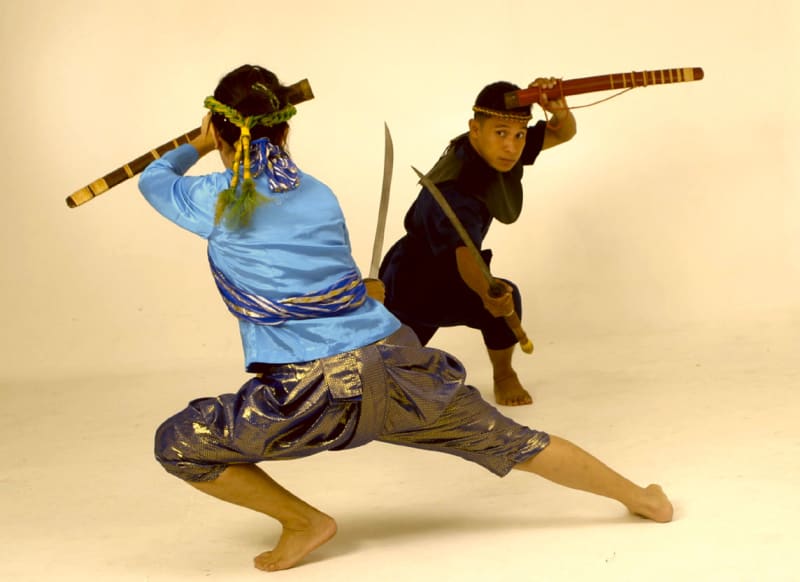
Krabi-Krabong (กระบี่กระบอง) is Thailand’s traditional weapons combat system — the name combines the two primary weapons: Krabi (กระบี่, the sword) and Krabong (กระบอง, the staff). Born during the prolonged warfare of the Ayutthaya Kingdom (1351–1767), when Siam was in constant conflict with Burmese Burma, Krabi-Krabong was the combat training of Siamese armies. When firearms replaced the blade, Krabi-Krabong survived as a ritual art — preserved over generations at the Buddhist temple Wat Phutthaisawan. Since 1935 it has been officially taught in schools; since 1975 it is part of the national curriculum of the Ministry of Education. Krabi-Krabong is inseparable from Muay Boran — both were part of the integrated combat system of Siamese warriors: when the weapon fell, the warrior turned to fists.
History
Ayutthaya — The Golden Age (1351–1767)
Krabi-Krabong developed as a warfare martial art of the Ayutthaya Kingdom during an era of constant wars with Burma. Techniques were oriented toward the reality of the battlefield: fast, aggressive sword work, shield use, and staff combat for various combat scenarios.
1767: The Burmese army destroys Ayutthaya completely — and with it almost all written sources on Krabi-Krabong. What survives does so through oral transmission and practice at the Buddhist temple Wat Phutthaisawan.
Chakri Dynasty and Preservation (1782–present)
King Rama I (r. 1782–1809) had Krabi-Krabong officially revived as part of the refounding of the Thai state (Bangkok period). Until the introduction of modern firearms it remained military training.
1935: First official school instruction in Krabi-Krabong.
1975: The Ministry of Education integrates Krabi-Krabong into the national physical education curriculum.
Weapons and Equipment
Krabi-Krabong encompasses a broad weapons arsenal:
| Weapon | Type | Use |
|---|---|---|
| Daab (ดาบ) | Long, curved sword | Primary weapon, one and two-handed |
| Daab Song Meu | Double swords | Most characteristic variant |
| Krabong | Long staff | Polearm, reach |
| Mai Sok (Tonfa) | Short staff with grip | Close-range weapon |
| Mai Sok San | Round buffalo hide shield | Defensive |
| Chang | Spear | Distance weapon |
| Trisula | Trident | Ceremonial variant |
The Daab Song Meu (double swords) are the most iconic image of Krabi-Krabong — both swords wielded simultaneously, in circular, rotating patterns.
Core Techniques
Mae Sowk (forearm shield): pair of buffalo hide forearm shields — enabling defensive techniques with free hands.
Krabok: Combined offensive and defensive sequences with both weapons simultaneously.
Unarmed transition: When a weapon falls or breaks, the Krabi-Krabong fighter transitions seamlessly to Muay Boran techniques — the two systems are trained as a unit.
Ritual opening (Wai Kru): As in Muay Thai, every practice begins with a bow — sign of respect to teachers and the art.
Philosophy
Krabi-Krabong is not only martial art — it is cultural heritage. The art embodies the identity and resistance of Siam against invaders. Its preservation at Wat Phutthaisawan by Buddhist monks gives it a spiritual dimension.
“The sword protects the kingdom. When the sword falls, the hands protect. Both are the same.” — Siamese warrior tradition
Connections to Other Martial Arts
- Muay Boran / Muay Thai — inseparably connected; Krabi-Krabong and Muay Boran formed the integrated combat system of Siamese warriors
- Escrima/Arnis — parallel Southeast Asian weapon system; both emphasize weapon transferability and fluid close-combat transitions
- Kenjutsu — structurally related: both are sword combat systems from feudal warrior societies
Today
Krabi-Krabong is taught in Thailand in school sports, at martial arts schools, and in cultural demonstrations. The National Institute of Physical Education coordinates the official transmission.
Related Articles
- Muay Thai
- Muay Boran
- Escrima / Arnis / Kali
- Stick Fighting in Eight Systems — the system that carries the dividing line within itself
- Jogo do Pau — the European counterpart: an art that carries the dividing line within itself