Naginatajutsu — The Art of the Japanese Halberd
Naginatajutsu is the Japanese art of the halberd — originally a battlefield weapon of foot soldiers and warrior monks, later the defining weapon of the samurai woman.
Lineage
Derived
Contents
Naginatajutsu (長刀術 / 薙刀術) is the traditional Japanese martial art of the Naginata — a polearm featuring a curved, single-edged blade on a long wooden shaft. The weapon resembles the European glaive or the Chinese Guan Dao. Naginatajutsu is among the oldest Japanese weapon arts: the first mentions appear in the Kojiki (712 AD), Japan’s oldest chronicle. The art underwent a fascinating historical transformation: from the brutal battlefield weapon of foot soldiers and warrior monks (Sōhei), to the prestige weapon of samurai, to the “woman’s weapon” — in the Tokugawa era, the Naginata became the symbol of the samurai wife defending her home while her husband fought at war. Today, Naginatajutsu has a global presence; Japan is the only country in the world where a weapons martial art is practiced predominantly by women.
History
Early History (712–1185): The Naginata appears in the 8th century; etymologically it may derive from Chinese halberd forms or developed independently from modified farm tools. The first clear written evidence is in the Kojiki (712 AD).
Heian and Kamakura periods (794–1333): The Naginata was the dominant polearm of Japanese warriors. The Sōhei (僧兵, warrior monks) of Mount Hiei’s Enryaku-ji temple were particularly feared for their Naginata use. Foot soldiers used it primarily to hamstring cavalry horses by cutting at their legs. Famous warrior of this era: Tomoe Gozen (巴御前, ~1157–~1247), described in the Genpei War narrative as a formidable Naginata fighter.
Sengoku era (1467–1615): Around 1400, battlefield tactics shifted — long spears (Yari) in massed formations replaced the Naginata in direct combat. The Naginata withdrew from the open battlefield.
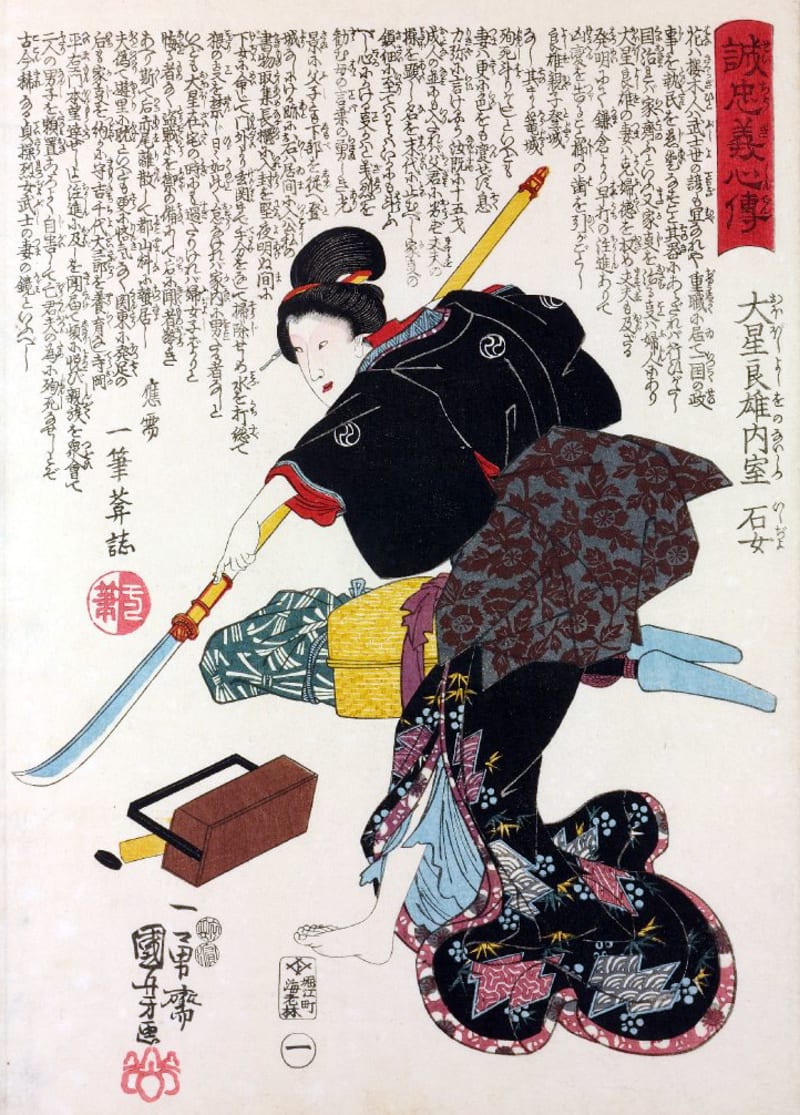
Edo period (1603–1868): The Naginata became the weapon of the samurai woman. All women of samurai class learned Naginatajutsu to defend castle and home while husbands were at war. The weapon became a status symbol — carried in wedding processions. Schools like Tendo-ryu specialized explicitly in teaching women. The Naginata was also the weapon through which women of the samurai class expressed Yamato Nadeshiko — the ideal of the gentle but inwardly strong Japanese woman.
Meiji era (1868–1912): Naginatajutsu was introduced as compulsory training in girls’ schools, elevated to the national female martial art.
Technical Foundations
The Naginata has a wooden shaft (Je) of 150–240 cm and a blade (Ha) of 30–60 cm, with a metal cap (Ishizuki) at the lower end for counter-striking.
| Technique Type | Term | Description |
|---|---|---|
| Cut | Kiri | Circular cuts with the blade |
| Thrust | Tsuki | Direct thrust with the blade tip |
| Strike | Uchi | With shaft or blade flat |
| Deflect | Uke | Deflecting incoming attacks |
| Leg techniques | Sune-Waza | Low attacks against legs and knees |
Movement principle: Naginata techniques are based on large, circular movements requiring balance and centered body use. Power comes through rotation of the entire body, not arm muscles alone. The long shaft allows distance control unavailable to a sword.
Core Techniques
Basic stances: Jodan (high) · Chudan (middle) · Gedan (low) · Hasso (diagonal)
Standard techniques:
- Men-Uchi — cut to the head
- Do-Uchi — cut to the torso / armor
- Sune-Giri — cut to the shins (classical horse-fighting technique)
- Tsuki — direct thrust with the blade tip
- Kaeshi-Waza — counter techniques after deflection
- Ishizuki-Waza — attacks with the lower metal cap of the shaft
Philosophy
Naginatajutsu carries the ethical principles of Budo — it is not merely weapon technique but character cultivation. Particularly in the Edo-era women’s practice, it was taught as an expression of Yamato Nadeshiko (大和撫子) — the ideal of the gentle but inwardly resolute Japanese woman.
In Koryu schools, Naginatajutsu is understood as a complete combat system uniting mind, technique, and ethics. The stillness within the great circular movement is simultaneously meditation.
“The Naginata needs no strength. It needs balance, circular movement, and a quiet mind.” — Tendo-ryu teaching tradition
Styles and Schools
| School | Founded | Founder | Distinctive Feature |
|---|---|---|---|
| Tendo-ryu | 1582 | Saito Denkibo Katsuhide | Oldest living Naginatajutsu school |
| Jikishinkage-ryu | 1860s | Satake Kanryūsai & Shigeo | Developed from sword tradition |
| Tenshin Shoden Katori Shinto-ryu | ~1447 | Iizasa Ienao | Oldest comprehensive school (includes Naginata) |
| Araki-ryu | Edo period | — | Comprehensive Koryu system with Naginata |
Connections to Other Martial Arts
- Kenjutsu — sister discipline; many Koryu schools (e.g. Tenshin Shoden Katori Shinto-ryu) taught both as an integrated system
- Sōjutsu (spear fighting) — comparable polearm tradition; Naginata and Yari complemented each other on the battlefield
- Jujutsu — unarmed combat was part of many Naginata schools for situations when the weapon was lost
- Modern Naginata — sport form developed from the Koryu tradition, now organized globally
Today
Modern Naginata (without the -jutsu suffix) is an active sport with global reach — in Japan with over 100,000 practitioners. The All Japan Naginata Federation regulates competitions and grade examinations under AJNF rules.
Traditional Koryu schools such as Tendo-ryu and Jikishinkage-ryu continue to preserve the original combat forms. Access is traditionally regulated by personal invitation; many schools are oriented explicitly toward women.
The gender ratio in Japan remains extraordinary: approximately 95% of modern Naginata practitioners are women — a globally unique phenomenon in a weapon art.
Criticism: The sport version of Naginata is increasingly diverging from the original combat techniques. Traditional masters lament the loss of “old forms” (Furyu-no-Kata). The debate between sport and martial art orientation is particularly acute in the Naginata world.