Shurikenjutsu — The Art of Throwing Blades
Shurikenjutsu is the Japanese art of throwing blades — not primarily to kill, but to distract, delay, and open defenses at critical moments of combat.
Lineage
Contents
Shurikenjutsu (手裏剣術, “art of hand-inside blades”) is the Japanese martial art of throwing small blades and metal spikes — a supplementary discipline within the comprehensive Samurai systems, alongside kenjutsu, sōjutsu and bōjutsu. The familiar attribution to ninjutsu came later than the art itself — the ninjutsu article sets that out. The popular name “ninja star” is a Western oversimplification: Shurikens came in many forms, and only one of them was star-shaped. The fundamental principle: Shurikens rarely served as direct killing weapons. Their primary function was distraction — briefly disturbing an opponent, slowing down a pursuer, creating an opening in the enemy’s attack. A well-thrown Shuriken need not hit lethally — it need only interrupt the rhythm of combat. This tactic was of extraordinary value in feudal Japan, where a moment of distraction could mean life or death.
History
Shurikens arose as practical tools in the Sengoku era (1467–1615) — a time of constant warfare when fighters had to exploit every possible tactical surprise. Small, easily concealed metal spikes and blades were ideal for operatives working in the shadows.
Japan’s first historically documented Shurikenjutsu school was Ganritsu Ryu (~1625), founded by Matsubayashi Henyasai Nagayoshi. This school integrated Shurikenjutsu as a supplement to Kenjutsu and Jujutsu — not as an independent main art.
Significant schools that taught Shurikenjutsu:
- Tenshin Shoden Katori Shinto-ryu — oldest Japanese martial arts school, Shuriken in curriculum
- Togakure-ryu — most significant Ninjutsu school, Shuriken as standard equipment
- Kashima Shinryu — classical sword school with Shurikenjutsu elements
In the Meiji era (1868–1912), many secret martial arts were made public. Masters like Naruse Kanji (1888–1948), Fujita Seiko (1899–1966), and Saito Satoshi (1922–2014) taught and documented Shurikenjutsu — preserving it from oblivion.
Types of Shuriken
Shurikens are divided into two main categories:
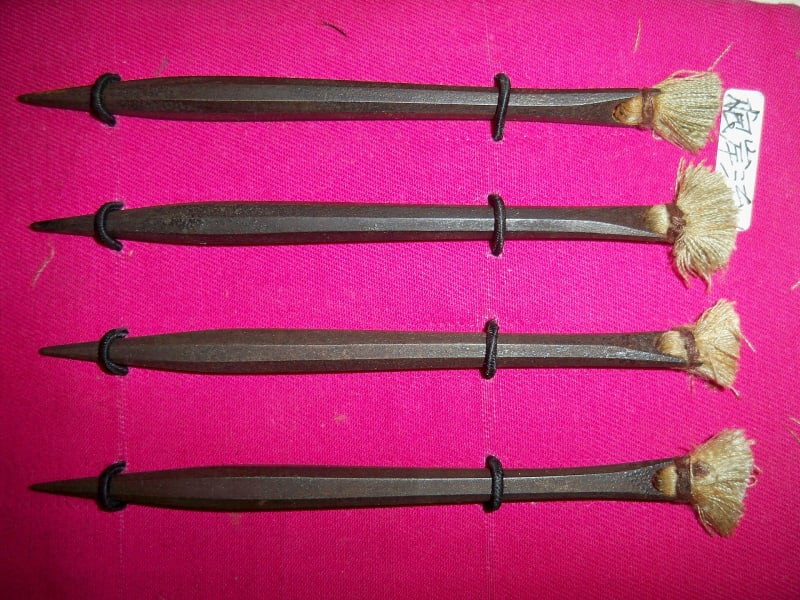
Bo-Shuriken (Rod Shuriken)
Long, thin metal spikes — pointed at one or both ends. They look inconspicuous and can be hidden in a sword scabbard, a sleeve, or the hair.
Throwing methods of Bo-Shuriken:
- Jiki Da-ho (direct hit): the Shuriken does not spin, hits straight on
- Han-Ten Da-ho (turning hit): controlled rotation, requires precise knowledge of distance
Hira-Shuriken (Flat Shuriken)
The star-shaped or disc-shaped variants — what is popularly known as the “ninja star.”
| Type | Form | Distinctive Feature |
|---|---|---|
| Shaken | 4–8 points | Rotating flight, more stable |
| Juji-Shuriken | Cross shape | Easy to produce |
| Kuruma-Shuriken | Wheel shape | Very aerodynamic |
| Happo-Shuriken | 8 points | Highest hitting accuracy |
Core Techniques
Grip and release: The correct throw is the key — a Shuriken thrown incorrectly spins uncontrolled and does not hit with the point.
Distance sense: Every Shuriken type has a specific spin distance — at which the end arrives at the target tip-first. Developing this feel requires thousands of repetitions.
Tactical integration: Shurikenjutsu is rarely used alone. Classic combination: throw Shuriken → opponent reacts/protects → enter with sword or staff.
Poisons: Some historical sources describe rubbing Shurikens with toxins — for more lethal effect even on non-vital hits.
Philosophy
Shurikenjutsu embodies the Ninja principle of strategic minimum: the smallest means with the greatest tactical effect. A handful of small metal spikes that an opponent does not expect can reverse a seemingly hopeless situation.
“The Shuriken rarely kills. But it creates the moment in which you kill.” — Shurikenjutsu tradition
Connections to Other Martial Arts
- Ninjutsu — Shurikenjutsu is one of the 18 classical Ninjutsu disciplines; inseparably connected with the Shinobi tradition
- Kenjutsu — many Kenjutsu schools taught Shurikenjutsu as tactical supplement
- Tessenjutsu — both are “concealed weapon” systems for situations where the sword is not at hand
Today
Shurikenjutsu is taught today primarily in the Bujinkan (Masaaki Hatsumi’s Ninjutsu organization) and other Ninjutsu schools. Competition-oriented Shuriken throwing exists in small circles in Japan.
The art has been influenced by modern sport shooting — precision competitions test distance and hitting accuracy. The tactical understanding, however — when and how to deploy Shurikens in combat — remains the core knowledge of the traditional school.