Silambam — The Tamil Staff Martial Art
Silambam is the Dravidian staff martial art of Tamil Nadu — over 2000 years old, documented in Sangam literature, unique in its fusion of rhythmic movement and lethal effectiveness.
Lineage
Derived
Contents
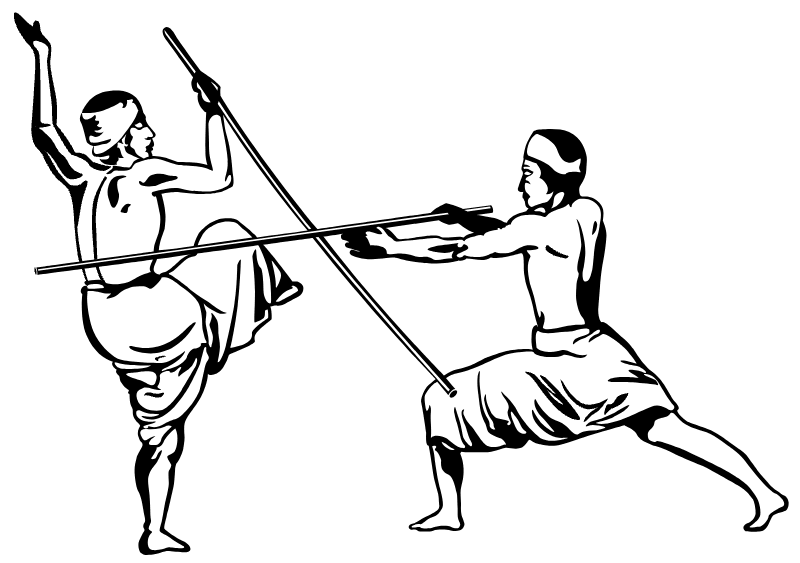
Silambam (சிலம்பம்) is the traditional staff martial art of the Tamils — one of the oldest documented martial arts in India. The name derives from the Tamil word Silam (hill): the Silambam staff was crafted from the specific Kurinjimala bamboo (mountain bamboo from the Kurinji hills in Kerala) — and gave the art its name. Silambam is unique among weapon arts of the world: it combines the destructiveness of a weapon art with the aesthetics of dance — Silambam movements are rhythmic, circular, and flowing, almost choreographic. This quality made Silambam an integral component of Tamil cultural festivals and temple ceremonies, where it is performed alongside classical dance. The Sangam literature (4th century BCE–3rd century CE) — the oldest Tamil literature — describes Silambam as an important warrior skill; the epic Silappadikaram contains detailed descriptions of the technique. Under the Chola, Chera, and Pandya dynasties, Silambam was mandatory training for the warrior caste.
History
Mythological Dimension
Silambam is said to have been taught by Murugan (Kartikeya) — the Tamil-Hindu war god — on the sacred mountain of Palani. This mythological origin anchors Silambam in the core of the Dravidian spiritual tradition.
The sage Agastya Muni reportedly received the art from Murugan and transmitted it to humanity. This tradition is culturally significant: it makes Silambam not only war technique but spiritual heritage.
Sangam Era (4th century BCE–3rd century CE)
The Sangam literature — the oldest Tamil poetic tradition — contains numerous references to Silambam masters and staff fights. The epic Silappadikaram describes the technique and the art’s significance in detail.
Under the three Tamil dynasties — Chera, Chola, and Pandya — Silambam was a central part of warrior training. Merchants and travelers carried Silambam staves as protective weapons.
Colonial Period and Suppression
Like many Indian martial arts, Silambam was restricted under British colonial rule — weapons laws made public training difficult. The art survived in family transmissions and in the context of religious festivals.
20th century: Revival through martial arts organizations in Tamil Nadu. Today Silambam is part of the official school curriculum in some Tamil districts.
The Silambam Staff
Kurinjimala bamboo — 1.5–2 meter bamboo staff, light and robust. Modern staves are also made from rattan.
The staff is used in different lengths for different technique levels:
- Shorter — for faster striking combinations
- Longer — for range and rotation techniques
Core Techniques
Kurinji — circular rotation techniques: the staff is led in continuous circles around the body — blockade and attack in one flowing movement.
Kuttu — strike combinations emerging from circular movement.
Sweep techniques — leg techniques to bring the opponent to the ground.
Kuttu Varisai — Silambam’s unarmed component: when the staff is unavailable, Kuttu Varisai enables transition to body combat.
Philosophy
Silambam joins two seemingly contradictory qualities: the dance-like aesthetics and the combat effectiveness. This duality is no contradiction — it is the essence of Dravidian martial philosophy.
Kalaripayattu (the other great South Indian combat system) and Silambam share this philosophy: the body as instrument of expression — in dance and combat equally.
“When the staff speaks, it is war. When it sings, it is peace. In Silambam, it does both simultaneously.” — Tamil tradition
Connections to Other Martial Arts
- Bōjutsu — Japanese parallel; both staff martial arts have surprisingly similar fundamental movements (rotations, thrusts, blocks) despite independent development
- Escrima/Arnis — Southeast Asian staff system; all three cultures developed staff combat systems based on rotational force and reach
- Kalaripayattu — other great South Indian martial art; Silambam and Kalaripayattu were often taught together and complement each other
Today
Silambam is experiencing a renaissance in Tamil Nadu — particularly in Chennai and Madurai. Competitions are organized at national level. The Tamil Nadu Silambam Association coordinates teaching and competition. Interest grows internationally through the Tamil diaspora.
Related Articles
- Bōjutsu
- Escrima / Arnis / Kali
- Sōjutsu
- Stick Fighting in Eight Systems — two metres of bamboo next to seven other answers
- Jogo do Pau — the European long staff that likewise stands in for nothing
- Thang-Ta — the weapon art of Manipur, whose competition stick is justified differently